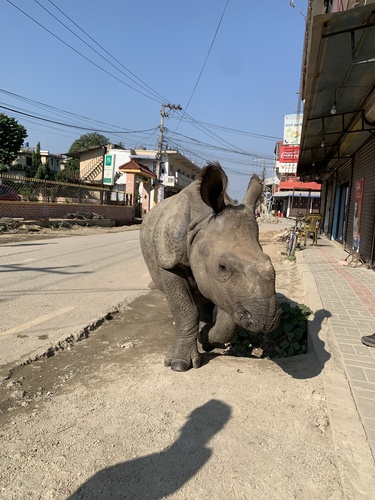
The Indian rhinoceros, also known as the greater one-horned rhinoceros, great Indian rhinoceros or Indian rhino, is a rhinoceros species native to the Indian subcontinent. It is the second largest living rhinoceros and the largest in Asia, with adult males weighing 2.07–2.2 t and adult females 1.6 t. Its thick skin is grey-brown with pinkish skin folds. It has a single horn on its snout that grows up to 57.2 cm (22.5 in) long. Its upper legs and shoulders are covered in wart-like bumps, and it is nearly hairless aside from the eyelashes, ear fringes and tail brush.
🛡️ Conservation Status
vulnerable
vu
📌 Taxonomy
Rhinoceros unicornis was the scientific name used by Carl Linnaeus in 1758 who described a rhinoceros with one horn. As type locality, he indicated Africa and India. He described two species in India, the other being Rhinoceros bicornis, and stated that the Indian species had two horns, while the African species had only one.
The Indian rhinoceros is a single species. Several specimens were described since the end of the 18th century under different scientific names, which are all considered synonyms of Rhinoceros unicornis today:
* R. indicus by Cuvier, 1817
* R. asiaticus by Blumenbach, 1830
* R. stenocephalus by Gray, 1867
* R. jamrachi by Sclater, 1876
* R. bengalensis by Kourist, 1970
📌 Etymology
The generic name rhinoceros is derived through Latin from the , which is composed of (rhino-, "of the nose") and (keras, "horn") with a horn on the nose. The name has been in use since the 14th century. The Latin word ūnicornis means "one-horned".
📌 Evolution
Ancestral rhinoceroses first diverged from other perissodactyls in the Early Eocene. Mitochondrial DNA comparison suggests the ancestors of modern rhinos split from the ancestors of Equidae around 50 million years ago. The extant family, the Rhinocerotidae, first appeared in the Late Eocene in Eurasia, and the ancestors of the extant rhino species dispersed from Asia beginning in the Miocene. The last common ancestor of living rhinoceroses belonging to the subfamily Rhinocerotinae is suggested to have lived around 16 million years ago, with the ancestors of the genus Rhinoceros diverging from the ancestors of other living rhinoceroses around 15 million years ago. The genus Rhinoceros has been found to be overall slightly more closely related to the Sumatran rhinoceros (as well as to the extinct woolly rhinoceros and the extinct Eurasian genus Stephanorhinus) than to living African rhinoceroses, though there appears to have been gene flow between the ancestors of living African rhinoceroses and the genus Rhinoceros, as well as between the ancestors of the genus Rhinoceros and the ancestors of the woolly rhinoceros and Stephanorhinus.
Elasmotherium sibiricum
|label2=Rhinocerotinae
|2=
|2= Woolly rhinoceros (Coelodonta antiquitatis)
|2= Merck's rhinoceros (Stephanorhinus kirchbergensis)
}}
|2=Sumatran rhinoceros (Dicerorhinus sumatrensis)
}}
|label2=
|2=
}}
}}
}}|style=font-size:100%;line-height:80%}}The earliest fossils of the genus Rhinoceros date to the Late Miocene, around 8–9 million years ago. The divergence between the Indian and Javan rhinoceros is estimated to have occurred around 4.3 million years ago. They also appear to have ranged as far south as Tamil Nadu in India, based on subfossil remains as recent as the Neolithic. A Late Pleistocene-aged partial fossil skeleton of R. unicornis was described from Kanchanaburi, Thailand in 2018.
Several fossil Rhinoceros species from South Asia, such as R. palaeindicus & R. sivalensis (from the Late Pliocene or early Pleistocene of Nahan), R. deccanensis (from the Pleistocene of Karnataka) and R. namadicus (from the Pleistocene of Madhya Pradesh) are potentially synonymous with R. unicornis.
📌 Characteristics
Indian rhinos have a thick grey-brown skin with pinkish skin folds and one horn on their snout. Their upper legs and shoulders are covered in wart-like bumps. They have very little body hair, aside from eyelashes, ear fringes and tail brush. Bulls have huge neck folds. The skull is heavy with a basal length above and an occiput above . The nasal horn is slightly back-curved with a base of about by that rapidly narrows until a smooth, even stem part begins about above base. In captive animals, the horn is frequently worn down to a thick knob. The Indian rhino's single horn is present in both bulls and cows, but not on newborn calves. The horn is pure keratin, like human fingernails, and starts to show after about six years. In most adults, the horn reaches a length of about , but has been recorded up to in length and in weight. They are also the second-largest living rhinoceros, behind only the white rhinoceros. Bulls have a head and body length of with a shoulder height of , while cows have a head and body length of and a shoulder height of . The thick skin does not protect against bloodsucking Tabanus flies, leeches and ticks.
📌 Distribution and habitat
Indian rhinos once ranged across the entire northern part of the Indian subcontinent, along the Indus, Ganges and Brahmaputra River basins, from Pakistan to the Indian-Myanmar border, including Bangladesh and the southern parts of Nepal and Bhutan. They may have also occurred in Myanmar, southern China and Indochina. They inhabit the alluvial grasslands of the Terai and the Brahmaputra basin. As a result of habitat destruction and climatic changes its range has gradually been reduced so that by the 19th century, it only survived in the Terai grasslands of southern Nepal, northern Uttar Pradesh, northern Bihar, northern West Bengal, and in the Brahmaputra Valley of Assam. During the Late Pleistocene, its range extended into Thailand, Vietnam and Laos, and remains of rhinoceroses found in the Pleistocene of Southern China, otherwise assigned to the species "Rhinoceros sinensis", may actually represent the Indian rhinoceros.
The species was present in northern Bihar and Oudh at least until 1770 as indicated in maps produced by Colonel Gentil. On the former abundance of the species, Thomas C. Jerdon wrote in 1867:
Today, its range has further shrunk to a few pockets in southern Nepal, northern West Bengal, and the Brahmaputra Valley. Its habitat is surrounded by human-dominated landscapes, so that in many areas, it occurs in cultivated areas, pastures, and secondary forests. In the 1980s, Indian rhinos were frequently seen in the narrow plain area of Manas River and Royal Manas National Park in Bhutan.
📌 Populations
In 2022, the total Indian rhinoceros population was estimated to be 4,014 individuals, up from 2,577 in 2006. Among them, 3,262 are in India and the remaining 752 are in Nepal and Bhutan. There is no permanent rhino population in Bhutan, but small rhino populations are occasionally known to cross from the Manas National Park or Buxa Tiger Reserve in India.
In India, there are around 2,885 individuals in Assam, including 2,613 in Kaziranga National Park, 125 in Orang National Park, 107 in Pobitora Wildlife Sanctuary and 40 in Manas National Park. West Bengal has a population of 339 individuals, including 287 in Jaldapara National Park and 52 in Gorumara National Park. Only 38 individuals are found in Dudhwa National Park, in Uttar Pradesh.
, Assam]]
By 2014, the population in Assam increased to 2,544 Indian rhinos, an increase of 27% since 2006, although more than 150 individuals were killed by poachers during these years.
The population in Kaziranga National Park was estimated at 2,048 individuals in 2009. By 2009, the population in Pobitora Wildlife Sanctuary had increased to 84 individuals in an area of .
In 2015, Nepal had 645 Indian rhinos living in Parsa National Park, Chitwan National Park, Bardia National Park, Shuklaphanta Wildlife Reserve and respective buffer zones in the Terai Arc Landscape as recorded in a survey conducted from 11 April to 2 May 2015. The survey showed that the population of rhinos in Nepal from 2011 to 2015 increased 21% or 111 individuals.
, Nepal]]
The Indian rhino population, which once numbered as low as 100 individuals in the early 1900s, has increased to more than 3,700 in the year 2021 as per The International Rhino Foundation. According to a population census conducted in late March 2025, the estimated population is 4,075, with 3,323 in India and 752 in Nepal.
📌 Ecology and behaviour
Bulls are usually solitary. Groups consist of cows with calves, or of up to six subadults. Such groups congregate at wallows and grazing areas. They are foremost active in early mornings, late afternoons and at night, but rest during hot days.
Indian rhinos have few natural enemies, except for tigers, which sometimes kill unguarded calves, but adult rhinos are less vulnerable due to their size. Mynahs and egrets both eat invertebrates from the rhino's skin and around its feet. Tabanus flies, a type of horse-fly, are known to bite rhinos. The rhinos are also vulnerable to diseases spread by parasites such as leeches, ticks, nematodes
Anthrax and the blood-disease sepsis are known to occur. Such cases are rare, as Indian rhinoceroses are not vulnerable to predation.
📌 Social life
Indian rhinos form a variety of social groupings. Bulls are generally solitary, except for mating and fighting. Cows are largely solitary when they are without calves. Mothers will stay close to their calves for up to four years after their birth, sometimes allowing an older calf to continue to accompany her once a newborn calf arrives. Subadult bulls and cows form consistent groupings, as well. Groups of two or three young bulls often form on the edge of the home ranges of dominant bulls, presumably for protection in numbers. Young cows are slightly less social than the bulls. Indian rhinos also form short-term groupings, particularly at forest wallows during the monsoon season and in grasslands during March and April. Groups of up to 10 rhinos, typically a dominant male with females and calves, gather in wallows.
Indian rhinos make a wide variety of vocalisations. At least 10 distinct vocalisations have been identified: snorting, honking, bleating, roaring, squeak-panting, moo-grunting, shrieking, groaning, rumbling and humphing. In addition to noises, the Indian rhino uses olfactory communication. Adult bulls urinate backwards, as far as behind them, often in response to being disturbed by observers. Like all rhinos, the Indian rhinoceros often defecates near other large dung piles. The Indian rhino has pedal scent glands which are used to mark their presence at these rhino latrines. Bulls have been observed walking with their heads to the ground as if sniffing, presumably following the scent of cows.
In aggregations, Indian rhinos are often friendly. They will often greet each other by waving or bobbing their heads, mounting flanks, nuzzling noses, or licking. Indian rhinos will playfully spar, run around, and play with twigs in their mouths. Adult bulls are the primary instigators in fights. Fights between dominant bulls are the most common cause of rhino mortality, and bulls are also very aggressive toward cows during courtship. Bulls chase cows over long distances and even attack them face-to-face. Indian rhinos use their horns for fighting, albeit less frequently than African rhinos, largely using the incisors of the lower jaw to inflict wounds.
📌 Reproduction
Captive bulls breed at five years of age, but wild bulls attain dominance much later when they are larger. In one five-year field study, only one Indian rhino estimated to be younger than 15 years mated successfully. Captive cows breed as young as four years of age, but in the wild, they usually start breeding only when six years old, which likely indicates they need to be large enough to avoid being killed by aggressive bulls. Their gestation period is around 15.7 months, and birth interval ranges from 34 to 51 months. In captivity, four Indian rhinos lived over 40 years, the oldest living to be 47.
📌 Threats
Habitat degradation caused by human activities and climate change as well as the resulting increase in the floods has caused many Indian rhino deaths and has limited their ranging areas which is shrinking.
Serious declines in quality of habitat have occurred in some areas, due to severe invasion by alien plants into grasslands affecting some populations, and demonstrated reductions in the extent of grasslands and wetland habitats due to woodland encroachment and silting up of beels (swampy wetlands). Grazing by domestic livestock is another cause.
The Indian rhino species is inherently at risk because over 70% of its population occurs at a single site, Kaziranga National Park. Any catastrophic event such as disease, civil disorder, poaching, or habitat loss would have a devastating impact on the Indian rhino's status. Additionally, a small population of rhinos may be prone to inbreeding depression.
📌 Poaching
]]
Sport hunting became common in the late 19th and early 20th centuries and was the main cause for the decline of Indian rhinoceros populations. Indian rhinos were hunted relentlessly and persistently. Reports from the mid-19th century claim that some British military officers shot more than 200 rhinos in Assam alone. By 1908, the population in Kaziranga National Park had decreased to around 12 individuals. By the mid-1990s, the Indian rhinoceros had been extirpated in this sanctuary. Almost 100 rhinos were poached in India between 2013 and 2018.
📌 Conservation
The Indian rhinoceros is listed as vulnerable by the IUCN Red list, as of 2018. After his subsequent survey of Chitwan in 1963, he recommended extension of the sanctuary to the south. By the end of the 1960s, only 95 rhinos remained in the Chitwan Valley. The dramatic decline of the rhino population and the extent of poaching prompted the government to institute the Gaida Gasti – a rhino reconnaissance patrol of 130 armed men and a network of guard posts all over Chitwan. To prevent the extinction of rhinos, the Chitwan National Park was gazetted in December 1970, with borders delineated the following year and established in 1973, initially encompassing an area of . To ensure the survival of rhinos in case of epidemics, animals were translocated annually from Chitwan to Bardia National Park and Shuklaphanta National Park since 1986.
📌 Reintroduction to new areas
Indian rhinos have been reintroduced to areas where they had previously inhabited but became extinct. These efforts have produced mixed results, mainly due to lack of proper planning and management, sustained effort, and adequate security for the introduced animals.
In 1984, five Indian rhinos were relocated to Dudhwa National Park—four from the fields outside the Pobitora Wildlife Sanctuary and one from Goalpara.
Indian rhinos were once found as far west as the Peshawar Valley during the reign of Mughal Emperor Babur, but are now extinct in Pakistan. After rhinos became "regionally extinct" in Pakistan, two rhinos from Nepal were introduced in 1983 to Lal Suhanra National Park, which have not bred so far.
📌 In captivity
]]
Indian rhinoceroses were initially difficult to breed in captivity. In the second half of the 20th century, zoos became adept at breeding Indian rhinoceros. By 1983, nearly 40 babies had been born in captivity. meaning that most captive animals are related to the Basel population. Due to the success of Zoo Basel's breeding program, the International Studbook for the species has been kept there since 1972. Since 1990, the Indian rhino European Endangered Species Programme is also being coordinated there, with the goal of maintaining genetic diversity in the global captive Indian rhinoceros population.
]]
The first recorded captive birth of an Indian rhinoceros was in Kathmandu in 1826, but another successful birth did not occur for nearly 100 years. In 1925, a rhino was born in Kolkata. No rhinoceros was successfully bred in Europe until 1956 when first European breeding took place when baby rhino Rudra was born in Zoo Basel on 14 September 1956. In June 2014, the first "successful" live-birth from an artificially inseminated rhino took place at the Buffalo Zoo in New York. As in Cincinnati, cryopreserved sperm was used to produce the female calf, Monica.
📌 Cultural significance
The Indian rhinoceros is one of the motifs on the Pashupati seal and many terracotta figurines that were excavated at archaeological sites of the Indus Valley Civilisation.
The Rhinoceros Sutra is an early text in the Buddhist tradition and is part of the Gandhāran Buddhist texts and the Pali Canon; a version was also incorporated into the Sanskrit Mahavastu. It praises the solitary lifestyle and stoicism of the Indian rhinoceros and is associated with the eremitic lifestyle symbolized by the Pratyekabuddha.
📌 Europe
1790) |direction=vertical |total_width=200}}
In the 3rd century, Philip the Arab exhibited an Indian rhinoceros in Rome. In 1515, Manuel I of Portugal obtained an Indian rhinoceros as a gift, which he passed on to Pope Leo X, but which died in a shipwreck off the coast of Italy in early 1516, on the way from Lisbon to Rome. Three artistic representations were prepared of this rhinoceros: A woodcut by Hans Burgkmair, a drawing and a woodcut called Dürer's Rhinoceros by Albrecht Dürer, all dated 1515.
in Venice, by Pietro Longhi, 1751.]]
In 1741–1758, Clara the rhinoceros (c. 1738 – 14 April 1758) was a female Indian rhinoceros who became famous during 17 years of touring Europe in the mid-18th century. She arrived in Europe in Rotterdam in 1741, becoming the fifth living rhinoceros to be seen in Europe in modern times since Dürer's rhinoceros in 1515. After tours through towns in the Dutch Republic, the Holy Roman Empire, Switzerland, the Polish–Lithuanian Commonwealth, France, the Kingdom of the Two Sicilies, the Papal States, Bohemia and Denmark, she died in Lambeth, England. In 1739, she was drawn and engraved by two English artists. She was then brought to Amsterdam, where Jan Wandelaar made two engravings that were published in 1747. In the subsequent years, the rhinoceros was exhibited in several European cities. In 1748, Johann Elias Ridinger made an etching of her in Augsburg, and Petrus Camper modelled her in clay in Leiden. In 1749, Georges-Louis Leclerc, Comte de Buffon drew it in Paris. In 1751, Pietro Longhi painted her in Venice.