🛡️ Conservation Status
vulnerable
vu
📌 Taxonomy
It is one of two extant and one probably extinct species of the South American macaw genus Anodorhynchus.
English physician, ornithologist, and artist John Latham first described the hyacinth macaw in 1790 under the binomial name Psittacus hyacinthinus. Tony Pittman in 2000 hypothesized that although the illustration in this work appears to be of an actual hyacinthine macaw, Latham's description of the length of the bird might mean he had measured a specimen of Lear's macaw instead. However, Latham's description was based on a taxidermic specimen, which was the only one Latham knew to exist up until 1822. It was prepared from a living animal originally belonging to Lord Orford, and given to the land agent Parkinson for display in the Leverian Museum after it died.
Nonetheless, Latham mentions another bird, which he calls the 'blue macaw', supposedly the same size. and was previously figured in the work of Mathurin Jacques Brisson (1760), Patrick Browne (1756) and Eleazar Albin (1738) as a macaw found in Jamaica. Albin, Browne and Brisson all reference even older authors and state the bird also occurs on the mainland, and Albin states this bird is the female version of the scarlet macaw. Latham mentions that the provenance of parrots in general was often confused by the fact that the birds were much traded across the world for the purposes of sale.
📌 Ecology
The hyacinth macaw mostly nests in Manduvi trees, which rely on the toco toucan for 83% of the tree's distribution of seeds. The toco toucan also feeds on 53% of the hyacinth macaw's offspring as eggs. Eggs are also regularly preyed on by corvids such as jays and crows, opossums,
📌 Behaviour
compromise a large part of the hyacinth macaw's diet]]
📌 Tool use
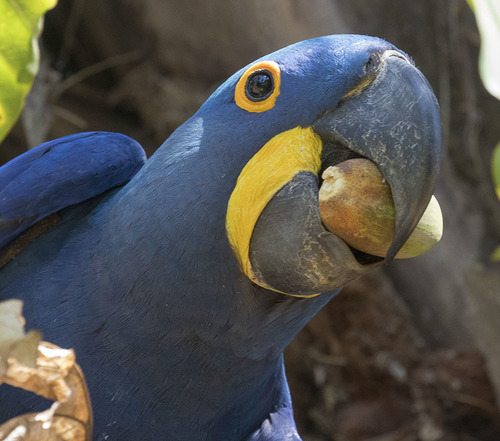
Limited tool use has been observed in both wild and captive hyacinth macaws. Reported sightings of tool use in wild parrots go as far back as 1863. Examples of tool use that have been observed usually involve a chewed leaf or pieces of wood. Macaws often incorporate these items when feeding on harder nuts. Their use allows the nuts the macaws eat to remain in position (prevent slipping) while they gnaw into it. It is not known whether this is learned social behavior or an innate trait, but observation on captive macaws shows that hand-raised macaws exhibit this behavior, as well. Comparisons showed that older macaws were able to open seeds more efficiently.
📌 Reproduction
Nesting takes place between July and December, with nests constructed in tree cavities or cliff faces depending on the habitat. However, the toucan is responsible for dispersing 83% of the seeds of Sterculia apetala, but also consumes 53% of eggs preyed. The clutch size is one or two eggs, The incubation period lasts about a month, and the male tends to his mate whilst she incubates the eggs. The chicks leave the nest, or fledge, around 110 days of age, and remain dependent on their parents until six months of age. They are mature and begin breeding at seven years of age.
📌 Distribution and habitat
, Brazil]]
The hyacinth macaw occurs today in three main areas in South America: In the Pantanal region of Brazil, and adjacent eastern Bolivia and northeastern Paraguay, in the cerrado regions of the eastern interior of Brazil (Maranhão, Piauí, Bahia, Tocantins, Goiás, Mato Grosso, Mato Grosso do Sul, and Minas Gerais), and in the relatively open areas associated with the Tocantins River, Xingu River, Tapajós River, and the Marajó island in the eastern Amazon Basin of Brazil. Smaller, fragmented populations may occur in other areas.
Over the last few decades the known range in Bolivia has grown. It is well known from the far southeast of the country near the tri-national border point with Brazil and Paraguay, where it is considered an emblematic symbol of the region, and locals often feed the macaws maize, like chickens. Censuses conducted in 2008, 2009, 2011 revealed stable population numbers: respectively 231, 107, 134,
It prefers semi-open, somewhat wooded habitats. It usually avoids dense, humid forest, and in regions dominated by such habitats, it is generally restricted to the edge or relatively open sections (e.g. along major rivers). In different areas of their range, these parrots are found in savannah grasslands, in dry thorn forests known as caatinga, and in palm stands or swamps,
A 2014 Bolivian study in San Matías Integrated Management Natural Area which correlated sightings to habitat found that areas including seasonally inundated savannas, wetlands and anthropogenic areas habitats interspersed with a mosaic of savannas, were the best indicators for the presence of the macaws. The most preferred habitat by far was anthropogenic, which is primarily cattle ranches practising extensive grazing in this area. The authors, however, were not very impressed by these results, and cautioned that the methodology might be flawed.
📌 Conservation and threats
, France]]
The conservation status of the hyacinth macaw is assessed as vulnerable.
The hyacinth macaw is protected by law in Brazil and Bolivia,
On 3 July 2025, the hyacinth macaw was recognized as the symbolic bird of Mato Grosso do Sul after the approval of Law No. 6.442. According to the Hyacinth Macaw Project, this new recognition can help preserve the species and boost local tourism.
📌 Threats
, Czech Republic]]
Throughout the macaw's range, habitat is being lost or altered due to the introduction of cattle ranching and mechanised agriculture, and the development of hydroelectric schemes.
Parrots, as a whole, being of the family Psittacidae, are some of the most threatened birds in the world. This family has the most endangered species of all bird families, especially in the neotropics, the natural home of the hyacinth macaw, where 46 of 145 species are at a serious risk of global extinction. This species qualifies as 'Vulnerable' on the IUCN Red List because the population has suffered rapid reductions with the remaining threats of illegal trapping for the cage bird trade and habitat loss A few serious threats to the survival of the species in the Pantanal include human activities, mainly those resulting in habitat loss, the burning of land for pasture maintenance, and illegal trapping The exceptionally noisy, fearless, curious, sedentary, and predictable nature of this species, along with its specialization to only one or two species of palm in each part of its range, makes them especially vulnerable to capture, shooting, and habitat destruction. Because this species exclusively relies on the fruit produced by two palm species, if these species were to suffer due to disease or habitat destruction, it would put the parrot species at risk. This species specifically requires previously occupied holes within the Manduvi trees in order to nest, so nesting availability can be sparse. Furthermore, old growth of these trees, the youngest being 60 years, is required for the species to produce large enough holes to nest. This limits future potential for reproduction if these trees are destroyed or competition with other species for space is increased.
In the Pantanal, habitat loss is largely contributed to the creations of pastures for cattle, while in many other regions, it is the result of clearing land for colonization. Similarly, large areas of habitat in Amazonia have been lost for cattle ranching and hydroelectric power schemes on the Tocantins and Xingu Rivers. Many young manduvi trees are then being grazed on by cattle or burnt by fire, and the Gerias is speedily being converted to land for mechanized agriculture, cattle ranching, and exotic tree plantations. While many trackers have been arrested, the illegal pet trade still largely continues in Santa Cruz, Bolivia. Unfortunately, animal trafficking is not necessarily viewed as a priority in the city, leaving national departmental and municipal governments unwilling to halt the trade in city centers, and local police reluctant to get involved. This ideology has in turn resulted in a lack of enforcement regarding trade in both CITES-restricted species and threatened species, with little to no restrictions regarding humane treatment of the animals, disease control, or proper hygiene. In the trade centers, the hyacinth macaw demanded the highest price of US$1,000, proving it to be a very desirable and valued bird in the pet trade industry.
📌 Conservation efforts
In 1989, the European Endangered Species Programme for the hyacinth macaw was founded as a result of concerns about the status of the wild population and the lack of successful breeding in captivity. The hyacinth macaw is protected by law in Brazil and Bolivia, and international trade is prohibited by its listing on Appendix I of the CITES. Appendix I has banned exporting the bird in all countries of origin, and several studies and conservational initiatives have been taken. The Hyacinth Macaw Project in the Caiman Ecological Refuge, located in the Pantanal, has employed artificial nests and chick management techniques, along with effectively raising awareness among cattle ranchers. Many ranch owners in the Pantanal and Gerais, to protect the birds, no longer allow trappers on their properties.
A number of conservation actions have been proposed, including the study of the current range, population status, and extent of trading in different parts of its range. Additionally, propositions have been made to assess the effectiveness of artificial nest boxes, enforce legal measures preventing trade, and experiment with ecotourism at one or two sites to encourage donors. Furthermore, the Hyacinth Macaw Project in Mato Grosso do Sul has carried out important research by ringing individual birds and has created a number of artificial nests to compensate for the small number of sites available in the region. Furthermore, proposals to list the species as Endangered under the US Endangered Species Act have been made to further protective measures in the US and to create Bolivian and Paraguayan trade management authorities under presidential control.
📌 Long-term prospects
Each of the three main populations should be managed as a separate biological entity so as to avoid numbers dropping below 500. While the birds may be in decline in the wild, notably higher populations of captive macaws are being held in zoos and private collections. If success in managing and replanting the macaw's food trees and erecting nest boxes as an experiment in the Pantanals is seen, the species could survive. Survival rates could also be enhanced if ranch owners would leave all large and potential nest trees standing and eliminate all trapping on their properties. Ultimately, should these factors work in tandem with the erection of nest boxes, the fencing off certain saplings, and the planting of others, the long-term prospects of the hyacinth macaw species would be greatly improved.
📌 As pets
The hyacinth macaw is sometimes kept as a companion parrot. Not recommended for novice bird-keepers, this bird requires large amounts of space, regular exercise and a custom-built stainless steel cage, as its powerful beak can easily destroy most commercially available parrot cages. In order to remain healthy, the species requires regular social interaction and play with humans or other birds. This large macaw, like most parrots, has a natural inclination to chew objects and due to its physical size and strength, can cause considerable damage. It is recommended that an entire room of the owner's home be set aside for use by the bird, which should be provided with plenty of safe, destroyable wooden and leather objects to keep it amused. It is also a very expensive pet: US$10,000 is not an uncommon price for a young hyacinth macaw. The World Parrot Trust recommends that the hyacinth macaw not be kept permanently indoors and that it should have access to an enclosure of at least 15 m (50 ft) for part of the year.
They are even-tempered and can be calmer than other macaws, being known as "gentle giants". It is not generally an aggressive bird and it appears to enjoy interacting playfully with humans. It can cause bite injuries simply by playfully "mouthing" its owner, however, and this behavior should be discouraged with training begun when the bird is young.
The hyacinth macaw can learn to talk, but it is not as gifted in that area as some other species. Nonetheless, it is an intelligent bird that may learn to use words and phrases in the correct context. It can live for over 50 years in captivity.