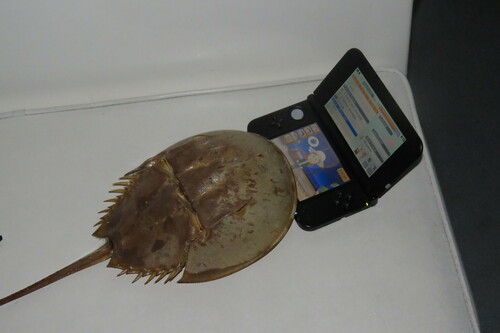
Horseshoe crabs are arthropods of the family Limulidae and the only surviving xiphosurans. Despite their name, they are not crabs or even crustaceans; they are chelicerates, more closely related to arachnids like spiders, ticks, and scorpions. The body of a horseshoe crab is divided into three main parts: the cephalothorax, abdomen, and telson. The largest of these, the cephalothorax, houses most of the animal's eyes, limbs, and internal organs. It is also where the animal gets its name, as its shape somewhat resembles that of a horseshoe. Horseshoe crabs have been described as "living fossils", having changed little since they first appeared in the Triassic around 250 million years ago, and similar-looking fossil xiphosurans extend back to the Ordovician around 445 million years ago.
π‘οΈ Conservation Status
vulnerable
vu
π Phylogeny and evolution
, a xiphosuran (early relative of horseshoe crabs) from the Ordovician, around 445 million years ago, which already bears a close resemblance to living horseshoe crabs]]
The fossil record of Xiphosura, the broader group that includes horseshoe crabs and their extinct relatives, extends back to the Early Ordovician, around 480 million years ago. Ordovician xiphosurans, such as Lunataspis, already bear a close resemblance to living horseshoe crabs. For modern horseshoe crabs, their earliest appearance was approximately 250 million years ago during the Early Triassic. Because they have seen little morphological change since then, extant (surviving) forms have been described as "living fossils".
Horseshoe crabs resemble crustaceans but belong to a separate subphylum of the arthropods, Chelicerata. Horseshoe crabs are closely related to the extinct eurypterids (sea scorpions), which include some of the largest arthropods ever to have existed, and the two may be sister groups. The difficult-to-classify chasmataspidids are also thought to be closely related to horseshoe crabs.
The radiation of horseshoe crabs resulted in 22 known species, of which only 4 remain. The Atlantic species is sister to the three Asian species, the latter of which are likely the result of two divergences relatively close in time. The last common ancestor of the four extant species is estimated to have lived about 135 million years ago in the Cretaceous.
Limulidae is the only extant family of the order Xiphosura, and contains all four living species of horseshoe crabs:
* Carcinoscorpius rotundicauda, the mangrove horseshoe crab, found in South and Southeast Asia
* Limulus polyphemus, the Atlantic or American horseshoe crab, found along the Atlantic coast of the United States and the Southeast Gulf of Mexico
* Tachypleus gigas, the Indo-Pacific, Indonesian, Indian, or southern horseshoe crab, found in South and Southeast Asia
* Tachypleus tridentatus, the Chinese, Japanese, or tri-spine horseshoe crab, found in Southeast and East Asia
π Genera
After Bicknell et al. 2021 and Lamsdell et al. 2020 Ballagan Formation, Scotland, Early Carboniferous (Tournaisian) (Considered Xiphosura incertae sedis by Lamsdell, 2020 Early Jurassic (Sinemurian) Moltrasio Limestone, Italy
**β Volanalimulus Lamsdell, 2020 Early Triassic, Madagascar.
* Subfamily Limulinae Leach, 1819
** β Crenatolimulus Feldmann et al., 2011 Upper Jurassic (upper Tithonian) Kcynia Formation, Poland. Lower Cretaceous (Albian) Glen Rose Formation, Texas, USA
** Limulus O. F. MΓΌller, 1785 Pierre Shale, United States, Late Cretaceous (Maastrichtian), Atlantic North America, Recent
* Subfamily Tachypleinae Pocock, 1902
** Carcinoscorpius Pocock, 1902, Asia, Recent
** Tachypleus Leach, 1819 Upper Cretaceous (Cenomanian) Haqel and Hjoula Konservat-Lagerstatten, Lebanon, Upper Eocene Domsen Sands, Germany, Asia, Recent
π Phylogeny
The horseshoe crab's position within Chelicerata is complicated. However, most morphological analyses have placed them outside the Arachnida. In response, a more recent paper has again placed horseshoe crabs as separate from the arachnids. This new study utilized both new and more complete sequencing data while also sampling a larger number of taxa.
Below is a cladogram showing the internal relationships of Limulidae (modern horseshoe crabs) based on morphology. It contains both extant and extinct members.
|2=
}}
|label2=Mesolimulus
|2=
}}
}}
}}
}}
|2=
|2=
}}
|2=
|2=
}}
}}
}}
}}
}}
}}
}}
}}
}}
π Whole genome duplication
The common ancestor of arachnids and xiphosurans (the group that includes horseshoe crabs) underwent a whole-genome duplication (WGD) event. This was followed by at least two, possibly three, WGDs in a common ancestor of the living horseshoe crabs. This gives them unusually large genomes for invertebrates (the genomes of C. rotundicauda and T. tridentatus being approximately 1.72 Gb each). Evidence for the duplication events includes similarity in structure between chromosomes (synteny), and clustering of homeobox genes. Over time, many of the duplicated genes have changed through processes of neofunctionalization or subfunctionalization, meaning their functions are different from what they originally were.
π Evolution of sexual size dimorphism
Several hypotheses have been given as possible reasons why a size difference exists between male and female horseshoe crabs. This phenomenon is known as sexual size dimorphism and results in the females having a larger average size than males. The existence of this trend is likely due to a combination of two things:
# First, females take a year longer to mature and undergo an additional molt, giving them a larger average body size.
# Second, larger female horseshoe crabs can house more eggs within their bodies. This lets them pass on more genetic material than smaller females during each mating cycle, making larger females more prevalent.
π Anatomy and physiology
=== General body plan ===
Like all arthropods, horseshoe crabs have segmented bodies with jointed limbs, which are covered by a protective cuticle made of chitin. They have heads composed of several segments, which eventually fuse as an embryo. This tagma is also covered by a large, semicircular carapace that acts as a shield around the animal's body. It is shaped like the hoof of a horse, giving this animal its common name.
The opisthosoma or abdomen of a horseshoe crab is composed of several fused segments. Attached to the perimeter of each pleural lobe is a flat, serrated structure known as the flange. The flange on either side is connected by the telson embayment, which itself is attached to the medial lobe. Along the line where these lobes meet are six sets of indentations known as apodeme. Each of these serves as a muscle attachment point for the animal's twelve movable spines.
On the underside of the abdomen are several biramous limbs. The branches closest to the outside are flat and broad, while the ones on the inside are more narrow. Closest to the front is a plate-like structure made of two fused appendages. This is the genital operculum and is where horseshoe crabs keep their reproductive organs. Following the operculum are five pairs of book gills. While mainly used for breathing, horseshoe crabs can also use their book gills to swim. At the end of a horseshoe crab's abdomen is a long, tail-like spine known as a telson. It is highly mobile and serves a variety of functions.
π Nervous system
==== Eyes ====
Horseshoe crabs have a variety of eyes that provide them with useful visual information. The most obvious of these are two large compound eyes found on top of the carapace. This feature is unusual, as all other living chelicerates have lost them in their evolution. In adult horseshoe crabs, the compound eyes comprise around 1,000 individual units known as ommatidia. Each ommatidium is made up of a ring of retinal and pigment cells that surround something known as the eccentric cell. Furthermore, their eyes are a million times more sensitive to light at night than during the day.
At the front of the animal along the cardiac ridge are a pair of eyes known as median ocelli. Their retina is even less organized than those of the compound eyes having between 5 and 11 photoreceptors paired with one or two secondary visual cells called arhabdomeric cells. Arhabdomeric cells are equivalent to eccentric cells as they function identically. The median ocelli are unique due to having two distinct visual pigments. While the first functions similarly to the pigment in the compound eyes, the second has a peak absorption of around 360 nanometers, allowing the animal to see ultraviolet light.
Other, more rudimentary eyes in horseshoe crabs include the endoparietal ocelli, the two lateral ocelli, two ventral ocelli, and a cluster of photoreceptors on the abdomen and telson. The endoparietal, lateral, and ventral ocelli are very similar to the median ocelli, except like the compound eyes, they only see in visual light with a peak absorbance of around 525 nanometers. The endoparietal eye further differs due to being a fusion of two separate ocelli. This eye is found not far behind the median eyes and sits directly on the cardiac ridge. The two ventral ocelli are located on the underside of the cephalothorax near the mouth and likely help to orient the animal when walking around or swimming. The lateral eyes can be found directly behind the compound eyes and become functional just before a horseshoe crab larvae hatch. The telson's photoreceptors are unique as they're spaced throughout the structure rather than located in a fixed spot. Together with UV-seeing median ocelli, these photoreceptors have been found to influence the animal's circadian rhythm.
π Circulation and respiration
Like all arthropods, horseshoe crabs have an open circulatory system. This means that instead of using a system of closed-off veins and arteries, gasses are transported through a cavity called the hemocoel. The hemocoel contains hemolymph, a fluid that fills all parts of the cavity and serves as the animal's blood. Rather than using iron-based hemoglobin, horseshoe crabs transport oxygen with a copper-based protein called hemocyanin, giving its blood a bright blue color. The blood also contains two types of cells: amebocytes that are utilized in clotting, and cyanocytes that create hemocyanin.
Horseshoe crabs pump blood with a long, tubular heart located in the middle of their body. Like the hearts of vertebrates, the hearts of these animals have two separate states: a state of contraction known as systole, and a state of relaxation known as diastole. At the beginning of systole, blood leaves the heart through a large artery known as the aorta and numerous arteries parallel to the heart. Next, the arteries dump blood into large cavities of the hemocoel surrounding the animal's tissues. Larger cavities lead to smaller cavities, allowing the hemocoel to oxygenate all the animal's tissues. During diastole, blood flows from the hemocoel to a cavity known as the pericardial sinus. From there, blood re-enters the heart and the cycle begins again.
Horseshoe crabs breathe through modified swimming appendages beneath their abdomen known as book gills. While they appear smooth on the outside, the insides of these book gills are lined with several thin "pages" called lamellae. Each lamella is hollow and contains an extension of hemocoel, allowing gasses to diffuse between a horseshoe crab's blood and external environment. There are roughly 80β200 lamellae present in each gill, with all ten of them giving the animal with a total breathing surface area of about two square meters. When underwater, the lamellae are routinely aerated by rhythmic movement of the book gills. These movements create a current that enters through two gaps between the cephalothorax and abdomen and exits on either side of the telson.
π Feeding, digestion, and excretion
]]
Horseshoe crabs first break up their food using bristles known as gnathobases located at the coxa, or base, of their walking limbs. This motion happens while feeding and walking, pushing food towards the mouth.
Horseshoe crabs are some of the only living chelicerates with guts that can process solid food. Its digestive system is J-shaped, lined with a cuticle, and can be divided into three main sections: the foregut, midgut, and hindgut. The foregut is contained in the animal's cephalothorax and comprises the esophagus, crop, and gizzard. The esophagus moves food from the mouth to the crop where it is stored before entering the gizzard. The gizzard is a muscular, toothed organ that serves to pulverize the food from the crop and regurgitate any indigestible particles. The foregut terminates in the pyloric valve and sphincter, a muscular door of sorts that separates it from the midgut.
The midgut is composed of a short stomach, a long intestinal tube. Connected to the stomach are a pair of large, sack-like digestive ceca known as hepatopancreases. These ceca fill most of the cephalothoracic and abdominal hemocoel and are where most digestion and nutrient absorption takes place. Before and following digestion, the midgut lining (epithelium) secretes a peritrophic membrane made of chitin and mucoproteins that surrounds the food and later the feces.
Horseshoe crabs excrete waste through both their book gills and hindgut. Similar to many aquatic animals, horseshoe crabs have an ammonotelic metabolism and eliminate ammonia and other small toxins through diffusion with their gills. After being processed in the midgut, waste is passed into a muscular tube known as the hindgut or rectum and then excreted from a sphincter known as the anus. Externally, this opening is located on the bottom side of the animal right below its telson.
π Distribution and habitat
In the modern day, horseshoe crabs have a relatively limited distribution. The three Asian species mainly occur in South and Southeast Asia along the Bay of Bengal and the coasts of Indonesia. A notable exception is the tri-spine horseshoe crab, whose range extends northward to the coasts of China, Taiwan, and Southern Japan.
As recently as the Early Pleistocene, 2 million years ago, Limulus polyphemus inhabited the Kap Kobenhavn Formation of northern Greenland, as demonstrated by environmental DNA. Around this time, the sea surface temperature would have been 8βΒ°C warmer than the present.
π Past adaptation to freshwater
According to a phylogeny from 2015, now-extinct xiphosurans traveled to freshwater at least five times throughout history. This same transition happened twice in the horseshoe crabs Victalimulus and Limulitella, with both inhabiting environments such as swamps and rivers.
π Behavior and life history
=== Diet ===
Horseshoe crabs eat primarily worms and mollusks living on the ocean floor. They may also feed on crustaceans and even small fish. Foraging usually takes place at night.
π Locomotion
Horseshoe crabs live a primarily benthic lifestyle, preferring to stay at the water's bottom. However, they're also known to swim. This behavior is widespread in young individuals or those traveling to the shore to breed. Horseshoe crabs swim upside-down with their bodies pointed downwards at an angle. They use their telson as a rudder, changing direction towards where it moved. To swim, the animal's retracted legs move to the front of its cephalothorax, extend, and stroke towards the back. This motion happens in unison with the genital operculum and the first three pairs of book gills. While the front appendages reset, the back two book gills perform a smaller stroke.
Horseshoe crabs have a variety of ways to right or flip themselves over. The most common method involves the animal arching its opisthosoma towards the carapace and balancing its telson on the substrate. The animal then moves the telson while beating its legs and gills. This causes the animal to tilt and eventually flip over. Furthermore, horseshoe crabs can right themselves while swimming. This method involves the animal swimming to the bottom, rolling on its side, and touching the bottom with its pusher legs while still in the water column.
π Growth and development
Baby horseshoe crabs begin their lives as a "trilobite larvae", a name given due to their resemblance to a trilobite. This process continues until the animal reaches its adult size. The smallest species is the mangrove horseshoe crab (C. rotundicauda) and the largest is the tri-spine horseshoe crab (T. tridentatus).
On average, males of C. rotundicauda are about long, including a telson that is about , and a carapace about wide. Some southern populations (in the YucatΓ‘n Peninsula) of L. polyphemus are somewhat smaller, but otherwise, this species is larger. This is only about longer than the largest females of L. polyphemus and T. gigas, but roughly twice the weight.
π Reproduction
During the breeding season (spring and summer in the Northeast US, year-round in warmer locations) horseshoe crabs migrate to shallow coastal waters. Nesting typically happens at high tides around full or new moons.
When mating, the smaller male clings to the back or opisthosoma of the larger female using specialized pedipalps. In the meantime, the female digs a hole in the sediment and lays between 2,000 and 30,000 large eggs. Some evidence indicates that mating takes place only in the presence of the sand or mud in which horseshoe crab eggs have previously hatched. Additionally, eggs and juveniles collected from the wild can easily be raised to adulthood in a captive environment.
π Relationship with humans
=== Consumption ===
(Si Racha, Chonburi Province, 2007)]]
Though they have little meat, horseshoe crabs are valued as a delicacy in some parts of East and Southeast Asia. Furthermore, only certain species can be eaten. There have been numerous reports of poisonings after consuming mangrove horseshoe crabs (Carcinoscorpius rotundicauda) as its meat contains tetrodotoxin.
While horseshoe crab meat is commonly prepared by grilling or stewing, it can also be pickled in vinegar or stir-fried with vegetables.
π Use in fisheries
In the United States, horseshoe crabs are used as bait to fish for eels, whelk, or conch. A ban on catching female crabs was put in place in Delaware, and a permanent moratorium is in effect in South Carolina.
π Use in medicine
The blood of a horseshoe crab contains cells known as amebocytes. These play a similar role to the white blood cells of vertebrates in defending the organism against pathogens. There is a high demand for blood, the harvest of which involves collecting the animals, bleeding them, and then releasing them back into the sea. Estimates of mortality rates following blood harvesting vary from 3–15% to 10–30%. Approximately 500,000 Limulus are harvested annually for this purpose.
According to the biomedical industry, up to 30% of an individual's blood is removed. NPR disagrees with this claim, reporting that it "can deplete them of more than half their volume of blue blood".
The horseshoe crabs spend between one and three days away from the ocean before being returned. Some scientists are skeptical that certain companies return their horseshoe crabs to the ocean at all, instead suspecting them of selling the horseshoe crabs as fishing bait.
The harvesting of horseshoe crab blood in the pharmaceutical industry is in decline. Jeak Ling Ding, a National University of Singapore researcher, patented a process for manufacturing rFC; on 8 May 2003, synthetic isolated rFC made via her patented process became available for the first time. Industry at first took little interest in the new product, however, as it was patent-encumbered, not yet approved by regulators, and sold by a single manufacturer, Lonza Group.
Vaccine research and development during the COVID-19 pandemic has added an additional "strain on the American horseshoe crab." PETA backed the report.
In June 2020, it was reported that U.S. Pharmacopeia had declined to give rFC equal standing with horseshoe crab blood. Without the approval for the classification as an industry standard testing material, U.S. companies will have to overcome the scrutiny of showing that rFC is safe and effective for their desired uses, which may serve as a deterrent for usage of the horseshoe crab blood substitute.
π Conservation status
Development along shorelines is dangerous to horseshoe crab spawning, limiting available space and degrading habitat. Bulkheads can block access to intertidal spawning regions as well.
The population of Indo-Pacific horseshoe crabs (Tachypleus gigas) in Malaysia and Indonesia has decreased dramatically since 2010. This is primarily due to overharvesting, as horseshoe crabs are considered a delicacy in countries like Thailand. The individuals most likely to be targeted are gravid females, as they can be sold for both their meat and eggs. This method of harvesting has led to an unbalanced sex ratio in the wild, something that also contributes to the area's declining population.
Because of habitat destruction for shoreline development, use in fishing, plastic pollution, status as a culinary delicacy, and use in research and medicine, the horseshoe crab faces both endangered and extinct statuses. One species, the tri-spine horseshoe crab (Tachypleus tridentatus), has already been declared locally extinct in Taiwan. Facing a greater than 90% decrease in T. tridentatus juveniles, it is suspected that Hong Kong will be the next to declare tri-spine horseshoe crabs as extinct from the area. This species is listed as endangered on the IUCN Red List, specifically because of the overexploitation and loss of critical habitat. It is estimated to take around 12 years before they are suitable for consumption. An effort is ongoing to develop adaptive-management plans to regulate horseshoe crab harvests in the bay in a way that protects migrating shorebirds. In 2023, the US Fish and Wildlife Service halted the harvesting of horseshoe crabs in the Cape Romain National Wildlife Refuge, South Carolina, from March 15 to July 15 to aid their reproduction.