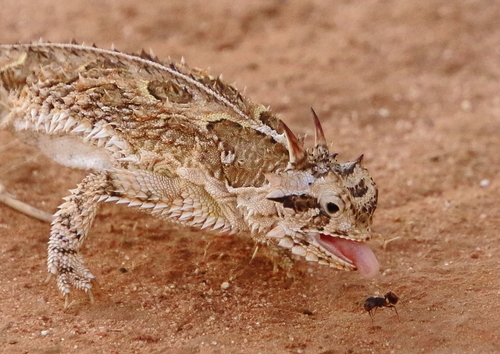
Phrynosoma, whose members are known as the horned lizards, horny toads, or horntoads, is a genus of North American lizards and the type genus of the family Phrynosomatidae. Their common names refer directly to their horns or to their flattened, rounded bodies, and blunt snouts.
📌 Biology
=== Rain-harvesting ===
Like the unrelated thorny devil (Moloch horridus) which also lives in arid environments, some species of horned lizards exhibit a behaviour known as "rain-harvesting". As rain falls on the scales of a lizard's back, water is passively transported through channels to its mouth by capillary action. The extent of this ability varies between species of horned lizards.
📌 Defenses
Horned lizards use a variety of means to avoid predation. Their coloration generally serves as camouflage. When threatened, their first defense is to remain motionless to avoid detection. If approached too closely, they generally run in short bursts and stop abruptly to confuse the predator's visual acuity. If this fails, they puff up their bodies to cause them to appear more horned and larger so that they are more difficult to swallow.
To avoid being picked up by the head or neck, a horned lizard ducks or elevates its head and orients its cranial horns straight up, or back. If a predator tries to take it by the body, the lizard drives that side of its body down into the ground so the predator cannot easily get its lower jaw underneath.
📌 Blood-squirting
At least eight species (P. asio, P. cornutum, P. coronatum, P. ditmarsi, P. hernandesi, P. orbiculare, P. solare, and P. taurus) are also able to squirt an aimed stream of blood from the corners of the eyes for a distance up to . They do this by restricting the blood flow leaving the head, thereby increasing blood pressure and rupturing tiny vessels around the eyelids. The blood not only confuses predators but also tastes foul to canine and feline predators. It appears to have no effect against predatory birds. Only three closely related species (P. mcallii, P. modestum, and P. platyrhinos) are certainly known to either be unable to squirt blood or only do it extremely rarely.
While previous thought held that compounds were added to the blood from glands in the ocular sinus cavity, current research has shown that the chemical compounds that make up the defense are already in the circulating blood. It is possible that their diet of large quantities of venomous harvester ants could be a factor; however, the origin and structure of the chemicals responsible are still unknown. The blood-squirting mechanism increases survival after contact with canine predators; the trait may provide an evolutionary advantage. Ocular autohemorrhaging has also been documented in other lizards, which suggests blood-squirting could have evolved from a less extreme defense in the ancestral branch of the genus. Recent phylogenic research supports this claim, so the species incapable of squirting blood apparently have lost the adaptation for reasons yet unstudied.
📌 Population decline
A University of Texas publication notes that horned lizard populations continue to disappear throughout their distribution despite protective legislation. Population declines are attributed to a number of factors, including the fragmentation and loss of habitat from real estate development and road construction, the planting of non-native grasses (both suburban and rural), conversion of native land to pastureland and agricultural uses, and pesticides. Additionally predation by domestic dogs and cats place continued pressure upon horned lizards.
Fire ants (Solenopsis invicta), introduced from South America via the nursery industry's potted plants, pose a significant threat to all wildlife including horned lizards. Phrynosoma species do not eat fire ants. Fire ants kill many species of wildlife, and are fierce competitors against the native ants, which horned lizards require for food (with their specialized nutritional content). Fire ants have given all ants a bad reputation, and human attempts to eradicate ants, including invasive species and the native species on which the lizards prey, contribute to the continued displacement of native ant species and the decline of horned lizards.
📌 Species and subspecies
The following 21 species (listed alphabetically by scientific name) are recognized as being valid by the Reptile Database, three species of which have recognized subspecies:
{| class="wikitable"
|-
! Image !! Common name !! colspan="2" | Scientific name !! style="width: 200pt;" | Distribution
|-
|||Giant horned lizard || colspan="2" | Phrynosoma asio ||southern Mexico
|-
| ||Baur's short-horned lizard || colspan="2" | Phrynosoma bauri (disputed, may be conspecific with P. hernandesi) ||United States (southern Wyoming and Nebraska south through eastern Colorado to northern New Mexico)
|-
|||San Diego horned lizard,
Blainville's horned lizard
| colspan="2" |Phrynosoma blainvillii ||United States (southern and central California), Mexico (northern Baja California)
|-
|||Short-tailed horned lizard || colspan="2" |Phrynosoma braconnieri || Mexico (Puebla and Oaxaca)
|-
| ||Great Plains short-horned lizard || colspan="2" | Phrynosoma brevirostris (disputed, may be conspecific with P. hernandesi) || Canada and the United States
|-
| ||Cedros Island horned lizard || colspan="2" | Phrynosoma cerroense || Mexico (Cedros Island)
|-
|||Texas horned lizard || colspan="2" |Phrynosoma cornutum ||United States (southeast Colorado, central and southern areas of Kansas, central and western areas of Oklahoma and Texas, southeast New Mexico, and extreme southeast Arizona), Mexico (eastern Sonora, most of Chihuahua, northeast Durango, northern Zacatecas and San Luis Potosí, and throughout most of Coahuila, Nuevo León, and Tamaulipas)
|-
| ||Coast horned lizard || Phrynosoma coronatum ||
*Cape horned lizard, P. c. coronatum
*California horned lizard, P. c. frontale
*Central peninsular horned lizard, P. c. jamesi
|| Mexico (Baja California Sur)
|-
| ||San Luis Valley short-horned lizard || colspan="2" | Phrynosoma diminutum (disputed, may be conspecific with P. hernandesi) ||United States (Colorado)
|-
| ||Ditmars' horned lizard,
rock horned lizard
| colspan="2" | Phrynosoma ditmarsi || Mexico (Sonora), United States (Arizona)
|-
|||Pygmy short-horned lizard || colspan="2" | Phrynosoma douglasii ||northwestern United States and adjacent southwestern Canada
|-
| ||Sonoran horned lizard,
Goode's desert horned lizard
| colspan="2" | Phrynosoma goodei ||United States (Arizona) and Mexico (Sonora)
|-
|||Greater short-horned lizard || colspan="2" | Phrynosoma hernandesi || southwestern United States and northwestern Mexico
|-
|||Flat-tail horned lizard || colspan="2" | Phrynosoma mcallii ||United States and Mexico
|-
|||Roundtail horned lizard || colspan="2" | Phrynosoma modestum || United States (Texas, New Mexico eastern Arizona, southeastern Colorado), northcentral Mexico
|-
|||Mexican Plateau horned lizard,
Chihuahua Desert horned lizard
| Phrynosoma orbiculare ||
*P. o. bradti
*P. o. cortezii
*P. o. dugesii
*P. o. orbiculare
*P. o. orientale
||Mexico (Chihuahua, Durango, Morelos, Nuevo León, Puebla, and Veracruz)
|-
| ||Desert short-horned lizard || colspan="2" | Phrynosoma ornatissimum (disputed, may be conspecific with P. hernandesi) || Canada and the United States
|-
|||Desert horned lizard || Phrynosoma platyrhinos ||
*Southern desert horned lizard, P. p. calidiarum
*Northern desert horned lizard, P. p. platyrhinos
|| southern Idaho in the north to northern Mexico
|-
| ||Guerreran horned lizard || colspan="2" |Phrynosoma sherbrookei ||Mexico
|-
|||Regal horned lizard || colspan="2" | Phrynosoma solare ||Arizona and Mexico
|-
|||Mexican horned lizard || colspan="2" | Phrynosoma taurus ||Mexico (Guerrero and Puebla)
|-
|}
Note: In the above list, a binomial authority or trinomial authority in parentheses indicates that the species or subspecies was originally described in a genus other than Phrynosoma.
📌 Symbol
Texas designated the Texas horned lizard (Phrynosoma cornutum) as the official state reptile in 1993. Wyoming’s state reptile is the “Horn Toad”, the greater short-horned lizard (Phrynosoma hernandesi).
The "TCU Horned Frog" is the mascot of Texas Christian University in Fort Worth, Texas. The "Horned Toad" is also the mascot for Coalinga High School in Coalinga, California. This school is located in Western Central California and its arid region is home to the San Diego Horned Lizard, which is protected. The City of Coalinga hosts an annual "Horned Toad Derby" on Memorial day weekend which features horned toad races, a carnival and parade.
File:Superfrog.jpg|The TCU mascot is commonly known as Super Frog to TCU fans and students. He is usually present at TCU sporting events.
File:HornedToad.png|Horned lizard on a necktie at El Paso, Texas, in 1940