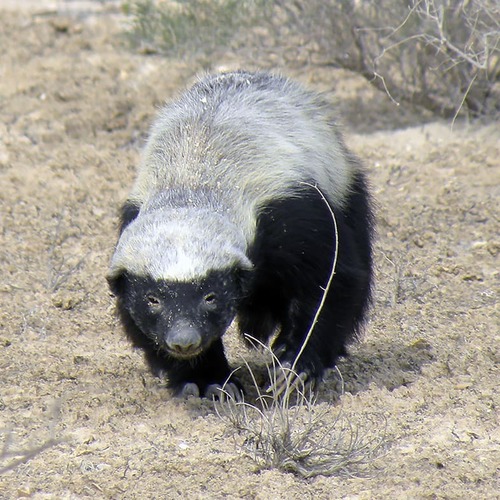
The honey badger, also known as the ratel, is a mammal widely distributed across Africa, Southwest Asia, and the Indian subcontinent. It is the only living species in both the genus Mellivora and the subfamily Mellivorinae. It has a fairly long body, with a distinctly thick-set and broad back, and remarkably loose skin, allowing the badger to turn and twist freely within it. The largest terrestrial mustelid in Africa, the honey badger measures 55 to 77 cm long and weighs up to 16 kg (35 lb). Sexual dimorphism has been recorded in this species, with males being larger and heavier than females. It has two pairs of mammae, and an eversible anal pouch.
📌 Taxonomy
Viverra capensis was the scientific name used by Johann Christian Daniel von Schreber in 1777 who described a honey badger skin from the Cape of Good Hope. Mellivorae was proposed as name for the genus by Gottlieb Conrad Christian Storr in 1780, while
Mellivorina was proposed as a tribe name by John Edward Gray in 1865. The honey badger is the only living species of the genus Mellivora. Although in the 1860s it was assigned to the badger subfamily, the Melinae, it is now generally agreed that it bears few similarities to the Melinae. It is much more closely related to the marten subfamily, Guloninae, and furthermore is assigned its own subfamily, Mellivorinae.
📌 Subspecies
In the 19th and 20th centuries, 16 zoological specimens of the honey badger were described and proposed as subspecies. Points taken into consideration in assigning different subspecies include size and the extent of whiteness or greyness on the back. , 12 subspecies are recognised as valid taxa:
|Western Middle Asia northward to the Ustyurt Plateau and eastward to Amu Darya. Outside the former Soviet Union, its range includes Afghanistan, Iran (except the southwestern part), western Pakistan and western India
|mellivorus (Bennett, 1830)
ratel (Horsfield, 1851)
ratelus (Fraser, 1862)
|-style="vertical-align:top;"
|Nepalese ratel (M. c. inaurita) (Hodgson, 1836)
|Distinguished from indica by its longer, much woollier coat and having overgrown hair on its heels
|Nepal and contiguous areas east of it
|
|-style="vertical-align:top;"
|White-backed ratel (M. c. leuconota) (Sclater, 1867)
|The entire upper side from the face to half-way along the tail is pure creamy white with little admixture of black hairs
|West Africa, southern Morocco, former French Congo
|
|-style="vertical-align:top;"
|Black ratel (M. c. cottoni) (Lydekker, 1906)
|The fur is typically entirely black, with thin and harsh hairs.
|
|Hadhramaut, southern Arabia
|
|-style="vertical-align:top;"
|Turkmenian ratel (M. c. buechneri) Baryshnikov, 2000
|Similar to the subspecies indica and inaurita, but is distinguished by its larger size and narrower postorbital constriction
|Turkmenistan
|
|}
📌 Evolution
The species first appeared during the middle Pliocene in Asia. A number of extinct relatives are known dating back at least 7 million years to the Late Miocene. These include Mellivora benfieldi from South Africa and Italy, Promellivora from Pakistan, and Howellictis from Chad. More distant relatives include Eomellivora, which evolved into several different species in both the Old and New Worlds, and the giant, long-legged Ekorus from Kenya.
📌 Etymology
The genus name, Mellivora, is derived from Latin, meaning "honey eater", while the species name, capensis, pertains to the location where the type specimen was discovered: the Cape of Good Hope.
📌 Distribution and habitat
The honey badger ranges through most of sub-Saharan Africa, from the Western Cape, South Africa, to southern Morocco and southwestern Algeria and outside Africa through Arabia, Iran, and Western Asia to Turkmenistan and the Indian Peninsula. It is known to range from sea level to as much as in the Moroccan High Atlas and in Ethiopia's Bale Mountains. These habitats can have an annual rainfall of as low as 100 mm in dry, arid regions to as high as 2,000 mm.
📌 Behaviour and ecology
, South Africa]]
The honey badger is mostly solitary, but has also been seen in Africa hunting in pairs. It also uses old burrows of aardvark, warthog and termite mounds. In the Serengeti National Park, the activity levels of the honey badger was largely dependent on the time of year; in the dry season, it was mostly nocturnal, in contrast to the wet season, when it remained active throughout the day, reaching its zenith during crepuscular hours. In the Sariska Tiger Reserve in India, a study concluded that the honey badger was highly nocturnal; a study in the Cauvery Wildlife Sanctuary yielded similar results. The honey badger is a skilled digger, able to dig tunnels into hard ground in 10 minutes. These burrows usually have only one entry, are usually only long with a nesting chamber that is not lined with any bedding. Adults control a patch of land known as a home range. Females establish a large home range that changes in size depending foremost on the abundance of food, and particularly when rearing young, while males' considerably larger home ranges depend on the availability of females in heat; this often leads to males' home ranges intersecting with that of about 13 females.
The honey badger is famous for its strength, ferocity and toughness. It is known to savagely and fearlessly attack almost any other species when escape is impossible, reportedly even repelling much larger predators such as lion and hyena. In some instances, honey badgers deter large predators by unleashing a pungent yellow liquid produced by the anal glands. They accompany this with a threat display characterized by rattling noises, goosebumps, a straight, upward-facing tail, and general charging behaviour while also holding their heads up high. and Southern African rock python.
The voice of the honey badger is a hoarse "khrya-ya-ya-ya" sound. When mating, males emit loud grunting sounds. Cubs vocalise through plaintive whines,
📌 Reproduction
The honey badger does not have a specific mating period, and instead breeds at any time of the year. Females have an estimated oestrus period of about 14 days. Their gestation period is thought to last 50–70 days, usually resulting in one to two cubs, which are born blind and hairless. Females give birth in a den, and transport their young from one shelter to another for the first three months. When foraging, females abandon their cubs, and return to suckle them in the den; sightings of females suckling young are generally rare, however, in one instance, a female suckling her young outside the den was observed laying in a supine position with her cub sitted atop her abdomen in an upside down orientation. At about three to five weeks of age, cubs begin developing the adult black-and-white coat, and at eight to twelve weeks, they follow their mother on foraging expeditions; weaning occurs during this period. On average, females will remain with their cubs for 1–1¼ years and during that time, they will teach cubs important life skills such as climbing, foraging and hunting. Not all cubs reach adulthood; in one study, the mortality rate of cubs in the Kgalagadi Transfrontier Park was 37%, and was caused by predation, infanticide and starvation. Although the exact age when males become sexually mature is uncertain, several factors indicate that they reach sexual maturity at two to three years of age. Also uncertain is when females reach sexual maturity, however, they are thought to be sexually mature on the onset of independency, the largest indicator of this being the migration of females outside their mothers range not too long after the separation. The lifespan of the species in the wild is unknown, though captive individuals have been known to live for approximately 24 years.
📌 Pathogens
Honey badgers are known to be susceptible to rabies. In one instance, a seemingly rabid honey badger attacked a dog and several people in separate attacks within the span of two days before being shot. The incident occurred in Kromdraai, South Africa in July 2021. An autopsy of the dead individual confirmed that the rabies arose from canines, both wild and domestic. Parasites that infect honey badgers include flatworms such as Strongyloides akbari, Uncinaria stenocephala, Artyfechinostomum sufrartyfex, Trichostrongylidae, Physaloptera, Ancylostoma, and Rictulariidae. There have also been cases of parasitic worm infections. Blood-sucking parasites known to infect this species include Haemaphysalis indica, Amblyomma javanensis and Rhipicephalus microplus.
📌 Status
As of 2016, the honey badger is listed as least concern on the IUCN Red List due to its extensive range. It is mostly threatened by killings from beekeepers and farmers, sometimes with the use of poisons or traps, and is used in traditional medicine and as bushmeat. In other cases, control programs that were meant for other predators such as caracals have led to unintentional honey badger deaths. It is thought that many honey badger populations were eradicated as a result of poisoning alone.
📌 Human–wildlife conflict
Honey badgers often become serious poultry predators. Because of their strength and persistence, they are difficult to deter. They are known to rip thick planks from hen-houses or burrow underneath stone foundations. Surplus killing is common during these events, with one incident resulting in the death of 17 Muscovy ducks and 36 chickens.
In Kenya, the honey badger is a major reservoir of rabies and is suspected to be a significant contributor to the sylvatic cycle of the disease.
📌 Conservation
The honey badger is protected in numerous range countries, such as Algeria, Morocco, Kazakhstan, Uzbekistan, and Turkmenistan. It also occurs in protected areas in many countries, such as the Kruger National Park in South Africa, and the Ustyurt Nature Reserve in Kazakhstan. In Ghana and Botswana, the populations are included under CITES Appendix III. The Indian population is protected under Schedule I of the Wildlife (Protection) Act, 1972.
📌 In captivity
Honey badgers are kept in captivity as pets and to be exhibited in zoos. They are said to be easy to tame, with some reportedly ceasing the utilization of their anal glands. Despite this, when in contact with a handler, honey badgers often release anal gland secretions.
📌 In culture
The native people of Somalia believe that a man becomes infertile after being bitten by a honey badger, hence the wide berth they give to the species. A British army spokesperson said that the badgers were "native to the region but rare in Iraq" and "are usually only dangerous to humans if provoked".
In popular media, the honey badger has garnered a reputation for being an intelligent, fearless animal with nicknames or titles given to it include "pound for pound, the most powerful creature in Africa", "most fearless animal in the world", "bravest animal in the world" and "meanest animal in the world". These names stem from the honey badger's ability to repel larger predators, which has been highlighted in such a way as to give the public audience the impression of invincibility. The noises made when performing the threat display are cited as another component of the honey badger's invincible image. Due to its ability of using tools, the honey badger is considered an intelligent creature and according to a BBC documentary titled Honey Badgers: Masters of Mayhem, captive individuals may work with others as cohesive unit to help unlock gates or enclosures with the use of tools. The species' supposed fearless attitude is highlighted in the popular comic book Randall's Guide to Nastyass Animals: Honey Badger Don't Care. Reflecting this reputation, the honey badger has also been adopted as a symbol of Bitcoin, whose advocates liken the currency’s uncontrollability to the animal’s renowned toughness.