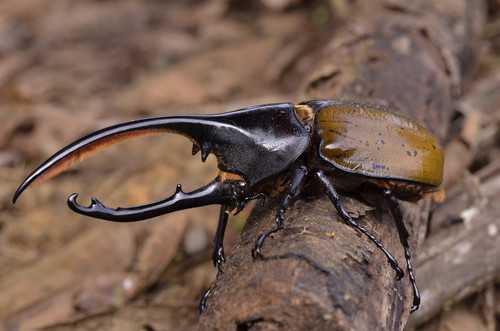
The Hercules beetle is a species of rhinoceros beetle native to the tropical forests of southern Mexico, Central America, South America, and the Lesser Antilles. It is the longest extant species of beetle in the world, and is also one of the largest flying insects in the world.
📌 Etymology
Dynastes hercules is known for its tremendous strength and is named after Hercules, a hero of classical mythology who is famed for his great strength.
📌 Taxonomy
D. hercules has a complex taxonomic history and has been known by several synonyms. It is in the subfamily Dynastinae (rhinoceros beetles) in the larger family Scarabaeidae (commonly known as scarab beetles). Not counting subspecies of D. hercules, seven other species are recognized in the genus Dynastes.
📌 Subspecies
Several subspecies of D. hercules have been named, though still some uncertainty exists as to the validity of the named taxa.
*Dynastes hercules ecuatorianus Ohaus, 1913
*Dynastes hercules hercules (Linnaeus, 1758)
*Dynastes hercules lichyi Lachaume, 1985
*Dynastes hercules morishimai Nagai, 2002
*Dynastes hercules occidentalis Lachaume, 1985
*Dynastes hercules paschoali Grossi & Arnaud, 1993
*Dynastes hercules reidi Chalumeau, 1977 (= baudrii Pinchon, 1976)
*Dynastes hercules septentrionalis Lachaume, 1985 (= tuxtlaensis Moron, 1993)
*Dynastes hercules takakuwai Nagai, 2002
*Dynastes hercules trinidadensis Chalumeau & Reid, 1995 (= bleuzeni Silvestre and Dechambre, 1995)
📌 Distribution and habitat
Populations of D. hercules may be found from southern Mexico to Bolivia in mountainous and lowland rain forests. Known populations include the Lesser Antilles, Trinidad and Tobago, Brazil, Ecuador, Colombia, and Peru.
📌 Life cycle
Not much is known about the life cycle in the wild, but much evidence has been gained through observations of captive-bred populations. The mating season for adults typically occurs during the rainy season (July to December). Females have an average gestation period of 30 days from copulation to egg-laying, and may lay up to 100 eggs on the ground or on dead wood. The eggs have an incubation period of approximately 27.7 days before they hatch. Once hatched, the larval stage of the Hercules beetle may last up to two years in duration, where it will go through 3 metamorphosis stages, also known as instars. The larvae have a yellow body with a black head. The larvae can grow up to in length and weigh more than 100 grams. In laboratory conditions at 25 ± 1°C, the first instar stage lasts an average of 50 days, the second stage an average of 56 days, and the third an average of 450 days. After the third instar stage, the pupal stage lasts about 32 days, where it will transition into an adult. Adult beetles can live for three to six months in captivity.
📌 Diet and behavior
===Diet===
The larvae of the Hercules beetle are saproxylophagous, meaning that they feed on rotting wood; they reside in same during their two-year developmental stage. Adults carve bark through the use of their synchronous mandibles to easily access the sap of trees. When these mandibles are closed, a narrow opening is formed which can act like a straw to allow consumption of tree sap.
📌 Behavior
Within their native rain forest habitats, the adult beetles, which are nocturnal, forage for fruit at night and hide or burrow within the leaf litter during the day. Like most insects, communication within the species is a mix of chemoreception, sight, and mechanical perception. Experiments on D. hercules have shown that a male placed in the vicinity of a female will immediately orient towards her and seek her out, suggesting chemical communication through strong sexual pheromones.
📌 Combat behavior between males
It has been observed in wild habitat and in captivity that male D. hercules will engage in combat to win possession and mating rights to a female. Male Hercules beetles typically use their large horns to settle mating disputes; these fights can cause significant physical damage to the combatants but may also include possible damage to the female in the process. During fights, the males attempt to grab and pin their rival between the cephalic and thoracic horns to lift and throw them. The successful male wins mating rights with the female, though the beetles remain polygynandrous.
📌 Physical strength
Reports suggest the Hercules beetle is able to carry up to 850 times its body mass. Actual measurements on a much smaller (and relatively stronger: see square-cube law) species of rhinoceros beetle show a carrying capacity only up to 100 times their body mass, at which point they can barely move.
📌 Relationship to humans
Dynastes hercules does not negatively affect human activities, either as an agricultural pest or disease vector. The beetles can be kept as pets.
📌 Relationship to the environment
Dynastes hercules is a beneficial contributor to the forest ecosystem, primarily during their larval stage where they are saproxylophagous. Feeding on rotting wood assists with biodegradation and cycling nutrients in the environment.