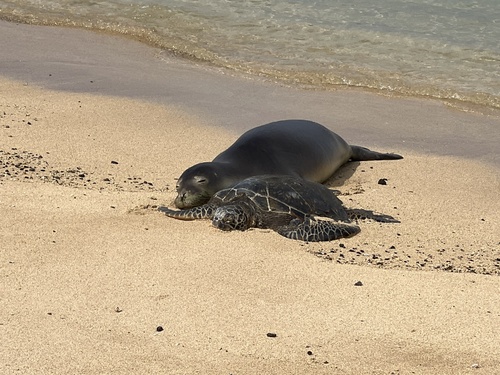
The Hawaiian monk seal is a vulnerable species of earless seal in the family Phocidae that is endemic to the Hawaiian Islands.
🛡️ Conservation Status
endangered
en
📌 Etymology
Known to native Hawaiians as īlio-holo-i-ka-uaua, or "dog that runs in rough water", its scientific name is from Hugo Schauinsland, a German scientist who discovered a skull on Laysan Island in 1899. Its common name, and the genus (first element) of its scientific name, comes from short hairs on its head, said to resemble a monk. It is the official state mammal of Hawaii.
📌 Evolution and migration
|alt=Photo of seal on the beach, looking directly at the photographer]]
The monk seals are members of the Phocidae. In an influential 1977 paper, Repenning and Ray proposed, based on certain unspecialized features, that they were the most primitive living seals. However, this idea has since been entirely superseded.
In an effort to inform the public and conserve the seals, the National Oceanic Atmospheric Administration (NOAA) Fisheries Service developed a historical timeline to demonstrate that the Hawaiian islands has been home to the seals for millions of years and that the seals belong there. Evidence points to monk seals migrating to Hawaii between 4–11 million years ago (mya) through an open water passage between North and South America called the Central American Seaway. The Isthmus of Panama closed the Seaway approximately 3 million years ago.
Berta and Sumich ask how this species came to the Hawaiian Islands when its closest relatives are on the other side of the world in the North Atlantic and Mediterranean Sea. The species may have evolved in the Pacific or Atlantic, but in either case, came to Hawaii long before the first Polynesians.
📌 Ecology
===Habitat===
|alt=A Hawaiian monk seal observed in Kauai]]
at Papahānaumokuākea Marine National Monument]]
The majority of the Hawaiian monk seal population can be found around the Northwest Hawaiian Islands but a small and growing population lives around the main Hawaiian Islands. Hawaiian monk seals breed and haul-out on sand, corals, and volcanic rock; sandy beaches are more commonly used for pupping. Due to the immense distance separating the Hawaiian Islands from other land masses capable of supporting the Hawaiian monk seal, its habitat is limited to the Hawaiian Islands.
📌 Feeding
Hawaiian monk seals mainly prey on reef dwelling bony fish, but they also prey on cephalopods and crustaceans. Both juveniles and sub-adults prey more on smaller octopus species, such as Octopus leteus and O. hawaiiensis, nocturnal octopus species, and eels than the adult Hawaiian monk seals,
📌 Predators
Tiger sharks, great white sharks and Galapagos sharks are the main predators of the Hawaiian monk seal.
📌 Reproduction
Hawaiian monk seals mate in the water during their breeding season, which occurs between June and August.
📌 Nursing
The pups are born on beaches and nursed for about six weeks. The mother does not eat or leave the pup while nursing. After that time, the mother deserts the pup, leaving it on its own, and returns to the sea to forage for the first time since the pup's arrival.
📌 Status
, near Waimea Bay|alt=A Hawaiian monk seal observed on the North Shore of Oʻahu.]]
Most seals are found on the Northwestern Hawaiian Islands. although its cousin species, the Mediterranean monk seal (M. monachus), is even rarer, and the even more closely related Caribbean monk seal (N. tropicalis), last sighted in the 1950s, was officially declared extinct in June 2008. In 2010, it was estimated that only 1100 individuals remained. A later estimate in 2016, which included a more complete survey of small populations, was approximately 1400 individuals. and 300 as of 2016. and again beached at Waikīkī on March 4, 2011, by the Moana Hotel. Another Monk Seal appeared at Punaluʻu Black Sands Beach in July 2023. Yet another adult came ashore for a rest next to the breakwater in Kapiʻolani Park Waikīkī on the morning of December 11, 2012, after first being spotted traveling west along the reef break from the Aquarium side of the Park. On June 29, 2017 monk seal #RH58 popularly known as "Rocky" gave birth to a pup on Kaimana Beach fronting Kapiʻolani Park. Despite the fact Kaimana beach is popular and busy, Rocky has been routinely hauling out on this beach for several years. In 2006, twelve pups were born in the main islands, rising to thirteen in 2007, and eighteen in 2008. As of 2008 43 pups had been counted in the main islands.
The Hawaiian monk seal was officially designated as an endangered species on November 23, 1976, and is now protected by the Endangered Species Act and the Marine Mammal Protection Act. It is illegal to kill, capture or harass a Hawaiian monk seal. Even with these protections, human activity along Hawaii's fragile coastlines (and in the world at large) still provides many stressors.
the IUCN downgraded the Hawaiian monk seal from Endangered to Vulnerable due to an increase in its population.
📌 Threats
Natural factors threatening the Hawaiian monk seal include low juvenile survival rates, reduction of habitat/prey associated with environmental changes, increased male aggression, and subsequent skewed gender ratios. Anthropogenic or human impacts include hunting (during the 1800s and 1900s) and the resulting small gene pool, continuing human disturbance, entanglement in marine debris, and fishery interactions.
📌 Natural threats
Low juvenile survival rates continue to threaten the species. High juvenile mortality is due to starvation and marine debris entanglement.
Mobbing leaves the targeted individual with wounds that increase vulnerability to sepsis, killing the victim via infection.
Postmortem examinations of some seal carcasses revealed gastric ulcerations caused by parasites. Some of the infectious diseases that pose a threat to the Hawaiian monk seal populations include distemper viruses, West Nile Virus, Leptospira spp., and Toxoplasma gondii. Protozoal-related mortality, specifically due to toxoplasmosis, are becoming a great threat to the recovery of the endangered Hawaiian monk seal and other native Hawaiian marine life.
📌 Anthropogenic impacts
In the nineteenth century, large numbers of seals were killed by whalers and sealers for meat, oil and skin. U.S. military forces hunted them during World War II, while occupying Laysan Island and Midway. Since 2001, toxoplasmosis has killed at least eleven seals. Other human-introduced pathogens, including leptospirosis, have infected monk seals.
Human disturbances have had immense effects on the populations of the Hawaiian monk seal. Monk seals tend to avoid beaches where they are disturbed; after continual disturbance the seal may completely abandon the beach, thus reducing its habitat size, subsequently limiting population growth. For instance, large beach crowds and beach structures limit the seal's habitat. Although the WWII military bases in the northwestern islands were closed, minimal human activities can be enough to disturb the species.
Marine fisheries can potentially interact with monk seals via direct and indirect relationships. Directly the seal can become snared by fishing equipment, entangled in discarded debris, and even feed on fish refuse. Although international law prohibits the intentional discarding of debris from ships at sea, entanglement still results in mortality because the seals get trapped in unintentional marine debris such as fishing nets and cannot maneuver or even reach the surface to breathe. Monk seals have one of the highest documented rates of entanglement of any pinniped species.
📌 Conservation
]]
In 1909, President Theodore Roosevelt created the Hawaiian Islands Reservation that included the Northwest Hawaiian islands. The Reservation later became the Hawaiian Islands National Wildlife Refuge (HINWR) and moved under the jurisdiction of the U.S. Fish and Wildlife Service (USFWS).
NOAA cultivated a network of volunteers to protect the seals while they bask or bear and nurse their young. NOAA is funding considerable research on seal population dynamics and health in conjunction with the Marine Mammal Center.
From NOAA, several programs and networks were formed to help the Hawaiian monk seal. Community programs such as PIRO have helped to improve community standards for the Hawaiian monk seal. The program also creates networks with the Native Hawaiians on the island to network more people in the fight for conservation of the seals. The Marine Mammal Response Network (MMRN) is partnered with NOAA and several other government agencies that deal with land and marine wildlife.
The Recovery Plan for the Hawaiian Monk Seal identifies public outreach and education as a key action for promoting the conservation of the Hawaiian monk seal and its habitat.
The task is to identify a manner of alleviation that is possible, cost-effective, and likely to maximize the organic return (in terms of growth potential) until much time has passed and natural conditions allow scientists to observe the effects.
📌 Protecting female pups
One key natural factor affecting the seal populations is the male-biased sex-ratio, which results in increased aggressive behaviors such as mobbing. The female pups remain during the summer months, leaving at roughly age three to seven months.
Another project began in 1984 at French Frigate Shoals. It collected severely underweight female pups, placed them in protective care, and fed them. The pups were relocated to Kure Atoll and released as yearlings. Identification and mitigation of these and other possible factors limiting population growth represent ongoing challenges and are the primary objectives of the Hawaiian monk seal conservation and recovery effort.
Beach, Maui August 15, 2025]]
📌 Draft environment impact statement
In 2011, the National Marine Fisheries Service issued a controversial draft programmatic environmental impact statement intended to improve protections for the monk seal. The plan includes:
* Expanded surveys using technology such as remote cameras and unmanned, remotely operated aircraft.
* Vaccination studies and vaccination programs.
* De-worming program to improve juvenile survival.
* Relocation to the Northwestern Hawaiian Islands.
* Diet supplements at feeding stations in the Northwestern Hawaiian Islands.
* Tools to modify undesirable contact with people and fishing gear in the main islands.
* Chemical alteration of aggressive monk seal behavior.