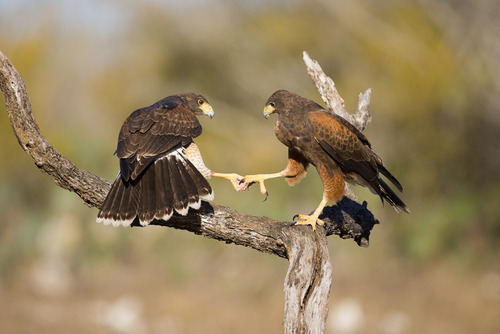
Harris's hawk, formerly also known as the bay-winged hawk or dusky hawk, and known in Latin America as the peuco, is a medium-large bird of prey that breeds from the southwestern United States south to Chile, central Argentina, and Brazil.
π Juvenile
The juvenile Harris's hawk is heavily streaked with white or buff on the underparts, and appears much lighter than the solidly dark-breasted dark adults. When in flight, the undersides of the juveniles' wings are buff-colored with brown streaking, and the primary feathers are whitish except at their tips, giving a pale panel on the outer wing; the tail band is also paler than on adults. They can look very unlike adults at first glance, but the identical chestnut plumage is an aid for identification.
π Taxonomy
Robert Ridgway placed Harris's hawk in its own new subgenus Urubitinga (Antenor) in 1873, and introduced the generic name Parabuteo in 1874. Richard Bowdler Sharpe also separated Harris's hawk to a monotypic genus, Erythrocnema, in 1874. In his Catalogue of Birds in the British Museum, Sharpe gives an extensive synonymy, with various authors having earlier placed P. u. harrisi in three genera and P. u. unicinctus in eleven.
π Subspecies
There are two subspecies of Harris's hawk:
{| class="wikitable "
|-
! Image !! Subspecies !! Description and notes !!Distribution
|-
|||P. u. harrisi ||Syn. P. u. superior.||Southwestern United States, Mexico, much of Central America, and western South America south to western Peru.|| Eastern and southern South America.
|-
|}
A third subspecies P. u. superior sometimes accepted in the past in the northwest of the species' range (Arizona to Baja California) was believed to have longer tails and wings and to be more blackish than P. u. harrisi; however, the sample size of the original study was quite small, with only five males and six females. Later research concluded that there is not as strong a physical difference as was originally assumed. Other ecological differences, and evidence of a latitudinal cline, were also brought up as arguments against the validity of the subspecies segmentation.
π Distribution and habitat
Harris's hawks live in sparse woodland and semi-desert, as well as marshes (with some trees) in some parts of their range (Howell and Webb 1995), including mangrove swamps, as in parts of their South American range. Harris's hawks are permanent residents and do not migrate.
The wild Harris's hawk population is declining due to habitat loss; however, under some circumstances, they have been known to move into developed areas.
π Behavior
, Mesa, Arizona]]
This species occurs in relatively stable groups. A dominance hierarchy occurs in Harris's hawks, wherein the mature female is the dominant bird, followed by the adult male and then the young of previous years. Groups typically include from two to seven birds. Not only do birds cooperate in hunting, but they also assist in the nesting process. No other bird of prey is known to hunt in groups as routinely as this species.
π Breeding
They nest in small trees, shrubby growth, or cacti. The nests are often compact, made of sticks, plant roots, and stems and are often lined with leaves, moss, bark, and plant roots. They are built mainly by the female. There are usually two to four white to blueish-white eggs sometimes with a speckling of pale brown or gray. The nestlings start light buff, but in five to six days turn a rich brown.
Very often, there will be three hawks attending one nest: two males and one female. Whether or not this is polyandry is debated, as it may be confused with backstanding (one bird standing on another's back). The female does most of the incubation. The eggs hatch in 31 to 36 days. The young begin to explore outside the nest at 38 days, and fledge, or start to fly, at 45 to 50 days. The female sometimes breeds two or three times in a year. In Chile, black-chested buzzard-eagles (Geranoaetus melanoleucus) are likely predators.
π Feeding
The majority of Harris's hawks' prey are mammals, including ground squirrels, rabbits, and larger black-tailed jackrabbits (Lepus californicus). Birds from the size of small passerines such as diuca finch (Diuca diuca) to adult great egret (Ardea alba) and half-grown wild turkey (Meleagris gallopavo) can be taken. In one instance, a lone Harris's hawk successfully killed a subadult great blue heron (Ardea herodias). Reptiles such as lizards and snakes are additionally taken as well as large insects. Even adult black-tailed jackrabbits weighing more than can be successfully taken by a pack of Harris's hawks.
Because it often pursues large prey, this hawk has larger and stronger feet, with long talons, and a larger, more prominent hooked beak, than most other raptors of similar size.
In the Southwestern United States, the most common prey species (in descending order of prevalence) are desert cottontail (Sylvilagus auduboni), eastern cottontail (Sylvilagus floridanus), black-tailed jackrabbit (Lepus californicus), ground squirrels (Ammospermophilus spp. and Spermophilus spp.), woodrats (Neotoma spp.), kangaroo rats (Dipodomys spp.), pocket gophers (Geomys and Thomomys spp.), Gambel's quail (Callipepla gambelii), scaled quail (C. squamata), northern bobwhite (Colinus virginianus), cactus wren (Campylorhynchus brunneicapillus), northern mockingbird (Mimus polyglottos), desert spiny lizards (Sceloporus magister), and skinks (Eumeces spp.) In the tropics, Harris's hawks have adapted to taking prey of several varieties, including those like chickens and European rabbits introduced by man. In Chile, the common degu (Octodon degus) makes up 67.5% of the prey.
π Hunting
While most raptors are solitary, only coming together for breeding and migration, Harris's hawks will hunt in cooperative groups of two to six. This is believed to be an adaptation to the lack of prey in the desert climate in which they live. In one hunting technique, a small group flies ahead and scouts, then another group member flies ahead and scouts, and this continues until prey is bagged and shared. In another, all the hawks spread around the prey and one bird flushes it out. Harris's hawks will often chase prey on foot and are quite fast on the ground; their long legs are adapted for this, whereas most other hawks do not spend as much time on the ground. Groups of Harris's hawks tend to be more successful at capturing prey than lone hawks, with groups of two to four individuals having ~10% higher success rates per extra individual.
π Relationship with humans
===Falconry===
Since about 1980, Harris's hawks have been increasingly used in falconry and are now the most popular hawks in the West (outside of Asia) for that purpose, as they are one of the easiest to train and the most social.
Trained Harris's hawks have been used to remove an unwanted pigeon population from London's Trafalgar Square, and from the tennis courts at Wimbledon.
Trained Harris's hawks have been used for bird abatement by falconry experts in Canada and the United States at various locations including airports, resorts, landfill sites, and industrial sites.
Harris's hawks have frequently escaped from captivity in Western Europe, especially Britain; they have occasionally bred in the wild, but have not to date become naturalized.
File:Harris's hawk in flight, Southern Ontario, Canada (captive).jpg|Harris's hawk in flight at a falconry centre
File:Harris's hawk at a licensed falconry centre.jpg|Harris's hawk at a licensed falconry centre, Ontario, Canada
File:Harriss Hawk being with chick leg (7913337978).jpg|Eating a chick's leg
File:Nestlings of Harris Hawk - Parabuteo unicinctus in Cheshire, England in 2011.jpg|Week-old chicks in captivity
π In art
John James Audubon illustrated Harris's hawk in The Birds of America (published in London, 1827β38) as Plate 392 with the title "Louisiana Hawk -Buteo harrisi". The image was engraved and colored by the Robert Havell, London workshops in 1837. The original watercolor by Audubon was purchased by the New York History Society where it remains to this day (January 2009).
π Historical material
* John James Audubon. "[https://www.biodiversitylibrary.org/page/33240028 Louisiana Hawk]", Ornithological Biography volume 5 (1839). [https://www.biodiversitylibrary.org/page/40382980 Illustration] from Birds of America octavo edition, 1840.
Category:Parabuteo
Category:Falconry
Category:Birds of Central America
Category:Birds of Mexico
Category:Birds of prey
Category:Birds of South America
Category:Native birds of the Southwestern United States
Category:Birds described in 1824
Category:Taxa named by Coenraad Jacob Temminck