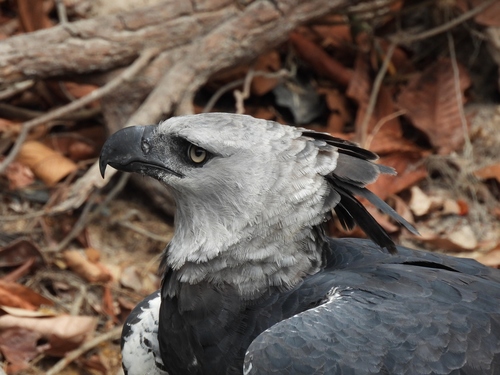
The harpy eagle is a large neotropical species of eagle. It is also called the American harpy eagle to distinguish it from the Papuan eagle, which is sometimes known as the New Guinea harpy eagle or Papuan harpy eagle. It is the largest bird of prey throughout its range, and among the largest extant species of eagles in the world. It usually inhabits tropical lowland rainforests in the upper (emergent) canopy layer. Destruction of its natural habitat has caused it to vanish from many parts of its former range, and it is nearly extirpated from much of Central America. It is the only member of the genus Harpia, which, together with Harpyopsis, Macheiramphus and Morphnus, forms the subfamily Harpiinae.
🛡️ Conservation Status
vulnerable
vu
📌 Taxonomy
The harpy eagle was first described by Carl Linnaeus in his landmark 1758 10th edition of Systema Naturae as Vultur harpyja, after the mythological beast harpy. It is now the only species placed in the genus Harpia that was introduced in 1816 by the French ornithologist Louis Pierre Vieillot. The harpy eagle is most closely related to the crested eagle (Morphnus guianensis), the Papuan eagle (Harpyopsis novaeguineae) and the bat hawk (Macheiramphus alcinus), the four composing the subfamily Harpiinae within the large family Accipitridae. Previously thought to be closely related, the Philippine eagle has been shown by DNA analysis to belong elsewhere in the raptor family, as it is related to the Circaetinae.
The specific name harpyja and the word "harpy" in the common name both come from Ancient Greek harpyia (). They refer to the harpies of Ancient Greek mythology. These were wind spirits who flew the dead to Hades or Tartarus, purported to have the lower body and talons of a raptor and the head of a woman, standing anywhere from the height of a tall child to as high as a grown man; some depictions have the creatures possessing an eagle-like body with the exposed breasts of an elderly female human, a giant wingspan and the head of a grotesque, sharp-toothed, mutant eagle—something more akin to a goblin with wings.
📌 Distribution and habitat
Relatively rare and elusive throughout its range, the harpy eagle is found from southern Mexico (incl. Chiapas, Oaxaca and the Yucatán states) and south through Central America, into South America to as far south as Argentina. They can still be seen by tourists and locals in Costa Rica and Panama. As their preferred habitat is rainforest, they nest and hunt predominantly in the emergent layer. The eagle is most common in Brazil, where it is found across the entire country. With the exception of some areas of the aforementioned Panama and Costa Rica, the species is nearly extinct in Central America, likely due to the logging industry's decimation of much of the Meso-American rainforests. Their habitat is expected to decline further due to climate change.
The harpy eagle prefers tropical, lowland rainforests and may also choose to nest within such areas from the canopy to the emergent vegetation. They typically occur below an elevation of , but have been recorded at elevations up to . Harpies, however, can be found flying over forest borders in a variety of habitats, such as cerrados, caatingas, buriti palm stands, cultivated fields, and cities. They have recently been found in areas where high-grade forestry is practiced.
📌 Size
Female harpy eagles typically weigh . One source states that adult females can weigh up to . An exceptionally large captive female, "Jezebel", weighed . Being captive, however, this large female may not be representative of the weight possible in wild harpy eagles due to differences in the food availability. The male, in comparison, is much smaller and may range in weight from . The average weight of adult males has been reported as against an average of for adult females, a 35% or higher difference in mean body mass. Harpy eagles may measure from in total length Mean talon size is in males, and in females.
It is sometimes cited as the largest eagle alongside the Philippine eagle, which is somewhat longer on average (between sexes averaging ) but weighs slightly less, and the Steller's sea eagle, which is perhaps slightly heavier on average (mean of three unsexed birds was ).
The harpy eagle may be the largest bird species to reside in Central America, though large water birds such as American white pelicans (Pelecanus erythrorhynchos) and jabirus (Jabiru mycteria) have scarcely lower mean body masses.
File:Harpia harpyja stuffed specimens Berlin 33.jpg|A skull exhibited at the Museum für Naturkunde, Berlin
File:Harpy Eagle with wings lifted.jpg|Harpy eagle with wings raised in attack posture
File:Harpia-harpyja-001.jpg|Harpy eagle in flight
📌 Vocalization
This species is largely silent away from the nest. There, the adults give a penetrating, weak, melancholy scream, with the incubating males' call described as "whispy screaming or wailing". The females' calls while incubating are similar, but are lower-pitched. While approaching the nest with food, the male calls out "rapid chirps, goose-like calls, and occasional sharp screams". Vocalization in both parents decreases as the nestlings age, while the nestlings become more vocal. The nestlings call chi-chi-chi...chi-chi-chi-chi, seemingly in alarm in response to rain or direct sunlight. When humans approach the nest, the nestlings have been described as uttering croaks, quacks, and whistles.
📌 Behavior
===Feeding===
(Cebus appella), are one of the main prey of the harpy eagle]]
, Berlin]]Full grown harpy eagles are at the top of a food chain. They possess the largest talons of any living eagle and have been recorded as carrying prey weighing up to roughly half of their own body weight. Its main prey are tree-dwelling mammals, and a majority of the diet has been shown to focus on sloths. Research conducted by Aguiar-Silva between 2003 and 2005 in a nesting site in Parintins, Amazonas, Brazil, collected remains from prey offered to the nestling by its parents. The researchers found that 79% of the harpy's prey was accounted for by sloths from two species: 39% brown-throated sloth (Bradypus variegatus), and 40% Linnaeus's two-toed sloth (Choloepus didactylus). Harpy eagles are capable of hunting all size of sloths, including full-grown adult two-toed sloths weighing up to . Similarly, cebid monkeys made up 35% of the remains found at 10 nests in Amazonian Ecuador. Monkeys regularly taken include capuchin monkeys, woolly monkeys, saki monkeys, howler monkeys, titi monkeys, squirrel monkeys, and spider monkeys. Smaller monkeys, such as tamarins and marmosets, are, however, seemingly ignored as prey by this species. Larger howler monkeys are also taken, mainly Colombian red howler (Alouatta seniculus), but also Guyanan red howler (Alouatta macconnelli) and mantled howler (Alouatta palliata). In one study, breeding harpy eagles hunted Yucatán black howler (Alouatta pigra), the largest howler monkey which can weigh between , although the ages of the monkeys taken by these eagles are unknown. Nevertheless, adults of other large monkeys can be taken by female harpy eagles, including gray woolly monkey (Lagothrix lagothricha cana) and Peruvian spider monkey (Ateles chamek), and red-faced spider monkey (Ateles paniscus) which can weigh around and possibly exceeding in large males.
Other partially arboreal and even land mammals are also preyed on given the opportunity. In the Pantanal, a pair of nesting eagles preyed largely on the porcupine (Coendou prehensilis) and the agouti (Dasyprocta azarae). Those carnivoran prey species usually weigh around , Other parrots have also been preyed on, as well as cracids such as curassows and other birds like seriemas.
Males usually take relatively smaller prey, with a typical range of or about half their own weight. Prey items taken to the nest by the parents are normally medium-sized, having been recorded from .
📌 Breeding
]]
In ideal habitats, nests would be fairly close together. In some parts of Panama and Guyana, active nests were located away from one another, while they are within of each other in Venezuela. In Peru, the average distance between nests was and the average area occupied by each breeding pairs was estimated at . In less ideal areas, with fragmented forest, breeding territories were estimated at . The bird also uses other huge trees on which to build its nest, such as the Brazil nut tree. A nesting site found in the Brazilian Pantanal was built on a cambará tree (Vochysia divergens).
📌 Status and conservation
]]
Although the harpy eagle still occurs over a considerable range, its distribution and populations have dwindled considerably. It is threatened primarily by habitat loss due to the expansion of logging, cattle ranching, agriculture, and prospecting. Secondarily, it is threatened by being hunted as an actual threat to livestock and/or a supposed one to human life, due to its great size. Although the harpy eagle is not actually known to prey on humans and only rarely on domestic stock, a scientifically documented case of this species attacking an adult woman has been reported, and its large size and nearly fearless behaviour around humans reportedly making it an "irresistible target" for hunters. Scientific 1990s records, however, suggest that the harpy Atlantic Forest population may be migratory. Subsequent research in Brazil has established that, as of 2009, the harpy eagle, outside the Brazilian Amazon, is critically endangered in Espírito Santo, São Paulo and Paraná, endangered in Rio de Janeiro, and probably extirpated in Rio Grande do Sul (where a recent (March 2015) record was set for the Parque Estadual do Turvo) and Minas Gerais – the actual size of their total population in Brazil is unknown.
Globally, the harpy eagle is considered vulnerable by IUCN It has disappeared from El Salvador, and almost so from Costa Rica.
📌 National initiatives
Various initiatives for restoration of the species are in place in various countries. Since 2002, the Peregrine Fund initiated a conservation and research program for the harpy eagle in the Darién Province. A similar—and grander, given the dimensions of the countries involved—research project is occurring in Brazil, at the National Institute of Amazonian Research, through which 45 known nesting locations (updated to 62, only three outside the Amazonian basin and all three inactive) are being monitored by researchers and volunteers from local communities. A harpy eagle chick has been fitted with a radio transmitter that allows it to be tracked for more than three years via a satellite signal sent to the Brazilian National Institute for Space Research. Also, a photographic recording of a nest site in the Carajás National Forest was made for the Brazilian edition of National Geographic Magazine.
In Panama, the Peregrine Fund carried out a captive-breeding and release project that released a total of 49 birds in Panama and Belize. The Peregrine Fund has also carried out a research and conservation project on this species since the year 2000, making it the longest-running study on harpy eagles.
In Belize, the Belize Harpy Eagle Restoration Project began in 2003 with the collaboration of Sharon Matola, founder and director of the Belize Zoo and the Peregrine Fund. The goal of this project was the re-establishment of the harpy eagle within Belize. The population of the eagle declined as a result of forest fragmentation, shooting, and nest destruction, resulting in near extirpation of the species. Captive-bred harpy eagles were released in the Rio Bravo Conservation and Management Area in Belize, chosen for its quality forest habitat and linkages with Guatemala and Mexico. Habitat linkage with Guatemala and Mexico were important for conservation of quality habitat and the harpy eagle on a regional level. As of November 2009, 14 harpy eagles have been released and are monitored by the Peregrine Fund, through satellite telemetry.
In January 2009, a chick from the all-but-extirpated population in the Brazilian state of Paraná was hatched in captivity at the preserve kept in the vicinity of the Itaipu Dam by the Brazilian/Paraguayan state-owned company Itaipu Binacional. In September 2009, an adult female, after being kept captive for 12 years in a private reservation, was fitted with a radio transmitter before being restored to the wild in the vicinity of the Pau Brasil National Park (formerly Monte Pascoal NP), in the state of Bahia.
In December 2009, a 15th harpy eagle was released into the Rio Bravo Conservation and Management Area in Belize. The release was set to tie in with the United Nations Climate Change Conference 2009, in Copenhagen. The 15th eagle, nicknamed "Hope" by the Peregrine officials in Panama, was the "poster child" for forest conservation in Belize, a developing country, and the importance of these activities in relation to climate change. The event received coverage from Belize's major media entities, and was supported and attended by the U.S. Ambassador to Belize, Vinai Thummalapally, and British High Commissioner to Belize, Pat Ashworth.
In Colombia, as of 2007, an adult male and a subadult female confiscated from wildlife trafficking were restored to the wild and monitored in Paramillo National Park in Córdoba, and another couple was being kept in captivity at a research center for breeding and eventual release. A monitoring effort with the help of volunteers from local Native American communities is also being made in Ecuador, including the joint sponsorship of various Spanish universities—this effort being similar to another one going on since 1996 in Peru, centred around a native community in the Tambopata Province, Madre de Dios Region. Another monitoring project, begun in 1992, was operating as of 2005 in the state of Bolívar, Venezuela.
📌 In human culture
according to the 1910 book, Animal figures in the Maya codices by Alfred Tozzer and Glover Morrill Allen]]
The harpy eagle is the national bird of Panama and is depicted on the coat of arms of Panama. The 15th harpy eagle released in Belize, named "Hope", was dubbed "Ambassador for Climate Change", in light of the United Nations Climate Change Conference 2009.
The bird appeared on the reverse side of the Venezuelan Bs.F 2,000 note.
The harpy eagle was the inspiration behind the design of Fawkes the Phoenix in the Harry Potter film series. A live harpy eagle was used to portray the now-extinct Haast's eagle in BBC's Monsters We Met.
📌 Indigenous cultures
In Aztec religion the harpy eagle was sacred to Quetzalcoatl.