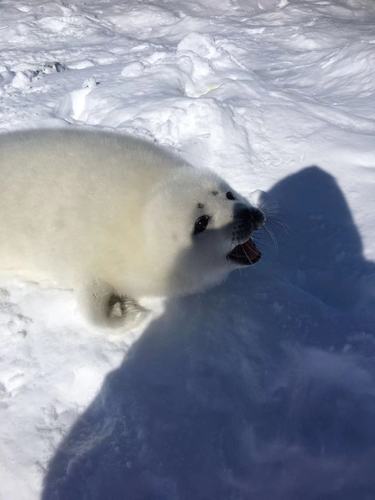
The harp seal, also known as the saddleback seal or Greenland seal, is a species of earless seal, or true seal, native to the northernmost Atlantic Ocean and Arctic Ocean. Originally in the genus Phoca with a number of other species, it was reclassified into the monotypic genus Pagophilus in 1844. In Greek, its scientific name translates to "Greenlandic ice-lover", and its taxonomic synonym, Phoca groenlandica translates to "Greenlandic seal". This is the only species in the genus Pagophilus.
π Physiology
The harp seal is a modest diver. Dive duration ranges from less than two minutes to just over 20 minutes. This behaviour allows the mother harp seal to conserve energy and avoid the harsh conditions of the fast-ice while remaining near her pup. As with most phocids, she requires vast amounts of energy to ensure sufficient mass transfer to her growing, weaning pup. Harp seals remain within their aerobic dive limit for 99% of dives.
π Thermoregulation
Harp seal insulation changes over the course of a seal's lifetime. Young harp seals rely on a lanugo pelt from nursing all the way up to their weaning age. The insulating quality of this fur depends on its ability to keep a layer of air trapped inside or between the hairs. It takes a year for their blubber to develop and for their first-year pelage to grow. This transition from thick lanugo fur to blubber is important because lanugo fur does not insulate well in water. Their lower critical temperature is believed to be under in air. A thick coat of blubber insulates the seal's body and provides energy when food is scarce or during fasting. Blubber also streamlines its body for more efficient swimming. Brown fat warms blood as it returns from the body surface as well as providing energy, most importantly for newly weaned pups. Flippers act as heat exchangers, warming or cooling the seal as needed. On ice, the seal can press its fore flippers to its body and its hind flippers together to reduce heat loss.
π Senses
The harp seal's eyes are large for its body size and contain a large spherical lens that improves focusing ability. Its mobile pupil helps it adapt to the intense glare of the Arctic ice. Its retina is rod-dominated and backed by a cat-like and reflective tapetum lucidum, enhancing its low light sensitivity. Its cornea is lubricated by lachrymal glands, to protect the eye from sea water damage.
On ice, the mother identifies her offspring by smell. This sense may also warn of an approaching predator. Underwater, the seal closes its nostrils, disabling its sense of smell.
Its whiskers, or vibrissae, lie in horizontal rows on either side of its snout. They can sense to low-frequency vibrations, and may be able to detect movement of nearby animals during dives.
π Life history
Harp seals spend relatively little time on land compared with time at sea. They are social animals and can be quite vocal in groups. Within their large colonies, smaller groups with their own hierarchies form. Harp seals can live over 30 years in the wild. On the ice, pups call their mothers by "yelling", and "mumble" while playing with other pups. Adults "growl" and "warble" to warn off conspecifics and predators. Underwater, adults have been recorded using more than 19 types of vocalization during courting and mating.
π Reproduction and development
The harp seal is a fast ice breeder and is believed to have a promiscuous mating system. Breeding occurs between mid-February and April. Females, who remain on the ice, will resist copulation unless underwater. The fertilized egg grows into an embryo which remains suspended in the womb for up to three months before implantation, to delay birth until sufficient pack ice is available. In the post-weaning phase (after abandonment), the pup becomes sedentary to conserve body fat. Within a few days, it sheds its white coat, reaching the "beater" stage.
Around 13β14 months old, the pups moult again, becoming "bedlamers". Juveniles moult several times, producing a "spotted harp", before the male adults' harp-marked pelt fully emerges after several years. In females, it may not emerge.
Seals congregate annually on the ice to moult, pup and breed before migrating to summer feeding grounds. Their lifespan can be over 30 years.
π Population and distribution
Global harp seal population estimates total around 4.5 million individuals. Some individuals from the Greenland Sea sub-population have been observed to forage in the Barents Sea alongside the White Sea sub-population during late summer and fall.
There are two recognised subspecies:
{| class="wikitable "
|-
! Image !! Subspecies !! Distribution
|-
|||Pagophilus groenlandicus groenlandicus ||Eastern Canada to Norway
|-
|||Pagophilus groenlandicus oceanicus ||White and Barents seas
|-
|}
π Migration and vagrancy
Harp seals are strongly migratory: the northwest population regularly moves up to northeast outside of the breeding season, and one individual was located off the north Norwegian coast, east northeast of its tagging location. Their navigational accuracy is high, with good eyesight an important factor. They are occasionally found as vagrants south of their normal range. In Great Britain, a total of 31 vagrants were recorded between 1800 and 1988.
More recently, they reached Lindisfarne in Northumberland in September 1995, and the Shetland Islands in 1987. The latter was linked to a mass movement of harp seals into Norwegian waters; by mid-February 1987, 24,000 were reported drowned in fishing nets and perhaps 30,000 (about 10% of the world population) had invaded fjords as far south as Oslo. The animals were emaciated, likely due to commercial fishing causing competition for the seals' prey.
Harp seals can strand on Atlantic coasts, often in warmer months, due to dehydration and parasite load. In March 2020, a harp seal was seen near Salvo, North Carolina. Harp seals often consume snow to stay hydrated, but in mild winters may not have enough available. Several centers are active in seal rescue and rehabilitation, including IFAW, NOAA, and the New England Aquarium. Harp seals are protected by the Marine Mammal Protection Act in the United States.
π Sealing
All three populations are hunted commercially, mainly by Canada, Norway, Russia and Greenland.
In Canada, commercial hunting season is from 15 November to 15 May. Most sealing occurs in late March in the Gulf of St. Lawrence, and during the first or second week of April off Newfoundland, in an area known as "the Front". This peak spring period is generally what is referred to as the "Canadian seal hunt". Hunting Canadian whitecoats has been banned since 1987. Since 2000, harp seals that are targeted during the hunt are often found to be "beaters" less than a year old. In 2006, the St. Lawrence hunt officially started on 25 March due to thin ice caused by the year's milder temperatures. Inuit living in the region hunt mainly for food and, to a lesser extent, commerce. In 2016, 66,800 harp seals and 1,612 grey seals were harvested in Atlantic Canada.
In 2005, the Independent Veterinarians' Working Group (IVWG) recommended a three-step process for hunters to kill the seals with little or no pain for the seals, as long as the process is completed in rapid succession.
The 2004 West Ice total allowable catch (TAC) was 15,000, almost double the sustainable catch of 8,200. Actual catches were 9,895 in 2004 and 5,808 in 2005. The 2004 White Sea TAC was 45,000. The catch was 22,474.
π Impact on populations
Hunting has tremendously affected the population size of harp seals. Over the past 150 years, the harp seal population has fluctuated from over 9 million to as little as 1 million. The current population is estimated to be around 4.5 million or less. but restriction of the hunt by quotas and other restrictions has led to some recovery.
File:FMIB 35605 Good day's catch, like this, fills the decks with quivering redness and the air with rarest perfumes.jpeg|Sealing ship off Newfoundland with a haul of dead harp seals
File:Phoeca groenlandica piece of meat upernavik 2007-06-26.JPG|Harp seal ribs, Upernavik
File:ENB Artisan flats with seal fur.jpg|Flats with harp seal fur