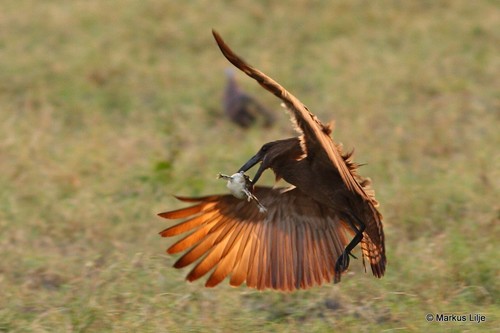
The hamerkop, also called the umbrette, is a medium-sized bird. It is the only living species in the genus Scopus and the family Scopidae. The species and family was long thought to sit with the Ciconiiformes but is now placed with the Pelecaniformes, and its closest relatives are thought to be the pelicans and the shoebill. The shape of its head with a long bill and crest at the back is reminiscent of a hammer, which has given this species its name after the Afrikaans word for hammerhead. It is a medium-sized waterbird with brown plumage. It is found in mainland Africa, Madagascar and Arabia, living in a wide variety of wetlands, including estuaries, lakesides, fish ponds, riverbanks, and rocky coasts. The hamerkop is a sedentary bird that often shows local movements.
📌 Taxonomy and systematics
The hamerkop was first described by the French zoologist Mathurin Jacques Brisson in 1760 in his landmark Ornithologia, which was published two years after the tenth edition of Carl Linnaeus' Systema Naturae. The species was subsequently described and illustrated by French polymath Comte de Buffon. When the German naturalist Johann Friedrich Gmelin revised and expanded Linnaeus's Systema Naturae in 1788 he included the hamerkop and cited the earlier authors. He placed the species in the genus Scopus that had been introduced by Brisson and coined the binomial name Scopus umbretta.
Brisson's names for bird genera were widely adopted by the ornithological community despite the fact that he did not use Linnaeus' binomial system. The International Commission on Zoological Nomenclature ruled in 1911 that Brisson's genera were available under the International Code of Zoological Nomenclature, so Brisson is considered to be the genus authority for the hamerkop. The generic name, Scopus, is derived from the Ancient Greek for "shadow". The specific name umbretta is modified from the Latin for "umber" or "dark brown".
The hamerkop is sufficiently distinct to be placed in its own family, although the relationships of this species to other families has been a longstanding mystery. Recent studies have found that its closest relatives are the pelicans and shoebill. Although the hamerkop is the only living member of its family, one extinct species is known from the fossil record. Scopus xenopus was described by ornithologist Storrs Olson in 1984 based on two bones found in Pliocene deposits from South Africa. Scopus xenopus was slightly larger than the hamerkop and Olson speculated based on the shape of the tarsus that the species may have been more aquatic.
The hamerkop is also known as the hammerkop, hammerkopf, hammerhead, hammerhead stork, umbrette, umber bird, tufted umber, or anvilhead.
📌 Subspecies
Two subspecies are recognized—the widespread nominate race S. u. umbretta and the smaller of West African S. u. minor, described by George Latimer Bates in 1931. That proposed subspecies was described by Austin L. Rand in 1936. It has also been suggested that birds near the Kavango River in Namibia may be distinct, but no formal description has been made.
📌 Distribution and habitat
The hamerkop occurs in Africa south of the Sahara, Madagascar, and coastal south-west Arabia. It requires shallow water in which to forage, and is found in all wetland habitats, including rivers, streams, seasonal pools, estuaries, reservoirs, marshes, mangroves, irrigated land such as rice paddies, savannahs, and forests. In Tanzania, it has also recently begun to feed on rocky shores. Most are sedentary within their territories, which are held by pairs, but some migrate into suitable habitat during the wet season only. The species is very tolerant of humans and readily feeds and breeds in villages and other human-created habitats.
📌 Behaviour and ecology
The hamerkop is mostly active during the day, often resting at noon during the heat of the day. They can be somewhat crepuscular, being active around dusk, but are not nocturnal as has sometimes been reported.
📌 Social behaviour and calls
The hamerkop is mostly silent when alone, but is fairly vocal when in pairs or in groups. The only call it usually makes when alone is a flight-call, a shrill "nyip" or "kek". In groups, vocalisations include a range of calls including cackles and nasal rattles. Dominant birds may signal to subordinates by opening their bills slightly and erecting their crests, but the species is not very aggressive in general towards others of its species. Birds in groups also engage in social allopreening. One bird presents its face of back of the head to the other to be preened.
📌 Food and feeding
This species normally feeds alone or in pairs, but also feeds in large flocks sometimes. It is a generalist, although amphibians and fish form the larger part of its diet. The diet also includes shrimp, insects, and rodents. The type of food they take seems to vary by location, with clawed frogs and tadpoles being important parts of the diet in East and Southern Africa and small fish being almost the only prey taken in Mali. Because it is willing to take a wide range of food items and also take very small prey, it is not resource-limited and only feeds for part of the day.
This species has been recorded foraging for insects flushed by grazing cattle and buffalo, It has also been recorded feeding in association with banded mongooses; when a band of mongooses began hunting frogs in dried mud at the side of a pool of water a pair of hamerkops attended the feeding group, catching frogs that escaped the mongooses.
📌 Breeding
The strangest aspect of hamerkop behaviour is the huge nest, sometimes more than across, and strong enough to support a man's weight. When possible, it is built in the fork of a tree, often over water, but if necessary, it is built on a bank, a cliff, a human-built wall or dam, or on the ground. A pair starts by making a platform of sticks held together with mud, then builds walls and a domed roof. A mud-plastered entrance wide in the bottom leads through a tunnel up to long to a nesting chamber big enough for the parents and young. Barn owls and eagle owls may force them out and take over the nests, but when the owls leave, the pair may reuse the nest. as may snakes, small mammals such as genets, and various birds, and weaver birds, starlings, and pigeons may attach their nests to the outside. Even where pairs have home ranges that are more spread out those home ranges overlap and are the boundaries are poorly defined.
Breeding happens year-round in East Africa, and in the rest of its range, it peaks at different times, with a slight bias towards the dry season. Pairs engage in a breeding display, then copulate on the nest or on the ground nearby. The clutch consists of three to seven eggs which start chalky white, but soon become stained. The eggs measure on average, and weight around , but considerable variation is seen. Egg size varies by season, by the overall size of the clutch, and from bird to bird. Both sexes incubate the eggs, but the female seems to do most of the work. Incubation takes around 30 days from the first egg being laid to hatching, eggs are laid with intervals of one to three days, and they hatch asynchronously.
Both parents feed the young, often leaving them alone for long times. This habit, which is unusual for wading birds, may be made possible because of the thick nest walls. The young hatch covered with grey down. By 17 days after hatching, their head and crest plumage is developed, and in a month, their body plumage. They first leave the nest around 44 to 50 days after hatching, but continue to use the nest for roosting at night until they are two months old.
📌 Relationship with humans
Many legends exist about the hamerkop. In some regions, people state that other birds help it build its nest.
It is known in some cultures as the lightning bird, and the Kalahari Bushmen believe or believed that being hit by lightning resulted from trying to rob a hamerkop's nest. They also believe that the inimical god Khauna would not like anyone to kill a hamerkop. According to an old Malagasy belief, anyone who destroys its nest will get leprosy, and a Malagasy poem calls it an "evil bird". Such beliefs have given the bird some protection. A south African name Njaka meaning "rain doctor" is derived from its habit of calling loudly prior to rain.
Scopus, a database of abstracts and citations for scholarly journal articles, received its name in honour of this bird, as did the journal of the East African Natural History Society, Scopus.