Collecting Taxonomy...
💡 Tip: Contribute to species pages to earn XP!
Collecting Taxonomy...
💡 Tip: Contribute to species pages to earn XP!
Collecting Taxonomy...
💡 Tip: Contribute to species pages to earn XP!
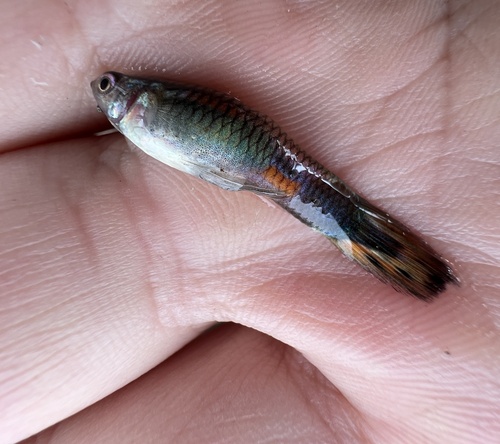
Poecilia reticulata
The guppy (Poecilia reticulata), also known as the millionfish or rainbow fish, is a member of the family Poeciliidae and, akin to most New World members of the family, is considered a livebearer. Male guppies, which are smaller than females, have ornamental caudal and dorsal fins. Wild guppies generally feed on a variety of food sources, including benthic algae and the larvae of aquatic insects. Originating from northeast South America, it has been introduced to many environments and are now found all over the world; guppies are now one of the world's most widely distributed tropical fish and one of the most popular freshwater aquarium fish species. They are highly adaptable and thrive in many different environmental and ecological conditions. Guppies are used as a model organism in the fields of ecology, evolution, and behavioural studies. good thing
Guppies were first described in Venezuela as Poecilia reticulata by Wilhelm Peters in 1859 and as Lebistes poecilioides in Barbados by De Filippi in 1861. It was named Girardinus guppii by Albert Günther in honour of Robert John Lechmere Guppy, who sent specimens of the species from Trinidad to the Natural History Museum in London. It was reclassified as Lebistes reticulatus by Regan in 1913. Then in 1963, Rosen and Bailey brought it back to its original name, Poecilia reticulata.
Distribution and habitat Guppies are native to Antigua and Barbuda, Barbados, Brazil, Guyana, Trinidad and Tobago, and Venezuela.[1][2][3] However, guppies have been introduced to many different countries on every continent except Antarctica. Sometimes this has occurred accidentally, but most often as a means of mosquito control. The guppies were expected to eat the mosquito larvae and help slow the spread of malaria, but in many cases, these guppies have had a negative impact on native fish populations.[4] Field studies reveal that guppies have colonised almost every freshwater body accessible to them in their natural ranges, especially in the streams located near the coastal fringes of mainland South America. Although not typically found there, guppies also have tolerance to brackish water and have colonised some brackish environments.[5] They tend to be more abundant in smaller streams and pools than in large, deep, or fast-flowing rivers.[6] They also are capable of being acclimated to full saltwater like their molly cousins. ^ body:not(.skin-timeless):not(.skin-minerva) "Countries where Poecilia reticulata is found". FishBase.org. Archived from the original on 21 September 2013. Retrieved 24 February 2010. ^ "Poecilia reticulata (fish)". Global Invasive Species Database. 27 October 2006. Archived from the original on 21 September 2013. Retrieved 27 August 2010. ^ "Ikan Guppy: Karakteristik, Warna, Dan Perawatan Yang Tepat - Brackto". Brackto. 22 February 2025. Retrieved 28 May 2025. ^ Froese, Rainer; Pauly, Daniel (eds.). "Poecilia reticulata". FishBase. April 2007 version. ^ Magurran, Anne E.; Phillip, Dawn A. T. (2001). "Evolutionary implications of large-scale patterns in the ecology of Trinidadian guppies, Poecilia reticulata". Biological Journal of the Linnean Society. 73 (1): 1–9. Bibcode:2001BJLS...73....1M. doi:10.1006/bijl.2000.0519.
Guppy
Actinopterygii
All references are verified for authenticity. We prioritize peer-reviewed studies, reputable databases (iNaturalist, GBIF), and established encyclopedias.
10
Observations
10
Countries
Data aggregates species content from multiple sources including Wikipedia, iNaturalist, GBIF, and ITIS. Content may transform over time. Wikipedia content is licensed under CC BY-SA 3.0.