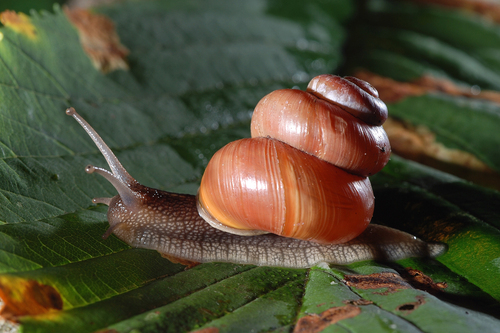
Cepaea nemoralis, the grove snail, brown-lipped snail or lemon snail, is a species of air-breathing land snail, a terrestrial pulmonate gastropod mollusc. Cepaea nemoralis is the type species of the genus Cepaea.
📌 Taxonomy
Cepaea nemoralis is the type species of the genus Cepaea.
;Subspecies
* Cepaea nemoralis etrusca (Rossmässler, 1835)
* Cepaea nemoralis nemoralis (Linnaeus, 1758)
📌 Similar species
Cepaea nemoralis is closely related to Cepaea hortensis. They share much the same habitat and exhibit a similar range of shell colours and banding patterns. Cepaea nemoralis tends to grow larger, but usually the species can most easily be recognised by the colour of the lip of adult shells. In a high proportion of regions, C. nemoralis consistently has a dark-brown lip to its shell, whilst C. hortensis has a white lip.
In areas where lip colour is variable, dissection is necessary. A cross-section of the love dart of C. nemoralis shows a cross with simple blades, whereas that of C. hortensis has bifurcated blades. The mucous gland has 3 or fewer branches in C. nemoralis, but 4 or more in C. hortensis.
Two superficially similar species Caucasotachea vindobonensis and Macularia sylvatica both have a lip that is brown near the columella becoming pale towards the suture, and they have fine growth ridges on the shell whereas in both Cepaea species it is smooth. Also, M. sylvatica is distinct in having a small blunt tooth in its aperture, whilst the lowest brown band on the shell of C. vindobonensis lies noticeably closer to the columella than in Cepaea.
📌 Colour polymorphism
Cepaea nemoralis has been used as a model organism in ecological genetics, including in citizen science projects, because it is highly polymorphic in shell colour and banding. The background colour of the shell varies along a continuum from brown through pink to yellow and sometimes almost white. Additionally the shells can be with or without dark bands. The bands vary in intensity of colour, in width and in number, from zero to five. The genetics underlying this variation is extensively understood and is shared with C. hortensis. The explanation might be camouflage or climatic selection: paler, more reflective colours in sunny environments reduce water loss and overheating. Climatic selection can also explain why yellow shells are more common in the south.
Another question is why the variation persists, usually even within a locality. Researchers have variously argued that the cause is random genetic drift and founder effects, different selection pressures in different areas with mixing by migration, and balanced polymorphism. Balanced polymorphism could arise when a predator like the song thrush develops a 'search image' for the commonest morph, so that the rarer morphs are less likely to be predated. Natural selection would then favour a diversity of colours and patterns as an antipredator adaptation. Most probably, the polymorphism has multiple causes.
📌 Distribution
The native distribution of C. nemoralis is from Western and Northern Europe to Central Europe, but it has been spreading eastwards especially over the last few decades. France, Great Britain, Ireland, Belgium, the Netherlands, Germany, Denmark, southern Sweden and Norway, Switzerland, Austria, the Czech Republic, Hungary, Bosnia, Croatia, and the northern half of Italy. In Central and Eastern Europe it has spread particularly along the Baltic coast (e.g. in Poland, Latvia, Estonia, southern Finland, the east coast of Sweden) but also now elsewhere in Poland, In Slovakia it was still known only from a single garden centre by 2020. The first reports from Romania and Bulgaria are each of a single very local occurrence within a city.
At the northern edge of its range,C. nemoralis is rare and scattered in northern Scotland, where it has been introduced.
Both in America and Eastern Europe it is known that some introductions have been deliberate.
The range of C. hortensis mostly overlaps that of C. nemoralis but extends further north and less far south.
📌 Biology and ecology
This is a very common and widespread species in Western Europe, occupying a wide range of habitats from coastal dunes to woodlands with full canopy cover, including gardens and abandoned land. in the Pyrenees, in Wales, in Scotland.
This species feeds mainly on dead or senescent plants. Although mostly not a pest of crops,
Like all pulmonate land snails, it is a hermaphrodite, and this species must mate to produce fertile eggs. or egg diameter can be 2.3–3.0 mm. The life-span for this species is up to seven or eight years, with the annual survival rate of adults about 50% (= 3% over five years, older adults suffer higher mortalities).
The most common predator of Cepaea nemoralis is the song thrush (Turdus philomelos), but other predators include rook (Corvus frugilegus), brown rat (Rattus norvegicus), European hedgehog (Erinaceus europaeus), wood/field mouse (Apodemus sylvaticus), moles (Talpidae), rabbits (Leporidae), phorid flies (Phoridae), maggots.