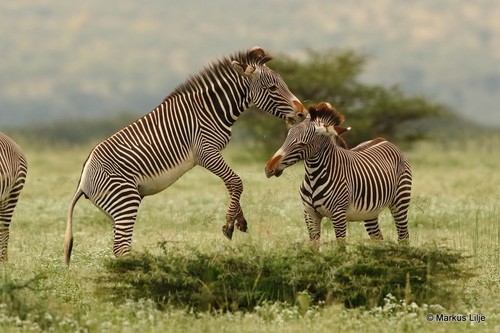
Grévy's zebra, also known commonly as the imperial zebra, is the largest living species of wild equid and the most threatened of the three species of zebras, the other two being the plains zebra and the mountain zebra. Named after French president Jules Grévy, it is found in parts of Kenya and Ethiopia. Superficially, Grévy's zebra's physical features can help to identify it from the other zebra species; its overall appearance is slightly closer to that of a mule and donkey, compared to the more "equine" (horse) appearance of the plains and mountain zebras. Compared to other zebra species, Grévy's zebra is the tallest; it has mule-like, larger ears, and has the narrowest stripes of all zebras. It has a distinctively erect mane, and a more slender snout.
🛡️ Conservation Status
endangered
en
📌 Taxonomy and naming
The Grévy's zebra was first described by French naturalist Émile Oustalet in 1882. He named it after Jules Grévy, then president of France, who, in the 1880s, was given one as a gift by the government of Ethiopia. Traditionally, this species was classified in the subgenus Dolichohippus with plains zebra and mountain zebra in Hippotigris.
Fossils of zebra-like equids have been found throughout Africa and Asia in the Pliocene and Pleistocene deposits. The latter, in particular is very similar to the Grévy's zebra and may have been its ancestor. and recent (2013) phylogenies have placed Grévy's zebra in a sister taxon with the plains zebra. In areas where Grévy's zebras are sympatric with plains zebras, the two may gather in same herds and fertile hybrids do occur.
📌 Range and ecology
Grévy's zebra largely inhabits northern Kenya, with some isolated populations in Ethiopia. It lives in Acacia-Commiphora bushlands and barren plains.
Grévy's zebras rely on grasses, forbs (such as legumes), and browse for nutrition. They commonly browse when grasses are not plentiful. Their hindgut fermentation digestive system allows them to subsist on diets of lower nutritional quality than that necessary for ruminant herbivores. Grevy's zebras can survive up to a week without water, but will drink daily when it is plentiful. They often migrate to better watered highlands during the dry season.
📌 Behaviour and life history
Adult stallions mostly live in territories during the wet seasons but some may stay in them year round if there's enough water left. Stallions that are unable to establish territories are free-ranging and are known as bachelors. Mares, young and non-territorial stallions wander through large home ranges. The mares will wander from territory to territory preferring the ones with the highest-quality food and water sources. Up to nine stallions may compete for a mare outside of a territory. Territorial stallions will tolerate other stallions who wander in their territory. However, when an oestrous mare is present the territorial stallion keeps other stallions at bay. Non-territorial stallions might avoid territorial ones because of harassment. When mares are not around, a territorial stallion will seek the company of other stallions. The stallion shows his dominance with an arched neck and a high-stepping gait and the least dominant stallions submit by extending their tail, lowering their heads and nuzzling their superior's chest or groin.
Zebras produce numerous sounds and vocalisations. When alarmed, they produce deep, hoarse grunts. Whistles and squeals are also made when alarmed, during fights, when scared or in pain. Snorts may be produced when scared or as a warning. A stallion will bray in defense of his territory, when driving mares, or keeping other stallions at bay. Barks may be made during copulation and distressed foals will squeal. The call of the Grévy's zebra has been described as "something like a hippo's grunt combined with a donkey's wheeze". To get rid of flies or parasites, they roll in dust, water or mud or, in the case of flies, they twitch their skin. They also rub against trees, rocks and other objects to get rid of irritations such as itchy skin, hair or parasites. Although Grévy's zebras do not perform mutual grooming, they do sometimes rub against a conspecific.
📌 Reproduction
Grévy's zebras can mate and give birth year round, but most mating takes place in the early rainy seasons and births mostly take place in August or September after the long rains. An oestrous mare may visit as many as four territories a day
The resident stallions of territories will try to subdue the entering mares with dominance rituals and then continue with courtship and copulation. This is a useful adaptation for a species whose mares mate polyandrously. Bachelors or outside territorial stallions sometimes "sneak" copulation of mares in another stallion's territory.
Gestation of the Grévy's zebra normally lasts 390 days (13 months), The foals will not hide, so they can be vulnerable to predators. To adapt to a semi-arid environment, Grévy's zebra foals have longer nursing intervals and wait until they are three months old before they start drinking water. Although offspring become less dependent on their mothers after half a year, associations with them continue for up to three years.
📌 Relationship with humans
in 1882]]
The Grévy's zebra was known to the Europeans in antiquity and was used by the Romans in circuses.
At least one specimen of the rare animal was imported into Rye, New York in the United States by Warner M. van Norden and his wife Grace Talcott as part of an endeavor to hybridize the animal with horses to create a superior farm animal. A special "zebra house" was built for the red-striped animal and other zebras complete with steam heating. Four of the specimens are said to have been kept on the Jay Estate for a number of years.
📌 Status and conservation
]]
The Grévy's zebra is considered endangered. In 2008, it was estimated that there are less than 2,500 Grévy's zebras still living in the wild, further declining to fewer than 2,000 mature individuals in 2016. Nonetheless, the Grévy's zebra population trend was considered stable as of 2016.
The Grévy's zebra is legally protected in Ethiopia. In Kenya, it is protected by the hunting ban of 1977. In the past, Grévy's zebras were threatened mainly by hunting for their skins which fetched a high price on the world market. However, hunting has declined and the main threat to the zebra is habitat loss and competition with livestock. Cattle gather around watering holes and the Grévy's zebras are fenced from those areas.