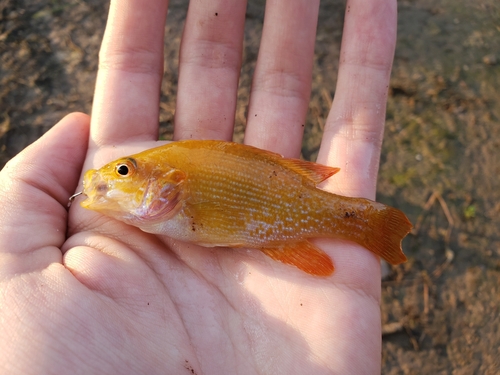
The green sunfish is a species of aggressive freshwater fish in the sunfish family (Centrarchidae) of order Centrarchiformes. The green sunfish does not always grow large enough to be an appealing target for anglers, but it is kept as an aquarium fish by hobbyists. They grow to be 3β6 inches (7.6β15.2Β cm) long on average, but can achieve a length of 12 inches (30Β cm).
π Etymology
The generic name Lepomis derives from the Greek λΡΟΞ―Ο (scale) and ΟΟΞΌΞ± (cover, plug, operculum). The specific epithet, cyanellus, derives from the Greek ΞΊΟ
Ξ±Ξ½ΟΟ (blue).
π Geographic distribution
The green sunfish is native to a wide area of North America, from the Rocky Mountains in the west to the Appalachian Mountains in the east and from the Hudson Bay basin in Canada to the Gulf Coast in the United States and northern Mexico. They are specifically indigenous to a number of lakes and rivers, such as the Great Lakes and some of the basins of the Mississippi River.
Green sunfish have been introduced to many bodies of water all across the United States. The green sunfish is considered an invasive species by the states of Arizona, California, Florida, Georgia and New Jersey, Their invasive potential is due in part to their penchant for chasing other sunfish away from mutually preferred habitat of submerged vegetation, a form of interference competition, their relatively large mouth, high fecundity and ability to tolerate sediment pollution. In the state of New Jersey, as of 2021, anglers must destroy green sunfish when caught and should report their catch to a state fisheries biologist. In the state of Florida, a permit is required in order to possess green sunfish as it is listed as a prohibited non-native species there. L. cyanellus has been transplanted to countries in Africa, Asia, and Europe, and has become established in some areas.
π Reproduction
Green sunfish begin spawning in the summer with the exact time varying with location and water temperature. When they do spawn, the males create nests in shallow water by clearing depressions in the bottom, often near a type of shelter such as rocks or submerged logs. The male defends his nest from other males using visual displays and physical force when necessary. On occasion, simply constructing a nest is sufficient for the male to attract a mate, but when it is not he will court a female with grunts and lead her to his nest.
They continue their courtship dance, swimming with each other around the nest until the female descends to deposit her eggs in the nest. The female will lay 2,000 to 26,000 eggs and leave them for the male to guard. He keeps watch over them until they hatch in three to five days, while protecting them and fanning them with his fins, keeping them clean and providing them with oxygenated water. When they hatch, the fry remain near the nest for a few days, then leave to feed and fend for themselves.
π Anatomy and physiology
The retina of the green sunfish includes a mosaic of cone cells and double cone cells in a regular arrangement. The green sunfish has been theorized to have vision that is sensitive to the polarization of light, which could enhance visibility of targets in scattering media if a processing technique called polarization difference imaging is employed by the fish. Experimental evidence, however, suggests that green sunfish are not able to visually discriminate on the basis of light polarization. Thus, the function of the green sunfish's retinal patterning is not known, although the two different types of cone cell present in green sunfish do facilitate color discrimination.
π IGFA records
The International Game Fish Association (IGFA) all-tackle world record for the species stands at , caught from Stockton Lake, Missouri in 1971.
π Aquaria
An aggressive sunfish, it is difficult to keep with other green sunfishes, other sunfishes, or even other perciform fishes in general unless kept in very spacious aquaria or ponds. Like many fishes, it is more tolerant of distantly related species (i.e., catfishes and minnows), if they are too large to be eaten. The green sunfish accepts a variety of foods, including flakes, pellets, krill, brine shrimp, bloodworms, and live prey.