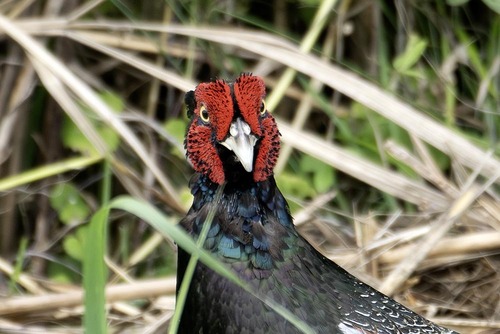
The green pheasant, also known as the Japanese green pheasant or Kiji, is an omnivorous bird native to the Japanese archipelago, to which it is endemic. Some taxonomic authorities consider it a subspecies of the common pheasant, Phasianus colchicus. It is the national bird of Japan.
📌 Taxonomy and systematics
Some sources claim that the green pheasant is a subspecies of the common pheasant, though others claim that they are separate, though closely related, species. The green pheasant has three subspecies. The nominate subspecies, P. v. versicolor, is called the southern green pheasant or kiji. The Pacific green pheasant, P. v. tamensis, and northern green pheasant, P. v. robustipes, are the other two subspecies. There are some cases of hybrids between the green pheasant and the copper pheasant or common pheasant.
📌 Behavior
===Diet===
In the wild, green pheasants eat small animals, such as worms and insects, grains and plants. They are, in captivity, sometimes fed pellets, seeds, plants and live food.
📌 Breeding
The green pheasants' breeding season starts during March or April and ends in June. Green pheasants can first breed when they are about one year old. One clutch has between six and fifteen eggs. The eggs are incubated for 23 to 25 days.
, Japan]]
📌 In culture
In Japan, many people claim that green pheasants are scared by earthquakes and 'scream'. They are the national bird of Japan It was featured on the Japanese 10,000 yen note.
📌 Habitat and distribution
It is found throughout Honshu, Shikoku, and Kyushu as well as some smaller islands;
In its native range, the green pheasant outcompetes introduced populations of common pheasant; despite the two species close relation, they have differing ecological requirements, and the common pheasant is less adapted to the ecology of the green pheasant's range.
📌 Conservation
Though the green pheasant population is decreasing, it is not severely fragmented. On a local and national level, green pheasants are used for food, sport hunting, specimen collecting and as pets or display animals. None of these practices are found on an international level.