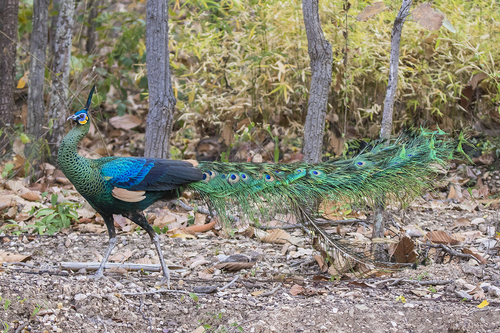
The green peafowl is a peafowl species native to the tropical forests of Southeast Asia and Southern China. It is the national bird of Myanmar. Formerly common throughout Southeast Asia, only a few isolated populations survive in Cambodia and adjacent areas of Vietnam. It has been listed as endangered on the IUCN Red List since 2009. This is primarily due to widespread deforestation, agriculture and loss of suitable habitat, severely fragmenting populations and contributing to an overall decline in numbers. The green peafowl is in demand for private and home aviculture and threatened by the pet trade, feather collectors and hunters for meat and targeted.
🛡️ Conservation Status
endangered
en
📌 Distribution and habitat
The green peafowl was widely distributed in Southeast Asia in the past from southern China especially Yunnan, eastern and north-eastern India, southeastern Bangladesh, northern Myanmar, extending through Laos, and Thailand into Vietnam, Cambodia, Peninsular Malaysia, and the island of Java in Indonesia, but in Java they are only found in protected areas such as Ujung Kulon National Park and Baluran National Park. Records from northeastern India have been questioned and old records are possibly of feral birds.
Green peafowl are found in a wide range of habitats, including primary and secondary forest, both tropical and subtropical, as well as evergreen and deciduous. They may also be found amongst bamboo, on grasslands, savannas, scrub, and farmland edge. In Vietnam, the preferred habitat was found to be dry, deciduous forest close to water and away from human disturbance. In Java they are only found in savanna. Proximity to water appears to be an important factor.
📌 Taxonomy
The species was first classified as Pavo muticus by Carl Linnaeus, although it was previously described in Europe by Ulisse Aldrovandi as "Pavo Iaponensis" based on a Japanese painting given to the pope by the emperor of Japan. These birds were depicted as having no spurs; Linnaeus followed Aldrovandi's description. The Japanese had imported green peafowl from Southeast Asia for hundreds of years, and the birds were frequently depicted in Japanese paintings. As a result, the type locality described by Linnaeus was "Habitat in Japonia", though the species is not native to Japan (they were kept by the emperor and no longer occur). François Levaillant was one of the first Western ornithologists to see a live bird, imported from Macau to an animal collection in Cape of Good Hope. From an Indian painting, George Shaw described a peafowl native to India with a "blue head" and an "upright lanceolate crest", which he named Pavo spicifer, the spike-crested peacock. A third form of green peafowl was described in 1949 by Jean Delacour, as P. imperator, found in Indochina. From the advice of a bird dealer in Hong Kong, Delacour concluded there were three races of green peafowl, lumping P. spicifer into the species, as well. Today, most authorities recognise these three:
📌 Behaviour and ecology
, Indonesia]]
The green peafowl is a forest bird which nests on the ground laying an egg clutch with three to six eggs.
It has been widely stated that the green peafowl is polygynous, but males are solitary and do not display in leks. Instead the solitary males are highly territorial and form harems with no pair bonds. However, the theory that the male is polygynous also conflicts with observations in captivity; pairs left alone with no human interaction have been observed to be strongly monogamous. The close similarity between both sexes also suggests a different courtship display in contrast to that of the Indian peafowl. Thus, some authors have suggested that the harems seen in the field are juvenile birds and that males are not promiscuous.
They usually spend time on or near the ground in tall grasses and sedges. Family units roost in trees at a height of .
📌 Threats
Due to hunting, especially poaching, and a reduction in extent and quality of habitat, the green peafowl is evaluated as endangered on the IUCN Red List of Threatened Species. The world population has declined rapidly, and the species no longer occurs in many areas of its past distribution. The population in the wild was estimated to be about 5,000 to 10,000 individuals around 1995.
Although there is no natural range overlap with the Indian peafowl, hybridisation is still a threat where the Indian peafowl is introduced as they produce fertile hybrids. In captivity hybrids are called "Spalding" peafowl and are used by breeders to create different breeds. Through backcrossing some hybrids become almost indistinguishable from pure green peafowl.
📌 Conservation
The green peafowl is listed on Appendix II of CITES.
📌 Cultural significance
In Myanmar, the green peafowl was the coat of arms of the Konbaung dynasty, the country's last dynasty. The insignia was stitched onto royal costumes, and was the primary motif of the Peacock Throne, one of eight royal palin thrones. The peacock symbolised the Sun, from which the Burmese monarchs claimed their descent.