Cotinis nitida, commonly known as the green June beetle, June bug or June beetle, is a beetle of the family Scarabaeidae. It is found in the eastern United States and Canada, where it is most abundant in the South. It is sometimes confused with the related southwestern species figeater beetle Cotinis mutabilis, which is less destructive.
📌 Life cycle
The complete life cycle for the green June beetle is one year.
📌 Egg
Mating occurs in the early morning. The male is attracted by a strongly scented milky fluid secreted by the female. Mating lasts only a few minutes after which the female enters her burrow or crawls under matted grass. Once the mating process has taken place, the female will lay between 60 and 75 eggs underground during a two-week period. The eggs, when first laid, appear white and elliptical in shape, gradually becoming more spherical as the larvae develop. The eggs hatch in approximately 18 days into small, white grubs.
📌 Larva
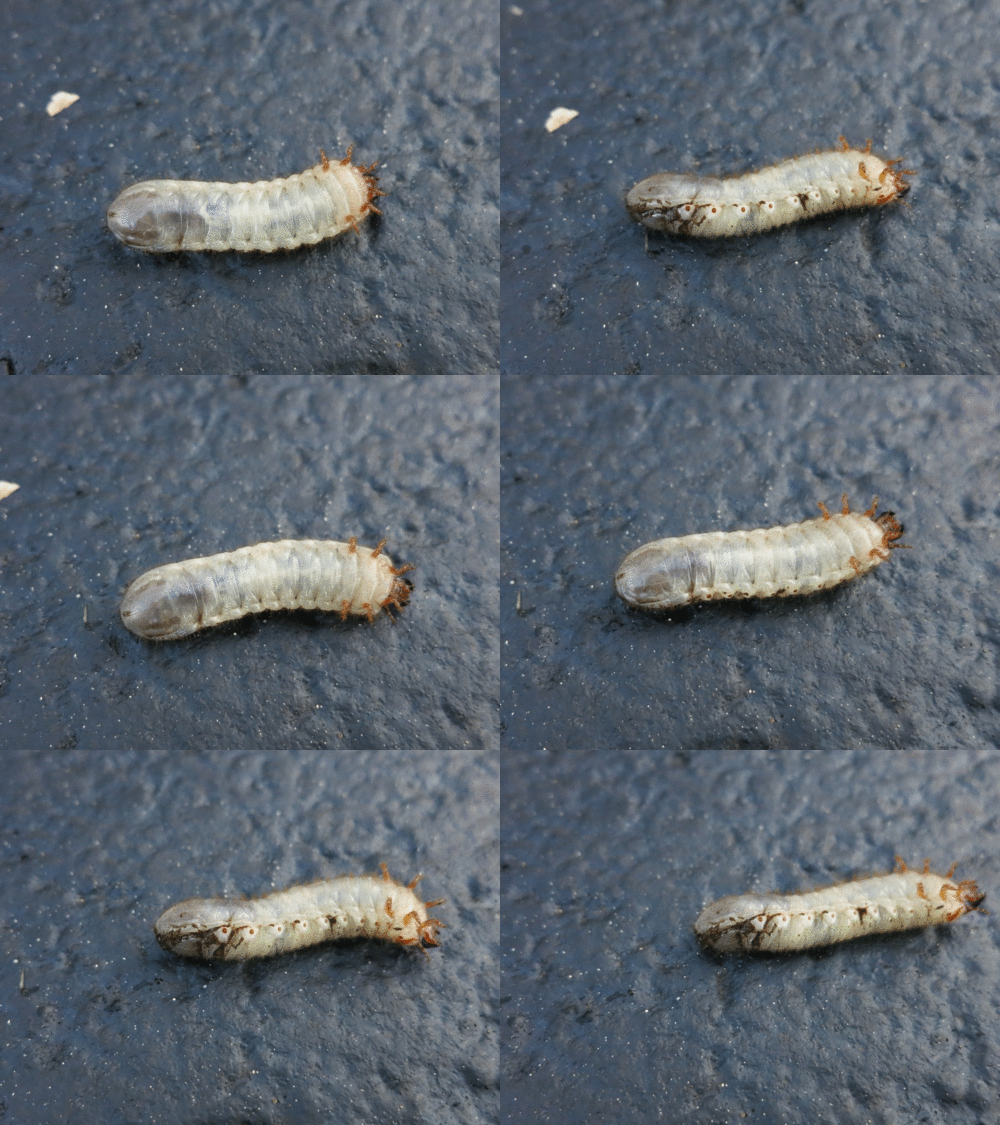
The grubs will grow to about and are white with a brownish-black head and brown spiracles along the sides of the body. The larvae will molt twice before winter. The fully grown larva color is glassy yellowish white shading toward green or blue at the head and tail. The larva has stiff ambulatory bristles on its abdomen which assist movement. The larva normally travels on its back. The underground speed is considered more rapid than any other known genus of Scarabaeidae in the United States and is comparable to that of the hairy caterpillar. The larvae feed largely on humus and mold but can do considerable damage to plant root systems. Injury has been reported to vegetables and ornamental plants, particularly those which have been mulched. The larvae are considered pests when they cause damage to lawns or turf grasses. The insect is considered more injurious in its larval stages than as a beetle. Pupation occurs after the third larval stage, which lasts nearly nine months. The pupal stage occurs in an oval cocoon constructed of dirt particles fastened together by a viscid fluid excreted by the larva. The pupa is white when first formed but develops greenish tints just before emergence.
📌 Adult
The adults after 18 days of the pupation period. The adult is from in length and in width. The colour varies from dull brown with green stripes to a uniform metallic green. The margins of the elytra vary from light brown to orange yellow. The adult beetle will feed upon a variety of fruits including berries, grapes, peaches, nectarines, apples, pears and figs. Adults are particularly attracted to rotting fruit which often occurs after an initial damage to sound fruit.
📌 Predation
The grubs of the beetle are largely held in control by natural predators.
Tall grasses offer beetles some protection, but they are easily hunted by birds in lawns with shorter grasses maintained by human interventions.
📌 Interactions
=== With one another ===
There is intense competition between males for access to mates and oftentimes more than one male tries to mate with a female at the same time. Part of this competition is because females are only receptive to mating attempts once in a given period of time, whereas males can mate repeatedly.
📌 With other insects
The larval stages of the friendly fly or large flesh fly (Sarcophaga aldrichi) have been observed attached near the base of the head and thorax of the adult beetle. The fly larvae have been observed inside the devoured thorax and abdomen of the beetle.
The flesh fly (Sarcophaga helicobia) has been observed to prey on both the larval and adult stage of the June beetle.
The digger wasp (Scolia dubia) attacks the larval stage of the beetle. The female will crawl into the larva burrow and lay her eggs on the grub.
📌 With vertebrates
Below ground, large number of larvae are consumed by moles. During rainy periods, when the burrows of the larvae are flooded, the larvae will crawl to the surface. At these times, the larvae are subject to predation by raccoons, gophers, skunks, opossums, and chipmunks.
Birds, notably the American crow, common grackle, northern mockingbird and blue jay, will also attack the adult.
📌 Geographic range
The geographic range of Cotinis nitida extends across the eastern United States and Canada, with its highest abundance in the South. They can be found from New Brunswick to Georgia and westward as far as California, with possible population overlap with their western cousin, the figeater beetle (Cotinis mutabilis).
The green June beetle is a Nearctic species of beetle. It is commonly found in New York, Florida, Nebraska, and Texas. Larvae of green June beetles live in the soil underground, and adults live on their host plants. They can be found on lawns, fields, and forests. They inhabit extensive habitats.
📌 Economic importance
Cotinis nitida can be prevented from causing large damage to crops by covering crops in pesticide. Pesticide usage can build up in water runoff and affect local communities and their water supply, leading to an increase in spending involving water purification. This increase in pesticides also causes issues involving cattle, mainly swine, and may cause health defects. Attempting to use these pesticides may cause a loss in other areas of earnings involving these same farms.
Green June beetles often follow other predatory bug species in consuming plants, as they do not typically consume fruits which have not already been broken open. As such, if other predatory insects are kept from crops, the green June beetle should not become an issue in terms of gross earnings for any specific crop.