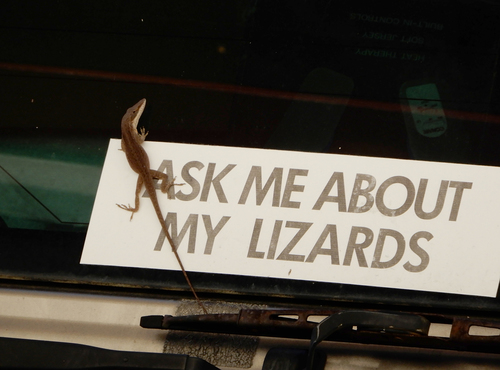
Anolis carolinensis or green anole is a tree-dwelling species of anole lizard native to the southeastern United States and introduced to islands in the Pacific and Caribbean. A small to medium-sized lizard, the green anole is a trunk-crown ecomorph and can change its color to several shades from brown to green.
📌 Taxonomy
Anolis carolinensis is a species of the large lizard genus Anolis within the family Dactyloidae (anole lizards). This species was named by Friedrich Siegmund Voigt (1781-1850) in 1832.
📌 Coloration and color morphs
, South Carolina, demonstrating camouflage]]
Colour varies from brown to green and can be changed like many other kinds of lizards, but anoles are closely related to iguanas and are not true chameleons. Although A. carolinensis is sometimes called an 'American chameleon', true chameleons do not naturally occur in the Americas, and A. carolinensis is not the only lizard currently in its area of distribution capable of changing colour. In contrast, many species of true chameleons display a greater range of color adaptation, though some can hardly change color at all.
Typical coloration for a green anole ranges from bright green to dark brown, with little variation in between. The color spectrum is a result of three layers of pigment cells or chromatophores: the xanthophores, responsible for the yellow pigmentation; cyanophores, responsible for the blue pigmentation, and melanophores, responsible for the brown and black pigmentation. The anole changes its color depending on mood, level of stress, activity level and as a social signal (for example, displaying dominance). Anolis carolinensis takes darker coloration as its base color at the beginning of the breeding season when it is generally cooler, and the adult males change their body coloration to more greenish when they need to advertise their territorial possession. Although often claimed, evidence does not support that they do it in response to the color of the background (camouflage). Whether they do it in response to temperature (thermoregulation) is less clear, with studies both supporting it and contradicting it. Changing color while under a sharply contrasting shadow can cause a "stencil effect", where the outline of the shadow is temporarily imprinted in the animal's coloration (see image in gallery, below). When stressed—while fighting, for example—the skin just behind the lizard's eyes may turn black independently from the rest of the animal's coloration, forming "postocular spots".
A lack in one of the pigment genes causes color exceptions. These color mutations are also called phases. The rare blue-phased green anole lacks xanthophores, which results in a blue, rather than red, often pastel blue, anole. These specimens have become popular recently in the pet trade market. When the anole is completely lacking xanthophores, it is said to be axanthic and the animal will have a completely pastel- or baby-blue hue. They are extremely rare—usually produced in one of every 20,000 individual anoles in the wild. Another phase is the yellow-phased green anole, which lacks cyanophores. Colonies of these rare color-phased anoles have been reported, but anoles with these color mutations rarely live for long, since the green color provides camouflage for hunting down prey, as well as hiding from predators.
📌 Distribution and habitat
]]
This species is native to North America, where it is found mainly in the subtropical southeastern parts of the continent. Anoles are the most abundant on the Atlantic Coastal Plains in North Carolina, South Carolina, Georgia and Florida, and on the Gulf Coast in Alabama, Mississippi, Louisiana, and Texas, where they extend inland as far as Texas Hill Country and the DFW Metroplex; they have also been recorded in Tamaulipas, Mexico, but it is mostly likely an introduction. In the Carolinas, they are found on the coastal plains as far north as False Cape in Virginia, and in the southern piedmont of North Carolina, but throughout South Carolina, Green anoles have also been considered successful invaders as they have made their way into parts of Europe. They have been sighted in Orange County and San Diego County of southern California, with sightings in San Diego going at least as far back as 1993.
A. carolinensis is arboreal in nature but may be seen on the ground and frequently seen on shrubs in the low country of the Carolinas. However, it can live in cities like Atlanta with little trouble so long as there is plentiful vegetation and bugs to eat. Compared to other species of lizards, green anoles are known to be the ones with the most adaptation to human encroachment. One can observe them on steps, trellises, and railings adjacent to foliage; on particularly hot summer days they may seek to cool off on indoor walls or on wrap around porches of older buildings, and in the former case can simply be captured in a shoebox and gently placed outdoors. It is common on roadsides, the edges of forests where there are shrubs and vines, but also construction sites having abundant foliage and sunlight. Their preferred habitat is open pine communities with a greater shrub density, it may harbor a greater abundance of anoles where they are able to watch for prey and intruders coming into their territory.
📌 Conservation
, e.g. among A. carolinensis and A. porcatus. The hybrid zone of the two species' lineages is shown in blue, with each horizontal line representing an individual introgressive event.]]
Although not threatened as a species, Carolina anoles increasingly struggle with competition from introduced anole species, such as the brown anole (Anolis sagrei), also known as the Bahamian anole. This competition happened to be an interesting model for evolutionary studies, as it illustrates the process of adaptation. When A. sagrei first appeared in the United States in the early 1900s, the Carolina anole mostly ceded ground-level territories and were relegated to a very different ecosystem high in the treetops. On occasion, more aggressive Carolina anole individuals may still be seen closer to the ground. Currently, A. carolinensis is abundant in its area of distribution and is able to thrive in disturbed areas, so it is not considered threatened, but A. sagrei may represent a developing threat in some areas.
📌 Relationships and hybridization
{{Location map|Florida
|float = left
|width=200
|caption = Location of hybridization between A. carolinensis and A. porcatus A 2022 study found there to be asymmetric introgression of certain A. porcatus alleles within the population of hybrid individuals, three of which were found to be significantly associated with environmental variables indicative of urbanization. It remains uncertain as to how this admixture of invasive alleles to the Carolina anole will affect the conservation of the species going forward. Not all admixture from invasive populations should be viewed as a negative outcome, and adaptive introgression as a result of hybridization with an ecologically robust invasive population might facilitate the long-term survival of native populations otherwise unable to adapt to human impact on the environment.
📌 Behavior
Male anoles are strongly territorial creatures. Some have even been witnessed fighting their own reflections in mirrored glass. The male will fight other males to defend his territory. On sighting another male, the anole will compress his body, extend the dewlap, inflate a dorsal ridge, bob his head and attempt to chase the rival away. If the rival male continues to approach, anoles will fight by biting and scratching each other. Studies have also shown that there is a positive correlation between bite-force and the size of the individual's dewlap. For heavyweight males of the same size the one with the higher bite force wins disputes more frequently.
Adult female anoles have much smaller dewlaps that they rarely use during encounters with other anoles and never use during courting. Serious injury is rare, but males often carry numerous scars on their heads and faces, especially during the mating season. Their territories, which are about , usually include two to three females.
The Carolina anole is diurnal and active throughout the year, peaking in spring and fall. Winter activity is dependent on sun and temperature.
📌 Predators
Major predators include the broadhead skink, snakes, birds, and in urban habitats, cats. Like many lizards, anoles display autotomic tails, which wiggle when broken off. This distracts the predator and helps the anole to escape. A new tail then starts to develop.
Anoles are parasitized by some species of sarcophagid flies, including Lepidodexia blakeae. Adult flies will deposit eggs on live anoles, and the fly larvae develop inside the lizard until they emerge from a wound and pupate into adult flies in sediment. Infection is often fatal, with mortality rates possibly as high as 90%.
📌 Reproduction
The typical breeding season for Carolina anoles starts as early as April and ends in late September, gonadal activity being largely regulated by photoperiod, enlarging in spring as the weather warms up and days lengthen, and then regressing in late summer. At the beginning of the non-breeding season, green anoles experience a refractory season, which would occur from late fall until late winter/early spring.
During this time, the males patrol their territory and the most brilliant displays of these creatures can be seen. Males are known to be very territorial and can inflict serious wounds by biting other males. Males defend their territory and females from rivals, while courting the females with elaborate displays of extending their brightly colored dewlaps while bobbing up and down, almost doing a dance. The dewlap is also used to ward off other males. The male courts and pursues a female until the two successfully mate. Usually, when the female is ready to mate, she may let the male catch her, at which point he will grasp her by biting a fold of her skin behind her neck. The male will then position his tail underneath the female's tail near her vent. Males have two sex organs, known as hemipenes, which are normally kept within the body, but are everted from his vent for mating. Males seem to alternate between the left and right hemipenis on successive matings.
The female matures one ovarian follicle at a time, the ovaries alternating in production. The sight of a courting male induces ovarian development, sexual receptiveness and then ovulation. About two to four weeks following mating, the female lays her first clutch of eggs, usually one or two in the first clutch. She can produce an egg every two weeks during the breeding season, until about 10 eggs have been produced. However, she can store sperm for up to eight months following mating. She then buries the soft-shelled eggs in a shallow depression in soft soil, leaf litter, compost, rotting wood, or even a hole in a nearby tree. Eggs average by in size.
The eggs are left to incubate by the heat of the sun, and if successful, will hatch in about five to seven weeks (30–45 days) from late May to early October. The incubation temperature has to be . On hatching, the hatchlings are in length.
The hatchlings must fend for themselves, as they are not cared for by either parent. The young hatchlings must be wary of other adult anoles in the area, as well as larger reptiles and mammals, which could eat them. Younger anoles differ from adults in having less obvious head ridges, a wider head and shorter tail. They mature in about eight months.
📌 Captivity
Carolina anoles' nervous natures makes it advisable not to attempt to handle them very often; despite this, Carolina anoles are popular pets. If nervous, they can bite their handlers, and can potentially lose their tail in the process of escaping. Individual animals may or may not adapt readily to cage life. Care must be taken to ensure the animals receive the support they need to adapt to captivity. An adequately sized enclosure, as well as the appropriate plants and substrate material, are beneficial to the health of captive Carolina anoles.
A green anole in captivity, if cared properly, can live up to 8 years. These lizards can be easily kept in a 10-gallon aquarium as they rarely grow more than 8 inches.
However, there should be one male green anole in a tank as they are territorial and may end up fighting for the territory. Keeping multiple female green anoles in a tank won't create any problem unless there isn't enough room for them.
Green anoles are considered to be a good pet for beginners as they are easy to care for. Their habitat should include the following:
* Humidity level should be kept at 60-70%.
* Day temperature should be maintained at .
* Night temperature should be maintained at .
* A basking light should be installed in the tank and a temperature of must be maintained.
* Natural light is best for reptiles, but a UVB light can be installed in the terrarium. A 5.0 UVB light would be a good option.
* Green anoles are terrestrial lizards and spend most of their time on the ground or climbing plants. They do not dig or burrow. A substrate should not be harmful for their skin. Substrate can be made using coconut coir, moss, reptile soil, etc., which is natural and also helps maintain moisture and temperature.
* Hatchlings should be given 2-3 food items (insects) once a day, whereas an adult should be fed 2-3 food insects every other day. Gut loading or dusting of insects can provide better nutrients to the lizards in captivity.
📌 Genomics
This species has been chosen as a model reptile for genomics by the National Human Genome Research Institute genome sequencing program. It was selected because of the ease and low cost of laboratory breeding and evolutionary value of the diversity of the genus. In 2011, the complete genome of this lizard was sequenced and published in Nature. Before its genome was published, only mammals and three bird species had been sequenced among amniotes. The draft genome sequence is 1.78 Gb (compared with 2.0–3.6 Gb mammalian and 0.9–1.3 Gb avian genome assemblies), of which 27% are mobile elements such as LINEs. A total of 17,472 protein-coding genes and 2,924 RNA genes were predicted from the A. carolinensis genome assembly.