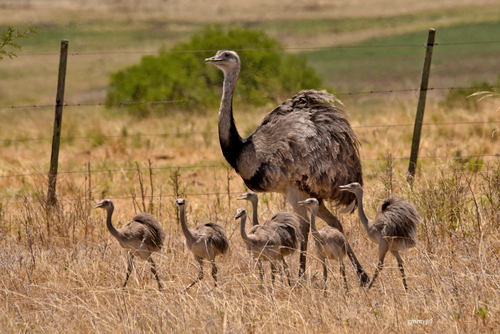
The greater rhea is a species of flightless bird native to eastern South America. Other names for the greater rhea include the grey, common, or American rhea; ema (Portuguese); or ñandú. One of two species in the genus Rhea, in the family Rheidae, it inhabits a variety of open areas, such as grasslands, savanna or grassy wetlands. Weighing 20–27 kilograms (44–60 lb), the greater rhea is the largest native bird in the Americas. In the wild, the greater rhea has a life expectancy of 10.5 years. It is also notable for its reproductive habits, and for the fact that a population has established itself in Northern Germany in the 2000s and 2010s. The species is listed as Near Threatened by the IUCN.
🛡️ Conservation Status
near threatened
nt
📌 Taxonomy
The greater rhea was formally described in 1758 by the Swedish naturalist Carl Linnaeus in the tenth edition of his Systema Naturae. He placed it with the ostriches in the genus Struthio and coined the binomial name Struthio americanus. Linnaeus based his account on the "Nhanduguaçú" that had been described in 1648 by the German naturalist Georg Marcgrave in his book Historia Naturalis Brasiliae. Linnaeus designated the type locality as South America but this has been restricted to the states of Sergipe and Rio Grande do Norte in eastern Brazil based on Marcgrave. The greater rhea is now placed in the genus Rhea that was introduced in 1760 by the French zoologist Mathurin Jacques Brisson. The common name and genus name is from Rhea, a Greek goddess. This species is placed in the family Rheidae, and the order Rheiformes. It closely related to other ratites such as emus, ostriches, cassowaries, and kiwi, along with the extinct forms: moa and elephant birds.
📌 Subspecies
There are five subspecies of the greater rhea; their ranges meet around the Tropic of Capricorn:
{| class="wikitable "
|-
! Image !! Subspecies !! Distribution
|-
| || R. a. americana ||campos of northern and eastern Brazil
|-
| || R. a. intermedia ||Uruguay and extreme southeastern Brazil (Rio Grande do Sul state)
|-
| || R. a. nobilis ||eastern Paraguay, east of Rio Paraguay
|-
| || R. a. araneipes ||chaco of Paraguay and Bolivia and the Mato Grosso state of Brazil
|-
| || R. a. albescens ||plains of Argentina south to the Rio Negro province
|-
|}
Main subspecific differences are the extent of the black coloring of the throat and the height. However, subspecies of the greater rhea differ so little across their range that, without knowledge of the place of origin, it is essentially impossible to identify captive birds by subspecies.
📌 Distribution and habitat
The greater rhea is native to Argentina, Bolivia, Brazil, Paraguay, and Uruguay. There are also feral populations of the greater rhea in Germany. In the autumn of 2018, the German population grew to 566 individuals, and hunting of the birds was allowed; additionally, the population was reduced by destroying eggs during breeding season.
📌 Behavior and ecology
===Individual and flock behavior===
The greater rhea is a silent bird except during mating season, when they make low booming noises, and as chicks, when they give a mournful whistle. During the non-breeding season they will form flocks of between 10 and 100 birds. When in flocks, they tend to be less vigilant, but the males can get aggressive towards other males. When chased they will flee in a zigzag pattern, alternately raising one wing then the other. These flocks break up in the winter in time for breeding season.
📌 Feeding and diet
, Cape Town, RSA]]
, Corrientes Province, Argentina]]
The rhea's diet mainly consists of broad-leaved foliage, particularly seed and fruit when in season, but also insects, scorpions, fish, small rodents, reptiles, and small birds.
Favorite food plants include native and introduced species from all sorts of dicot families, such as Amaranthaceae, Asteraceae, Bignoniaceae, Brassicaceae, Fabaceae, Lamiaceae, Myrtaceae or Solanaceae. Magnoliidae fruit, for example of Duguetia furfuracea (Annonaceae) or avocados (Persea americana, Lauraceae) can be seasonally important.
They do not usually eat cereal grains, or monocots in general. However, the leaves of particular grass species like Brachiaria brizantha can be eaten in large quantities, and broad-leaved plants (e.g. the sarsaparilla Smilax brasiliensis) have also been recorded as foodplants. Even tough and spiny vegetable matter like tubers or thistles is eaten with relish.
Like many birds which feed on tough plant matter, the greater rhea swallows pebbles which help grind down the food for easy digestion. It is much attracted to sparkling objects and sometimes accidentally swallows metallic or glossy objects. Rheas are also coprophagous and occasionally consume fresh fecal matter of other rheas.
field in Mecklenburg-Vorpommern, Germany. The species normally uses such monocultures to hide rather than to feed on the plants.]]
In fields and plantations of plants they do not like to eat, e.g., cereals or eucalyptus, the greater rhea can be a species quite beneficial to farmers. It will eat any large invertebrate it can catch; its food includes locusts and grasshoppers, true bugs, cockroaches, and other pest insects. Juveniles eat more animal matter than adults. In mixed cerrado and agricultural land in Minas Gerais (Brazil), R. a. americana was noted to be particularly fond of beetles. It is not clear whether this applies to the species in general but for example in pampas habitat, beetle consumption is probably lower simply due to availability while Orthoptera might be more important.
The greater rhea is able to eat Hymenoptera in quantity. These insects contain among them many who can give painful stings, though the birds do not seem to mind. Sometimes, greater rheas will gather at carrion to feed on flies; they are also known to eat dead or dying fish in the dry season, but as vertebrate prey in general not in large quantities.
📌 Reproduction
]]
with hatchling at its feet]]
After the large flocks break up in the winter, they form into three loose groups:
📌 Predators
The natural predators of adult greater rheas are limited to the cougar (Puma concolor), which are found in most areas inhabited by greater rheas and are certain to be their leading predator, and the jaguar (Panthera onca), which are found with greater rheas and opportunistically hunt them in the Paraguayan chaco, central Bolivia and the Brazilian cerrado. Feral dogs are known to kill younger birds, and the crested caracara (Caracara plancus) is suspected to prey on hatchlings. Armadillos sometimes feed on greater rhea eggs; nests have been found which had been undermined by a six-banded armadillo (Euphractus sexcinctus) or a big hairy armadillo (Chaetophractus villosus) and the rhea eggs were broken apart. Predation on young rheas has also been reportedly committed by greater grisons (Galictis vittata).
Captive-bred greater rheas exhibit significant ecological naïveté. This fearlessness renders them highly vulnerable to predators if the birds are released into the wild in reintroduction projects. Classical conditioning of greater rhea juveniles against predator models can prevent this to some degree, but the personality type of the birds – whether they are bold or shy – influences the success of such training. In 2006, a protocol was established for training greater rheas to avoid would-be predators, and for identifying the most cautious animals for release.
📌 Status and conservation
The greater rhea is considered a Near Threatened species according to the IUCN, and they have a decreasing range of about . German authorities have issued 'alternatives' to culling the birds which still sparks controversy.
📌 Relationship with humans
Ancient humans in the Patagonia region used to hunt greater rhea, and stencils of greater rhea feet dating back to the early Holocene can be found at rock art sites such as Cueva de las Manos.
The species is farmed in North America and Europe in a similar fashion to other ratites, such as the emu and ostrich. The main products are meat and eggs, but rhea oil is used for cosmetics and soaps, and rhea leather is also traded in quantity. Male greater rheas are very territorial during the breeding season. The infant chicks have high mortality in typical confinement farming situations, but under optimum free-range conditions chicks will reach adult size by their fifth month.