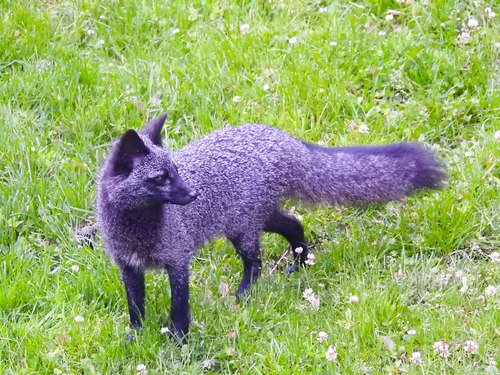
The gray fox, or grey fox, is an omnivorous mammal of the family Canidae, widespread throughout North America and Central America. This species and its only congener, the diminutive island fox of the California Channel Islands, are the only living members of the genus Urocyon, which is considered to be genetically sister to all other living canids. Its species name cinereoargenteus means "ashen silver".
📌 Etymology
The genus Urocyon comes from Ancient Greek οὐρά (ourá, "tail") + κύων (kúōn, "dog"). The species epithet cinereoargenteus is a combination of 'cinereo' (from 'cinereus') meaning ashen, and 'argenteus' (from argentum), meaning 'silver', referencing the color of the tail.
📌 Origin and genetics
in California]]
The gray fox appeared in North America during the mid-Pliocene (Hemphillian land animal age) epoch ago (AEO) with the first fossil evidence found at the lower 111 Ranch site, Graham County, Arizona with contemporary mammals like the giant sloth, the elephant-like Cuvieronius, the large-headed llama, and the early small horses of Nannippus and Equus. Genetic analysis has shown that the gray fox migrated into the northeastern United States post-Pleistocene in association with the Medieval Climate Anomaly warming trend.
Genetic analyses of the fox-like canids confirmed that the gray fox is a distinct genus from the red foxes (Vulpes spp.). The genus Urocyon is considered to be sister to the other living canid taxa. Genetically, the gray fox often clusters with two other ancient lineages: The east Asian raccoon dog (Nyctereutes procyonoides) and the African bat-eared fox (Otocyon megalotis).
The chromosome number is 66 (diploid) with a fundamental number of 70. The autosomes include 31 pairs of sub-graded subacrocentrics, but one only pair of metacentrics.
Recent mitochondrial genetic studies suggests divergence of North American eastern and western gray foxes in the Irvingtonian mid-Pleistocene into separate sister taxa.
The gray fox's dwarf relative, the island fox, is likely descended from semi-domesticated mainland gray foxes. These foxes apparently were transported by humans to the islands and from island to island, and are descended from a minimum of 3–4 matrilineal founders.
📌 Distribution and habitat
]]
The species occurs throughout most rocky, wooded, brushy regions of the southern half of North America from southern Canada (Manitoba through southeastern Quebec) to the northern part of South America (Venezuela and Colombia), excluding the mountains of northwestern United States. It is the only canid whose natural range spans both North and South America. In some areas, high population densities exist near brush-covered bluffs. In southeastern Mexico, the species prefers areas with a human presence such as near roads.
📌 Behavior
The gray fox is specifically adapted to climb trees. Its strong, hooked claws allow it to scramble up trees to escape many predators, such as the domestic dog or the coyote, It descends primarily by jumping from branch to branch, or by descending slowly backwards like a domestic cat. The gray fox is primarily nocturnal or crepuscular and makes its den in hollow trees, stumps or appropriated burrows during the day. Such gray fox tree dens may be located above the ground.
📌 Interspecies competition
(Vulpes vulpes) confronting a gray fox, San Joaquin Wildlife Refuge ]]
Gray foxes often hunt for the same prey as bobcats and coyotes who occupy the same region. To avoid interspecific competition, the gray fox has developed certain behaviors and habits to increase their survival chances. In regions where gray foxes and coyotes hunt for the same food, the gray fox has been observed to give space to the coyote, staying within its own established range for hunting. Gray foxes may also avoid competitors by occupying different habitats from them. In California, gray foxes do this by living in chaparral where their competitors are fewer and the low shrubbery provides them a greater chance to escape from a dangerous encounter. This explains the gray fox's tendency to change behavior in response to the coyote threat, as they are essentially lower on the food chain.
📌 Reproduction
The gray fox is assumed to be monogamous, like other foxes. The breeding season of the gray fox varies geographically; in Michigan, the gray fox mates in early March, in Alabama, breeding peaks occur in February. The gestation period lasts approximately 53 days. Litter size ranges from 1–7, with a mean of 3.8 young per female.
]]
The sexual maturity of females is around 10 months of age. Kits begin to hunt with their parents at the age of 3 months. By the time that they are 4 months old, the kits will have developed their permanent dentition and can now easily forage on their own. The family group remains together until the autumn, when the young males reach sexual maturity, then they disperse. Adult gray foxes showed no signs of dispersion for either sex. The gray fox will typically live between six and ten years.
The annual reproductive cycle of males has been described through epididymal smears. They become fertile earlier and remain fertile longer than females.
Logs, trees, rocks, burrows, or abandoned dwellings serve as suitable den sites. Dens are used at any time during the year but mostly during whelping season. Dens are built in brushy or wooded regions and are better concealed than the dens of the red fox.
📌 Ecosystem role
Since woodrats, cotton rats, and mice make up a large part of the gray fox's diet, they serve as important regulators of small rodent populations.
In addition to their beneficial predation on rodents, gray foxes are also less welcome hosts to some external and internal parasites, which include fleas, lice, nematodes, and tapeworms.
📌 Hunting
Gray foxes are hunted in the U.S. The intensity of the hunting has correlated with the value of their pelts. Between the 1970–1971 and 1975–1976 hunting seasons, the price of gray fox pelts greatly increased and the number of individuals hunted jumped over six-fold from 26,109 to 163,458.
📌 Subspecies
There are 16 subspecies recognized for the gray fox.
* Urocyon cinereoargenteus borealis (New England)
* Urocyon cinereoargenteus californicus (southern California)
* Urocyon cinereoargenteus cinereoargenteus (eastern United States)
* Urocyon cinereoargenteus costaricensis (Costa Rica)
* Urocyon cinereoargenteus floridanus (Gulf states)
* Urocyon cinereoargenteus fraterculus (Yucatán)
* Urocyon cinereoargenteus furvus (Panama)
* Urocyon cinereoargenteus guatemalae (southernmost Mexico south to Nicaragua)
* Urocyon cinereoargenteus madrensis (southern Sonora, south-west Chihuahua, and north-west Durango)
* Urocyon cinereoargenteus nigrirostris (south-west Mexico)
* Urocyon cinereoargenteus ocythous (Central Plains states)
* Urocyon cinereoargenteus orinomus (southern Mexico, Isthmus of Tehuantepec)
* Urocyon cinereoargenteus peninsularis (Baja California)
* Urocyon cinereoargenteus scottii (south-western United States and northern Mexico)
* Urocyon cinereoargenteus townsendi (northern California and Oregon)
* Urocyon cinereoargenteus venezuelae (Colombia and Venezuela)
📌 Parasites
Parasites of gray fox include trematode Metorchis conjunctus. Other common parasites that were collected on gray foxes in Texas were a variety of tapeworms (Mesocestoides litteratus, Taenia pisiformis, Taenia serialis) and roundworms (Ancylostoma caninum, Ancylostoma braziliense, Haemonchus similis, Spirocerca lupi, Physaloptera rara, Eucoleus aerophilus). T. pisiformis was the most common parasite species and was associated with frequent impacts on health.