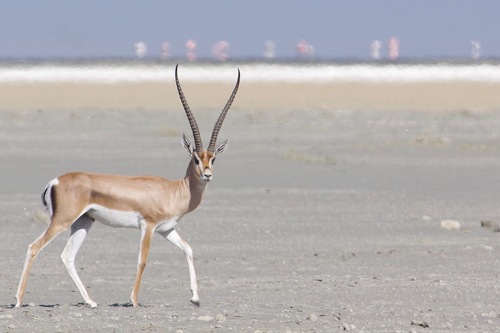
Grant's gazelle is a relatively large species of gazelle antelope, distributed from northern Tanzania to South Sudan and Ethiopia, and from the Kenyan coast to Lake Victoria. Its Swahili name is swala granti. It was named for a 19th-century Scottish explorer, James Grant.
📌 Ecology, distribution and behaviour
Grant's gazelle are found in several countries in East Africa, including Ethiopia, Kenya, South Sudan and Tanzania, where they live in small to midsized herds, separated into females with juveniles and bachelor groups; during the mating season, when males become territorial and protective over a harem of females to breed with, bachelor herds briefly married disperse before tensions die-down again. Confrontations between hormonal males rarely end in violence or death, with the 'loser' simply fleeing.
Grant's gazelle prefer living on short, grassy plains where they can graze, but can also be found browsing and foraging in more sparse, arid scrublands; they avoid areas with excessively high, untrimmed grass with compromised visibility of predators. They also occur in semiarid areas, being relatively well-adapted to drier areas, They are sometimes seasonally migratory, but do not travel along the same routes as most of the other savanna ungulates, such as the Cape buffalo, plains zebra, Thomson's gazelle and the white-bearded gnu, which are all far more susceptible to dehydration. Grant's gazelle can subsist on vegetation in waterless, semiarid areas, where they face considerably less resource competition.
The most common predators of the Grant's gazelle are the cheetah and African wild dog; the typical predatory threats of hyenas, leopards, and lions are also ever-present. African leopards may hunt Grant's gazelle, if given the opportunity, though they tend to prefer impala, an antelope which frequents the same open forest-grassland areas where leopards can sit in-wait in the trees. African lions could hunt Grant's gazelle, theoretically, though with their larger familial groups (prides), they generally pursue larger, more substantial ungulates such as buffalo, gnu, and zebra.
At rivers, streams and some lakes, Nile crocodiles are a threat to nearly any mammal (excluding rhinos, hippos or elephants) that is unaware and comes to drink or cross to the other side. Hippopotamus, while not carnivorous or outwardly predatory, are nonetheless extremely volatile beings with massive mouths and teeth, and are known to aggressively chase any other animal within their territory, including humans, at times resulting in the victim's death; a video was uploaded to YouTube of an apparently lost Grant's gazelle attempting to swim across a river filled with dozens of hippos, all of which responded with hostility. It is unclear if the gazelle made it across or not. Another video showed a Grant's gazelle attempting to flee a pursuing carnivore by retreating to the water, only to be attacked and killed by a hidden submerged hippopotamus.
Humans also hunt gazelle, the meat being fairly popular in some areas. In the Serengeti, Grant's gazelle is a potential prey item for the cheetah, but the smaller Thomson's gazelle is preferred; in Nairobi National Park, Grant's gazelle are seemingly preferred by cheetahs over Thomson's gazelle, making them an important resource for the cheetah. Most of the time, the male's stance in relation to her is enough to keep the female from leaving.
The bachelor groups are composed of adolescent males and adult males not currently holding territory. Any potentially new members will perform mock-intimidation displays to enter the group. However, bachelor groups tend to be loose and members can come and go at-will. Grant's gazelle will sometimes join groups of Thomson's gazelle to protect themselves from predators. Predators are less likely to attack the Grant's gazelle when associated with these mixed groups, perhaps because the Thomson's gazelle provides an easier target. The larger, older males with thick horns have the best chance of establishing a territory. Conflicts between adult males are usually solved with intimidation displays. The bucks circle each other and swing their necks from side to side, displaying their neck power. Neck strength is important in an actual fight and the male that cannot keep up yields. Gazelles of nearly equal neck strength are more likely to engage in actual combat. Fighting occurs in young males more often than older ones. Dominant males can simply run off subordinates rather than having to display to them.
📌 Reproduction
Grant's gazelles sexually mature at 18 months. Territory-holding males mate more than those in bachelor groups. If she is, he will continue to follow her. The female will lift her tail, signaling she is ready to mate, and the male will mount her. Births in the Serengeti peak in January and February. A female will leave her herd and find a well-hidden place to give birth. Afterwards, the female eats the afterbirth and other fluids to keep the fawn clean and scentless. Females that have recently given birth will stay together for protection. When the fawn can walk, it leaves with its mother to join a herd. Around this time, fawns will associate with one another in peer groups. A gazelle is weaned at six months, but will continue to associate with its mother until adolescence.
📌 Threats and conservation
The Grant's gazelle is still a common species, despite having been eradicated in certain areas. Major threats have been habitat destruction and poaching. The gazelle's status as an unthreatened species is dependent on protection of the national parks and reserves where it lives, including Serengeti National Park and Ngorongoro Conservation Area in Tanzania, and Lake Turkana National Parks in Kenya. Estimates of the population range from 140,000 to 350,000. While certain areas have stable populations, overall the population trend is going downward.