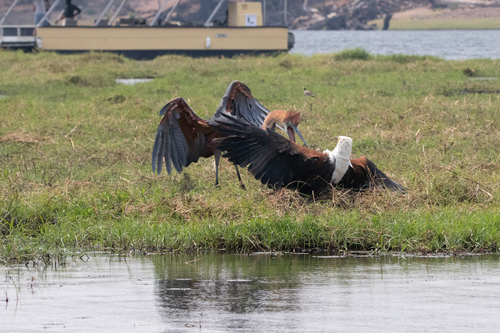
The Goliath heron, also known as the giant heron, is a very large wading bird in the heron family, Ardeidae. It is primarily found in sub-Saharan Africa, with smaller, declining numbers in Southwest and South Asia. Asian records are now very rare, but it is still known as an occasional vagrant.
📌 Diet and behaviour
Goliath herons are solitary foragers and are highly territorial towards other herons entering their feeding territories. On occasions, two may be seen together but these are most likely to be a breeding pair or immatures. A diurnal and often rather inactive feeder, this heron often hunts by standing in the shallows, intently watching the water at its feet. This is a typical feeding method among large Ardea herons and it can forage in deeper waters than most due to its larger size. It may also perch on heavy floating vegetation, to prevent water from rippling around them. As prey appears, the heron rapidly spears it with open mandibles, often spearing both mandibles through the fish's body, and then swallows it whole. It is possible that the bill is used in a lure-like fashion occasionally, attracting fish to the static, large object submerged in the water. The handling period is long, with herons often placing their struggling prey on floating vegetation while preparing to swallow it. Due to its generally slow movements and handling time, the goliath is frequently vulnerable to kleptoparasitism. In Africa, African fish eagles frequently pirate food caught by goliath herons, and other large birds such as saddle-billed storks and pelicans may also steal their prey.
The prey consists almost entirely of fish. The Goliath heron is a specialist in relatively large fish, with prey weight range of , averaging and length of . Fish exceeding are usually rejected, though there is a report that the heron managed to swallow fish. Small fish are generally ignored and the average Goliath heron catches around two or three fish a day. Breams, mullet, tilapia and carp have locally been recorded as preferred species. Any other small animals that they come across may be eaten, including frogs, prawns, small mammals, lizards, snakes, insects and even carrion.
📌 Breeding
]]
Its breeding season coincides generally with the start of the rainy season, which is around November to March. In some areas, breeding is year around, with no discernable peak season. Breeding may not occur every year. Fairly adaptable in their nesting site selection, Goliath herons generally prefer to nest on islands or islands of vegetation. The birds may abandon a nesting site if the island becomes attached to the mainland. Lakes or other large bodies of water usually hold colonies. They nest fairly low in variously sedge, reeds, bushes, trees or even on rocks or large tree stumps. The nesting dispersal seems highly variable as everything from a solitary pair (with no other Goliath nests anywhere near) to fairly large colonies have been observed, with no seeming local geographical preferences. Occasionally, they may join mixed-species colonies including other heron species, cormorants, darters, ibises and gulls. The breeding displays are not well known and may be subdued, due in part to breeding pairs possibly reunited year after year. The nests are large but often flimsy (depending on available vegetation around the nesting site), often measuring around in diameter.
The eggs are pale blue, averaging and weighing around . The clutch size can range from 2 to 5 (usually 3 or 4). Incubation lasts 24 to 30 days. Although they can sometimes replace clutches, often only around 25% of eggs succeed in hatching due to various environmental conditions or predation. The young are fed by regurgitation in the nest and, after a few weeks, can bill jab and practice defensive postures against each other. At around five weeks they leave the nest completely. The parents continue to tend to them for variously 40 to 80 days. Around 62% of fledglings who successfully leave the nest survive to adulthood. Locally, the white-tailed eagle and the African fish eagle may be a predator in colonies. Despite their ponderous movements, Goliath herons can think quickly and often take flight before danger approaches. Also, due to its size and formidable bill, the full-grown Goliath heron may not have any regular predators.