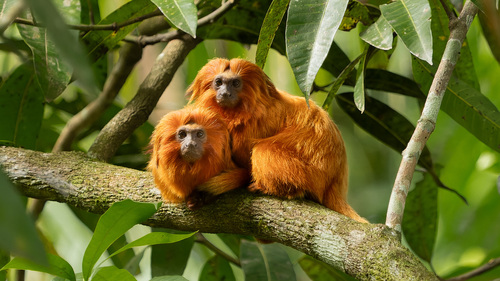
The golden lion tamarin, less commonly known as the golden lion marmoset, is a small New World monkey of the family Callitrichidae. Endemic to the Atlantic coastal forests of Brazil, the golden lion tamarin is an endangered species. Its geographic range is entirely within the state of Rio de Janeiro. A 2022/2023 census estimated about 4,800 individuals living in the current primary area of occurrence in the non-coastal area of the São João and Macaé river basins, with unknown but smaller additional numbers in limited coastal forests and to the west of the primary area of occurrence. There is a captive population maintaining about 490 individuals among 150 zoos.
🛡️ Conservation Status
endangered
en
📌 Physical characteristics
The golden lion tamarin gets its name from its bright reddish-orange pelage and the extra-long hairs around the face and ears, which give it a distinctive mane. Its face is dark and hairless. The bright orange fur of this species does not contain carotenoids, which commonly produce bright orange colors in nature. The golden lion tamarin is the largest of the callitrichid monkeys. It is typically around and weighs around . Almost no size difference exists between males and females. As with all callitrichids, the golden lion tamarin has claw-like nails, instead of the flat nails found in other monkeys and apes, although callitrichids do have a flat nail on the big toe.
Golden lion tamarins walk, run, and bound quadrupedally on top of branches, or, less frequently, they run and walk on the ground. When golden lion tamarins run or bound, their hindlimbs alternately overstride their forelimbs, and their feet are set atop the support and grasp it almost perpendicular to the line of travel, making the body's angle of travel oblique rather than precisely parallel to the substrate, a pattern known as "transaxial bounding". pp 108–117, 137, 155).
📌 Habitat and distribution
The golden lion tamarin has a limited current area of occupancy, as most of the original habitat in the Brazilian state of Rio de Janeiro has been lost to deforestation. with some tamarins living in areas closest to the coast found in a sandy soil forest type called "arboreal restinga". Golden lion tamarins are thought to occur primarily in low-elevation forests, up to 150 or 300 meters above sea level, but a 1990–1992 survey identified two groups above 500 meters, and reports from the recently identified western geographic area include records above 700 meters.
Golden lion tamarin population estimates in the 1960s and 1970s ranged from only 100 to 600, although these estimates were not based on range-wide censuses. The first such census, carried out 1990–1992, counted about 560 wild individuals and translocation of wild individuals from small, at-risk forest fragments and community-based conservation and engagement programs, the population has grown significantly. Most recently, a 2022-23 census estimated about 4,800 golden lion tamarins living in the current primary area of occurrence in the noncoastal area of the São João and Macaé River basins, with unknown but smaller additional numbers in limited coastal forests and to the west of the primary area of occurrence.
📌 Behaviour and ecology
]]
📌 Plant material
Fruits, mostly ripe, Tamarins swallow the seeds of most fruits they consume and are considered to function as effective seed dispersers for many plant species.
Wild golden lion tamarins eat from a wide variety of plant species, with 160 species noted in one multiple-group study. and gum consumption represented less than 2% of total feeding observations or time.
📌 Animal prey
Animal prey reported as eaten by wild golden lion tamarins in at least one study include frogs and tree frogs, amphibian egg masses, lizards, snakes, nestling birds, bird eggs, snails, spiders, centipedes, katydids, grasshoppers, crickets, beetles and beetle larvae, cockroaches, ants, stick insects, butterflies, caterpillars, and insect-infested tree galls. Orthopteran insects (e.g., grasshoppers, katydids, and crickets) were the most commonly eaten prey in one study. and in golden lion tamarins has been termed "micro-manipulation". Peres reported that such extractive foraging accounted for 98% of prey captures observed in one study in the Poço das Antas Biological Reserve. Lion tamarins (the genus Leontopithecus as a whole) have significantly longer and narrower hands (including longer fingers) than other callitrichids. This is considered to be an adaptation to their micro-manipulation foraging behavior.
📌 Home range and use of space
Golden lion tamarin groups are highly territorial; they have areas of exclusive use, but engage in aggressive encounters with neighboring groups at borders and in areas of overlap.(pp 66–67), with a range of 17.4-87.7 ha (43.0-216.7 acres). Reports from União Biological Reserve indicate larger home range sizes there, which may be a result of lower population density in União at the time of the studies as well as differences in calculation methods. Golden lion tamarin home ranges are not static over time. One study found a mean of 77% home range overlap for a group between one year and the next. Wild golden lion tamarins use their home ranges unevenly, with some areas used much more heavily than others. In a study in Poço das Antas Biological Reserve, "core areas", where 50% of a group's location records were documented, averaged around 10% of a group's total home range.
Reports of average daily travel distances for individual groups range from 1,339 to 2,135 m (4,393 to 7,005 ft). Single-day travel distances for groups vary more widely. For example, in one study of two groups in União Biological Reserve, single-day travel distances ranged from 401 to 3,916 m (1,316 to 12,848 ft).
📌 Sleeping sites
Golden lion tamarins usually spend more than half their time in overnight sleeping sites and thus they are active for less than half the day. Two groups in the União Biological Reserve spent an average of 14.2 hours and 13.1 hours in their sleeping sites
Multiple authors have reported that golden lion tamarins prefer to sleep in naturally occurring tree holes. Tree holes, also termed tree cavities or tree hollows, are reported as the predominant sleeping site for other lion tamarin species as well.
Golden lion tamarin groups use multiple sleeping sites across time. Some groups in the Poço das Antas Biological Reserve used more than 40 sites across multiple years of study. Groups use a small subset of these sites frequently, suggesting that some sites are highly preferred over others. In the Poço das Antas Biological Reserve, golden lion tamarin groups used the same sleeping site on consecutive nights in roughly 50% of the cases when sites for consecutive nights were identified. Two groups in the União Biological Reserve used the same site on consecutive nights at somewhat lower rates, 20% and 38%.
Multiple authors have discussed the role of sleeping site selection in relation to (overnight) predation, proposing that tree holes may provide greater protection from predators than other sleeping site types (for example,)
📌 Predators
Only a few published reports confirm the identities of successful predators on golden lion tamarins, with these cases including a boa constrictor (Boa constrictor) and a feral dog (Canis familiaris), capuchin monkeys (Cebus/Sapajus nigritus);
Tayra were strongly suspected as the primary predator in a series of deaths and disappearances in Poço das Antas Biological Reserve. and the wild.
📌 Cognition
Bigger (heavier) brains, relative to body weight, are said to be correlated with, and are implied to be causally linked to, better cognitive performance on a variety of tasks, e.g., Jerison, but see Reader and Laland and van Schaik et al. Primates tend to have relatively larger brains than other mammalian orders, or any other group of living animals,
Reader et al. (2011), using a single measure of nonhuman primate intelligence that combined performance on a variety of cognitive laboratory tasks, showed that callitrichid primates (lion tamarins, tamarins, and marmosets) perform poorly compared to apes, macaques, baboons, capuchin monkeys, and even lemurs and lorises. Lion tamarins (species of the genus Leontopithecus) had the lowest value of this intelligence measure among all primate genera in this dataset. In similar comparative studies of primate cognitive performance, by Deaner et al., members of the marmoset genus Callithrix were ranked 23rd of 24 primate genera, lower than even the lemurs and lorises that were included. Lion tamarins were not tested in these studies, and extrapolation from the performance of the genus Callithrix to that of Leontopithecus should be made cautiously. Deaner et al. both concluded that, in general, marmosets and tamarins (including lion tamarins) perform poorly relative to other primates on laboratory tests of non-social problem-solving and strategic thinking.
Other papers have included or focused on lion tamarin cognitive performance. Day et al. studied the extraction of foods from novel puzzle-boxes by captive lion tamarins, other tamarins, and marmosets. The lion tamarins (study subjects included black and golden-headed lion tamarins in addition to golden lion tamarins) began working on the tasks significantly faster and had more successful task solutions than either the other tamarins or the marmosets. Menzel and Beck conducted a study of spatial memory and detour behavior by a family group of six golden lion tamarins that were living in a large, outdoor free-ranging zoo exhibit. When their preferred arboreal travel routes were severed, the tamarins learned quickly how to find and navigate detours.
📌 Tool use
Stoinski and Beck reported observations of golden lion tamarins using and modifying tools while living in free-ranging zoo exhibits. Eight different individual golden lion tamarins were seen to spontaneously use tools and three individuals were seen to modify tools. The tamarins used twigs, which in some cases they broke off prior to use, as well as the wire antennas of their radiocollars. The most common modes of tool use were prying under tree bark and probing in tree crevices while foraging for animal prey, and probing on skin and through fur during allo- and auto-grooming. The total number of tool use bouts was not reported, but Stoinski and Beck golden lion tamarins are one of only two callitrichid species documented to have used tools. The other reported case of callitrichid tool use was also from a lion tamarin - one wild black lion tamarin (Leontopithecus chrysopygus) that inserted and probed with a stick between the leaves of a bromeliad to expel insects. This was the only case of tool use documented in the Kaisin et al. study, which involved observation of four groups for a total of more than 2,500 hours. For golden lion tamarins, despite thousands of hours of monitoring by skilled observers, there are no reports of tool use by wild individuals or by reintroduced individuals and their descendants.
Shumaker et al. emphasized that tool use is not unequivocally an indicator of intelligence; much animal tool use is based on simple associative learning processes or genetically programmed behaviors. However, the golden lion tamarins described by Stoinski and Beck exhibited flexibility when modifing and using different types of tools (twigs, wire), in several different ways (inserting, probing, prying, reaching), on different substrates (bark, tree holes, skin), and in different contexts (foraging, grooming).
📌 Social structure
Golden lion tamarins are social and groups typically consist of two to eight members. These groups usually consist of one breeding adult male and female but may also have two or three males and one female or the reverse. Other members include subadults, juveniles, and infants of either sex. These individuals are typically the offspring of the adults. When more than one breeding adult is in a group, one is usually dominant over the other, which is maintained through aggressive behavior. The dominance relationship between males and females depends on longevity in the group. A newly immigrated male is subordinate to the resident adult female that inherited her rank from her mother. Both males and females may leave their natal groups at the age of four, but females may replace their mothers as the breeding adult, if they die, which will lead to the dispersal of the breeding male who is likely her father. This does not happen with males and their fathers. Dispersing males join groups with other males and remain in them until they find an opportunity to immigrate to a new group. The vast majority of recruits to groups are males. A male may find an opportunity to enter into a group when the resident male dies or disappears. Males may also aggressively displace resident males from their group; this is usually done by two immigrant males that are likely brothers. When this happens, only one of the new males is able to breed and suppresses the reproduction of the other. A resident male may also leave a vacancy when his daughter becomes the breeding female and he must disperse to avoid inbreeding.
📌 Communication
Like other callitrichids, golden lion tamarins use auditory, olfactory, and visual signals to communicate within and between groups.
📌 Vocal communication
Because the dense structure of their rainforest habitat limits opportunity for visual signaling, golden lion tamarins rely mostly on sound for real-time communication about group movement, availability of food, predator presence, and intergroup spacing, reported that adults emitted an average of 2.1 vocalizations/minute.
Ruiz-Miranda and Kleiman have each used different names and grouping systems for golden lion tamarin calls.
Most of their vocalizations appear to provide information about the caller - identity, location,
Young golden lion tamarins are also highly vocal, and may call at up to three times the rate of adults.
📌 Olfactory communication
Like other marmosets and tamarins, golden lion tamarins scent-mark using multiple glandular regions. Research on other callitrichids indicates that scent marks allow receivers to differentiate individuals and determine sex, dominance status, and female reproductive status, and this may be true for golden lion tamarins, as well.
Studies on scent-marking in zoo and wild golden lion tamarins have led researchers to propose specific within- and between-group communication functions that may vary by sex and dominance status, and that scent may serve as a marker for important ecological resources. However, challenges in ascribing or excluding particular functions for scent-marking in callitrichids have been noted in studies on other callitrichid species, including conflicting interpretations of scent-marking data from wild moustached tamarins (Saguinus mystax) (compare with ) and saddleback tamarins (Saguinus fuscicollis) (compare and with ). Further, a summary largely focused on cottontop tamarins (Saguinus oedipus) and common marmosets (Callithrix jacchus) demonstrates the complex relationship between social context and chemical communication in callitrichids.
📌 Visual communication
A small array of visual signals has been described for golden lion tamarins. The arch walk, the highest intensity of the golden lion tamarins arch displays, is characterized by erected fur, lowered head, forward-directed gaze, strongly arched back, rigid limbs, and tail held down and pressed forward and particularly
📌 Reproduction
The mating system of the golden lion tamarin is largely monogamous. When two adult males are in a group, only one of them mates with the female. There are cases of a male mating with two females, usually a mother and daughter. Females are sexually mature between 15 and 20 months old, but they cannot reproduce until 30 months old. Males may reach puberty by 28 months. A mother is not able to provide for her litter and needs the help of the other members of the group. The younger members of the groups may lose breeding opportunities, but they gain parental experience in helping to rear their younger siblings. In their first 4 weeks, the infants are completely dependent on their mother for nursing and carrying. By week five, the infants spend less time on their mother's back and begin to explore their surroundings. Young reach their juvenile stage at 17 weeks and begin to socialize with other group members. The subadult phase is reached at 14 months, when a tamarin first displays adult behaviors.
📌 Conservation
]]
The geographic ranges of and available habitats for golden lion tamarins have both shrunk drastically in the five centuries since the arrival of Portuguese explorers in Brazil in 1500. However, no estimates of the size of the population before 1500 are known, and the first published estimates did not appear until the 1970s. By then, golden lion tamarin population estimates ranged from only 100 to 600 surviving individuals, and the potential impact of non-native species, most notably the introduced marmoset species that are now found in many of the forest areas occupied by golden lion tamarins, and a feral population of introduced golden-headed lion tamarins (Leontopithecus chrysomelas) within 50 km of the geographic range of the golden lion tamarin, presenting a threat of hybridization (most of the golden-headed lion tamarins were removed between 2015 and 2018).
Although not specifically identified in association publications, climate change may also present a threat to long-term survival for golden lion tamarins. Meyer and coauthors used climate-change modeling to estimate how much of the historic geographic ranges of the four lion tamarin (Leontopithecus) species would be suitable for their survival in 2050 and 2080. They concluded that the amount of climatically suitable habitat for golden lion tamarins would be severely reduced by 2050 and insufficient for population survival by 2080. The authors stressed caution in interpreting and acting on this conclusion because of numerous uncertainties in the modeling process.
Key events in the conservation of golden lion tamarins outlined below describe past and ongoing efforts to address many of these threats.
*1970s: Following their field studies, which indicate a small, declining wild population of golden lion tamarins, Adelmar Coimbra-Filho and Alceo Magnanini championed efforts that resulted in the 1974 creation of the federal Poço das Antas Biological Reserve. In 1980, there were an estimated 75 to 150 golden lion tamarins living within the reserve.
*1983: The Golden Lion Tamarin Conservation Program began activities in Brazil, launching the first systematic field studies of behavioral ecology of golden lion tamarins in the Poço das Antas Biological Reserve, later expanding to the União Biological Reserve and reintroduction sites, and initiating a community-based environmental education program in the area surrounding Poço das Antas. The program's successor, the Associação Mico-Leão-Dourado, a Brazilian not-for-profit, was launched in 1992 and is active today.
*1984: The first zoo-born tamarins were reintroduced into the wild. thus connecting separated subpopulations of golden lion tamarins. By 2022, the association had planted a total of with native forest trees in Poço das Antas Biological Reserve and on 15 private farms with tamarins. Each provides opportunities for reforestation to establish critical forest connections between separated golden lion tamarin subpopulations.
2016: The Associação Mico-Leão-Dourado adopted an overall 2025 goal of 2,000 wild golden lion tamarins living in 25,000 ha (61,766 acres; 250 km2, 97 miles2) of connected and protected habitat, which computer modeling suggested would achieve 100% probability of species survival for the next 100 years, with retention of 98% of (then current) genetic diversity during that period. After the Rio de Janeiro Primate Center tested the vaccine's efficacy and safety on lion tamarins housed there, As of the end of 2024, 489 individuals had been vaccinated. BR-101 runs adjacent to a portion of Poço das Antas Biological Reserve and between the two sections of União Biological Reserve, as well as separating Poço das Antas and one section of União from relatively large tamarin subpopulations on the northern side of the highway. The company that designed and constructed the highway expansion was legally required to fund these mitigating actions to maintain and expand fragment connectivity and reduce traffic-related wildlife deaths on this busy highway. Tamarins were already using two of the canopy overpasses by late 2021.
2022/2023: The fourth census of wild golden lion tamarins showed an estimated population of more than 4,800 in the species' primary area of occurrence, indicating rapid recovery from the yellow fever epidemic.
📌 Reintroduction
In the early 1980s, the Smithsonian National Zoological Park and the Rio de Janeiro Primate Center initiated a program to reintroduce captive-born golden lion tamarins to bolster the existing wild population, thought to be no more than 600 individuals at the time. The animals had been born at or lived in 43 different zoos and research centers in Brazil, Europe, and the United States. None of the release sites, including the specific release sites in Poço das Antas, was thought to have wild golden lion tamarins at the time of the reintroductions.
The reintroduced, captive-born golden lion tamarins all had prerelease veterinary examinations. Those from Europe or the United States were quarantined for 30 days, either at one of several designated zoo quarantine facilities before shipment or at the Rio de Janeiro Primate Center after arrival in Brazil. All of the captive-born individuals were acclimated for at least 24 hours in outdoor cages at the reintroduction sites before their release. The animals were monitored on five or six days per week for at least three months after being released. Most were given supplementary food and artificial shelter boxes for at least several months, and were captured and returned to the release site if they got lost. This intensive postrelease support improved early survival rate, although efforts to train tamarins in survival-critical skills before release did not appear to affect postrelease survival.
Over time, some of the reintroduced golden lion tamarins and/or their offspring were translocated to eight other privately owned locations, and recovery of forests on private lands has also allowed the tamarins to expand on their own to additional ranches and farms. As of 2022, 22 of the farms and ranches with golden lion tamarins were official private nature reserves. At the time of the most recent census, in 2022/2023, an estimated 2,256 surviving descendants of reintroduced golden lion tamarins remained, representing almost half (46%) of the total estimated population in the species' primary area of occurrence, in the noncoastal area of the São João and Macaé River basins in the Brazilian state of Rio de Janeiro.
R$20 banknote]]
📌 Translocation
During a 1990-1992 survey, a number of golden lion tamarin groups were identified in very small and/or immediately imperiled forest fragments in the Rio de Janeiro State municipalities of Cabo Frio, Búzios, Saquarema, and Araruama.. The reserve lies within the species' historic area of occurrence but had no resident golden lion tamarins at the time. The two primary goals of the translocation program were to rescue imminently threatened golden lion tamarins and to add genetic diversity to the more protected part of the population.
The population at the União reserve has grown substantially since the initial translocations. The population had already grown to 120 by December 2000, and to more than 220 in 30 family groups by 2006. The most recent census, carried out in 2022-2023, estimated that 473 descendants of the original translocated golden lion tamarins existed. This represented 10% of the total estimated 2022-2023 population of 4,869 in the species' primary area of occurrence in the non-coastal area of the São João and Macaé river basins (calculated from, Supplementary Materials).