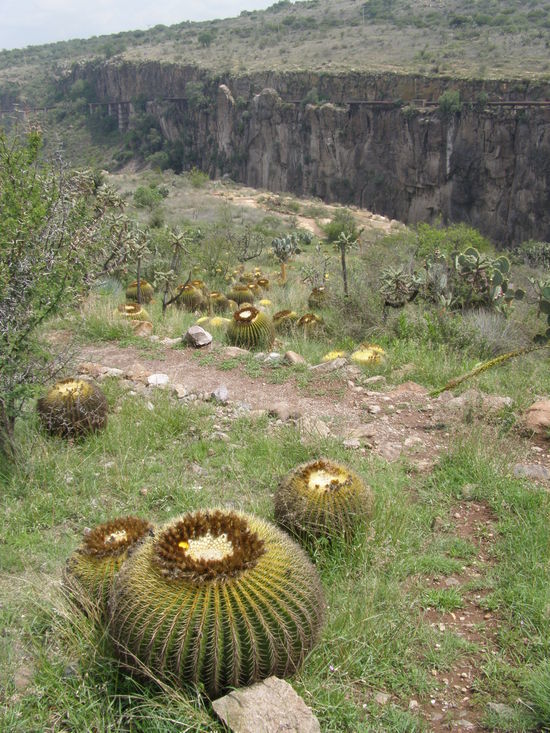
Kroenleinia grusonii, popularly known as the golden barrel cactus, golden ball, "mother-in-law's cushion" or "mother-in-law's chair", is a species of barrel cactus which is endemic to east-central Mexico.
🛡️ Conservation Status
endangered
en
📌 Distribution
The golden barrel cactus is rare and endangered—potentially regionally extinct—in nature. It is native to the Mexican states of Querétaro and Hidalgo, particularly near Mesa de León. Wild populations of K. grusonii were adversely affected in the 1990s as a result of wild specimens being poached as well as the creation of the Zimapán Dam and reservoir (in Hidalgo). The golden barrel cactus is a fairly adaptable species, but naturally prefers growing in rich, volcanic (but well-aerated) soil on sunny slopes, where water quickly flees from its roots. The species may be found growing at altitudes as high as above sea level.
📌 Taxonomy
Kroenleinia grusonii was originally placed in the small genus Echinocactus, which, together with the related genus Ferocactus, are collectively referred to as ball or barrel cacti, and occasionally as fish-hook cacti. The species was first described by German plantsman Heinrich Hildmann in 1891, and was named for German industrialist and cacti-collector Hermann Gruson. While sometimes referred to as 'golden ball', this species is not to be confused with the "other" golden ball, Parodia leninghausii, which has fuzzy, harmless spines and is native to Brazil and Paraguay.
Recent phylogenetic studies have found that Echinocactus grusonii is probably polyphyletic, with respect to the rest of Echinocactus, and is likely a result of hybridization between Echinocactus and Ferocactus. To correct this, Echinocactus grusonii was moved to its own genus, and, under this scheme, the new species name became Kroenleinia grusonii Lodé. However, thus far, not all authorities have accepted this change.
📌 Cultivation
Kroenleinia grusonii is widely cultivated by specialty plant nurseries as an ornamental plant, for planting in containers, desert habitat gardens, rock gardens, and in conservatories. A white-spined and a short-spined form, as well as a teal-blue cultivar ('Blue barrel'), are also in-cultivation.
The golden barrel is among the most popular cacti in collections and in landscaping, and has increasingly become popular as an architectural accent plant in contemporary garden designs.
The golden barrel cactus is considered one of the easiest to care for, and is a relatively fast grower in warmer climates, around the world. The plants do have some basic requirements: an average minimum winter temperature of (though they can tolerate brief periods of lower temperatures if provided with adequate cover and frost protection), with good drainage being the key factor. As with most succulents, the golden barrel survives with less water in winter; in nature, it is found on elevated, angled slopes, where precipitation and runoff quickly washes over the roots and leaves the plant; pooling water quickly leads to root rot and eventual death of the entire plant. In the Americas, it is found in various locations, from Mexico south through Chile, and notably throughout the American Southwest and the U.S. West Coast. It is also found on several Caribbean islands. In Europe, it is found nearly everywhere around the Mediterranean Sea and the Levant, the Middle East, to South Asia, South Africa and Australia, among other locations.