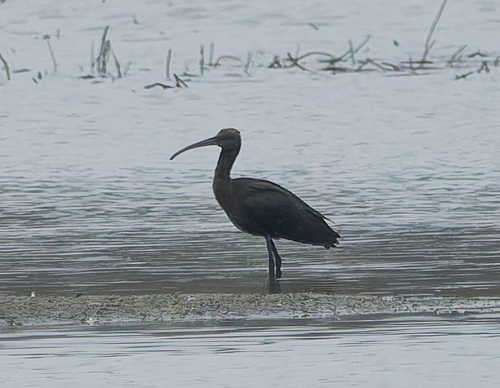
The glossy ibis is a water bird in the order Pelecaniformes and the ibis and spoonbill family Threskiornithidae. The scientific name derives from Ancient Greek plegados and Latin, falcis, both meaning "sickle" and referring to the distinctive shape of the bill.
📌 Distribution
This is the most widespread ibis species, breeding in scattered sites in warm regions of Europe, Asia, Africa, Australia, and the Atlantic and Caribbean regions of the Americas. It is thought to have originated in the Old World and spread naturally from Africa to northern South America in the 19th century, from where it spread to North America. Birds from other populations may disperse widely outside the breeding season. It is increasing in Europe, after earlier major declines in the 19th and early 20th centuries due to uncontrolled heavy hunting pressure and habitat loss. Birds which arrived in Great Britain and Ireland were routinely shot as trophies until the 1920s, when attitudes started to change. It disappeared as a regular breeding bird in Spain in the early 20th century, but with legal protection re-established itself in 1993 and has since rapidly increased with thousands of pairs in several colonies. It has also established rapidly increasing breeding colonies in France, a country with very few breeding records before the 2000s. However, in Italy, where illegal hunting has been a continuing problem despite legal protection since 1977, the increase in the population has been markedly lower with only 10–50 pairs breeding. For example, there appears to be a growing trend for birds to winter in Britain and Ireland, with at least 22 sightings in 2010. A few birds now spend most summers in Ireland, but there is no present evidence of breeding. In New Zealand, a few birds arrive there annually, mostly in the month of July; recently a pair bred amongst a colony of royal spoonbill. Glossy ibis have been a breeding species in Australia since the 1930s. In India, they are now a breeding species with colonies now seen in agricultural areas, in forested areas with bamboo thickets and breeding alongside other colonially nesting waterbirds. Year-long studies have also shown glossy ibises to be foraging in agricultural wetlands and flooded farmlands in western India.
📌 Behaviour
Glossy ibises undertake dispersal movements after breeding and are highly nomadic. The more northerly populations are fully migratory and travel on a broad front, for example across the Sahara Desert. Glossy ibis ringed in the Black Sea seem to prefer the Sahel and West Africa to winter, those ringed in the Caspian Sea have been found to move to East Africa, the Arabian peninsula and as far east as Pakistan and India. Numbers of glossy ibis in western India varied dramatically seasonally with the highest numbers being seen in the winter and summers, and drastically declining in the monsoon likely indicating local movements to a suitable area to breed. Populations in temperate regions breed during the local spring, while tropical populations nest to coincide with the rainy season. Nesting is often in mixed-species colonies. When not nesting, flocks of over 100 individuals may occur on migration, and during the winter or dry seasons the species is usually found foraging in small flocks. Glossy ibises often roost communally at night in large flocks, with other species, occasionally in trees which can be some distance from wetland feeding areas.
📌 Breeding
The nest is usually a platform of twigs and vegetation positioned at least above water, sometimes up to high, in dense stands of emergent vegetation, low trees, or bushes. Three to four eggs (occasionally five) are laid, and are incubated by both male and female birds for between 20 and 23 days. The young can leave the nest after about seven days, but the parents continue to feed them for another 6 or 7 weeks. The young fledge in about 28 days.
📌 Conservation
The glossy ibis is one of the species to which the Agreement on the Conservation of African-Eurasian Migratory Waterbirds (AEWA) applies. Glossy ibises can be threatened by wetland habitat degradation and loss through drainage, increased salinity, groundwater extraction and invasion by exotic plants.