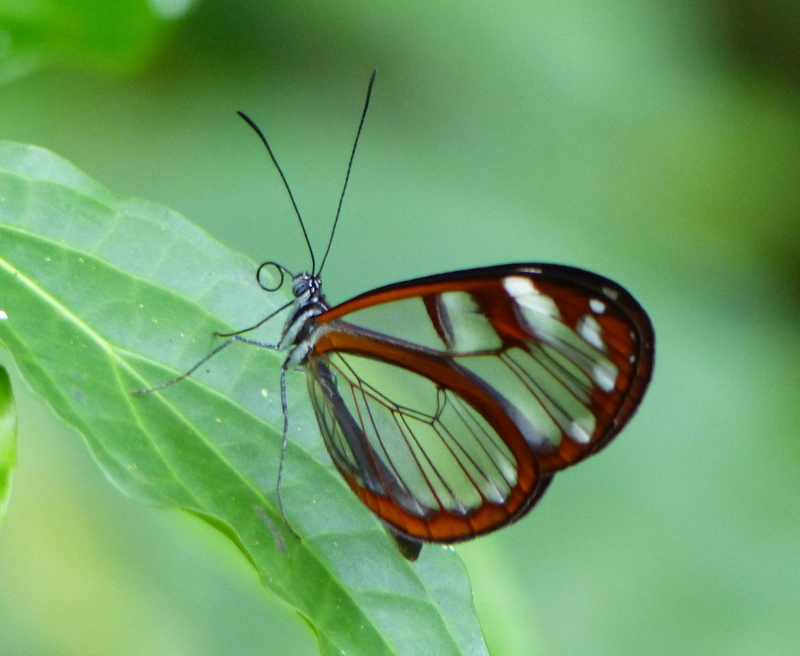
Greta oto is a species of brush-footed butterfly and member of the subfamily Danainae, tribe Ithomiini, and subtribe Godyridina. It is known by the common name glasswing butterfly for its transparent wings, which allow it to camouflage without extensive coloration. In Spanish-speaking regions, it may also be referred to as espejitos, meaning "little mirrors" because of its transparent wings. The butterfly is mainly found in Central America and northern regions of South America, with sightings as far north as Texas and as far south as Chile. While its wings appear delicate, the butterfly is able to carry up to 40 times its own weight. In addition to its wing physiology, the butterfly is known for behaviors such as long migrations and lekking. Greta oto closely resembles Greta andromica.
📌 Geographic range and habitat
The glasswing butterfly is most commonly found from Central to South America as far south as Chile, with appearances as north as Mexico and Texas. This butterfly thrives in the tropical conditions of the rainforests in the Central and South American countries.
📌 Lifecycle
===Egg===
Eggs are typically laid on plants of the genus Cestrum, a member of the nightshade family, which serves as a food source for their later life stages.
📌 Larva
The caterpillars of the glasswing butterfly have green bodies, with yellow stripes in later stages. They are found on the host plants of the genus Cestrum. The larvae are cylindrical in shape with dorsal projections that are smooth with filaments. These properties make the larvae extremely reflective, which essentially causes them to be invisible to predators.
📌 Pupa
The pupae are initially green with black specks, later becoming silver in colour.
📌 Adult
The adult glasswing butterfly can be identified by its transparent wings with opaque, dark-brown borders tinted with red or orange. Its body is a dark brown color. The butterfly is long and has a wingspan of .
📌 Adult
The adult butterfly feeds mainly on the nectar of the flowers of the genus Lantana, which includes 150 species of perennial flowering plants. They also eat flowers in the Asteraceae and Boraginaceae families and the droppings of insectivorous birds, absorbing amino acids that are later converted to proteins. Adult butterflies are also toxic due to the males consuming Asteraceae flowers whose nectar contains pyrrolizidine alkaloids.
📌 Migration
The glasswing butterfly is migratory and travels up to per day at speeds of up to . It migrates to change elevations, which causes population density differences in varying geographical areas.
📌 Predation
Birds are common predators of this butterfly. The glasswing combats predators by consuming toxins through plants of genus Cestrum and family Asteraceae in both the caterpillar and butterfly stages. Toxin consumption gives the butterfly a foul taste that discourages predation.
📌 Protective coloration
This butterfly uses its transparency to hide from predators by camouflaging into the background during flight. Transparency is a rare trait among the Lepidoptera; they more commonly use mimicry to ward off predators.
📌 Mating
This butterfly species mates polygynously, with males attempting to obtain one or more female mates per breeding season.
📌 Lekking
To attract females, male butterflies form leks, or large gatherings, where males compete for mates. They gather in shaded areas of the rainforest and competitively display themselves to attract mates. Male glasswing butterflies also release pheromones during lekking to attract females. The pheromones produced are derived from pyrrolizidine alkaloids that the butterflies obtain through their diet of plants of the Asteraceae. The alkaloids are then converted to pheromones through the formation of a pyrrole ring, followed by ester cleavage and oxidation. Additionally, since the process by which the pheromone is produced is not only formed by butterflies and moths themselves, but also derived from plants, as with the glasswing butterfly, the pheromone is unlikely to be used to distinguish between species.
📌 Physiology
===Wings===
Wing transparency in Greta oto results from the combination of several properties; low absorption of visible light, low scattering of the light that passes through the wings, and low reflection of the light impinging on the wing's surface occurs. The last occurs for a broad range of incident wavelengths, covering the entire visible spectrum, and all incidence angles. This broadband and omnidirectional antireflection property originates from nanopillars standing on the wing's surface, which ensures a gradient of refractive indices between the incident medium, air, and the wing's membrane. Additionally, the structure of the nanopillars allows for the wings to have a low roughness factor because of its tiny hair-like microtrichia features. This was experimentally tested through water droplet adhesion to the wings. Basically, it reflects light and is transparent because of nanopillars that make up the wing. The nanopillars help the butterflies stay hidden from any predators by reflecting light and being able to blend in with any of its surroundings. Due to the unproportinate size of the wings it renders it nonvisible when viewed in certain angles Binetti, V. R., Schiffman, J. D., Leaffer, O. D., Spanier, J. E., & Schauer, C. L. (2009).
📌 Conservation
These parks and reserves in Costa Rica currently feature the glasswing butterfly and are working on their conservation: Guanacaste National Park, Rincón de la Vieja National Park, Monteverde Cloud Forest Reserve, Palo Verde National Park, Carara National Park, Poás Volcano National Park, La Selva Reserve and Biological Station, Juan Castro Blanco National Park, Irazú Volcano National Park, Chirripó National Park, and La Amistad International Park.