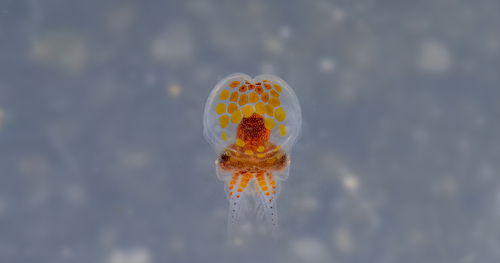
The giant Pacific octopus, also known as the North Pacific giant octopus, is a large marine cephalopod belonging to the genus Enteroctopus and Enteroctopodidae family.
📌 Etymology
The giant Pacific octopus was first described in 1910 by Gerhard Wülker of Leipzig University in Über Japanische Cephalopoden. He describes the species' morphology in detail, and mentions that there seems to be much variation within the species. The specific name dofleini was chosen by Gerhard Wülker in honor of German scientist Franz Theodor Doflein. It was moved to genus Enteroctopus by Eric Hochberg in 1998.
📌 Size
E. dofleini is distinguished from other species by its large size. It is the largest octopus species. Adults usually weigh around , with an arm span up to . The largest individual may have weighed in at , with a radial span of , according to the fisherman who caught it. Other large specimens caught while commercial fishing may have weighed as much as .
British zoologist G. H. Parker found that the largest suckers on a giant Pacific octopus are about and can support each.
📌 Ecology
=== Diet ===
E. dofleini preys on shrimp, crabs, scallops, abalones, cockles, snails, clams, lobsters, fish, squid, and other octopuses. Food is procured with its suckers and then bitten using its tough beak of chitin. It has also been observed to catch spiny dogfish (Squalus acanthias) up to in length while in captivity. Additionally, consumed carcasses of this same shark species have been found in giant Pacific octopus middens in the wild, providing strong evidence of these octopuses preying on small sharks in their natural habitat. In May 2012, amateur photographer Ginger Morneau was widely reported to have photographed a wild giant Pacific octopus attacking and drowning a seagull, demonstrating that this species may eat any available source of food within its size range, even birds.
📌 Predators
Scavengers and other organisms often attempt to eat octopus eggs, even when the female is present to protect them. Giant Pacific octopus paralarvae are preyed upon by many other zooplankton and filter feeders. Marine mammals, such as harbor seals, sea otters, and sperm whales depend upon the giant Pacific octopus as a source of food. Pacific sleeper sharks are also confirmed predators of this species. In addition, the octopus (along with cuttlefish and squid) is a significant source of protein for human consumption. About are commercially fished, worth $6 billion annually. The octopus is parasitized by the mesozoan , which lives in its renal appendages.
📌 Movement patterns
E. dofleini move through the open water using jet propulsion, which is achieved by drawing water into its body cavity and then forcefully expelling it through a siphon, creating a powerful thrust and propelling the octopus through the water at a high speed. When moving on the seafloor, however, the octopus crawls using its arms.
E. dofleini remain stationary or in hiding 94% of the time, usually concealed within dens, kelp, or camouflaged in their environment. Otherwise, they exhibit activity throughout the day, increasingly so from midnight to the early morning. While stationary, E. dofleini hide, groom, eat, sleep, and maintain dens. E. dofleini are capable of moving vast distances to occupy new areas or habitats, with large octopuses moving further than smaller ones. Their movements are not random; they demonstrate a preference for habitats with dense kelp cover and rocky terrain suggesting a sophisticated level of habitat selection, likely optimizing foraging efficiency and minimizing exposure to predators. Furthermore, their movement patterns include direct relocations to new areas and central-tendency movements to return to familiar habitats.
E. dofleini migration patterns vary depending on the population. In the eastern Pacific waters off the coast of Japan, migration coincides with seasonal temperature changes in the winter and summer. Here, E. dofleini migrate to shallower waters in the early summer and winter and offshore in the late summer and winter. There is no evidence of these migration patterns in the Alaskan and northeast Pacific populations of E. dofleini.
📌 Shelter
E. dofleini are den dwellers, which serve as a central point from which they forage while also providing protection, shelter, and privacy. Shells, bones, and other feeding debris pile up outside of the den, creating "den litter" that is commonly used by scientists and divers to find E. dofleini. E. dofleini prefer to occupy same shelter for at least one month, often longer if possible. It is common for these octopus to leave their den for short periods of time and eventually return to re-use the same den. However, over longer periods of time, E. dofleini relocate to new dens situated relatively nearby, within an average distance of 13.2 meters.
📌 Lifespan and reproduction
Unlike most other octopus species, whose lifespans normally last only one year, the giant Pacific octopus has a lifespan of three to five years. Gonadal maturation has been linked to the optic gland of octopuses which has been compared functionally to the vertebrate pituitary gland. The female's death is the result of starvation, as she subsists on her own body fats during this period of approximately 6 months. and very few survive to adulthood. Their growth rate is quite rapid: starting from and growing to at adulthood, which is an increase of around 0.9% per day. Because they are cool-blooded, they are able to use most of their consumed energy for body mass, respiration, physical activity, and reproduction. This part of the male arm anatomy contains no suckers. Large spermatophores are characteristic of octopuses in this genus. The female stores the spermatophore in her spermatheca until she is ready to fertilize her eggs. One female at the Seattle Aquarium was observed to retain a spermatophore for seven months before laying fertilized eggs. This multiple paternity potentially allows females to increase the odds of at least one of the males she mates with producing fit offspring. After mating, both the males and females stop eating and ultimately die. Death is typically attributed to starvation, as the females have stopped hunting in order to protect their eggs; males often spend more time in the open, making them more likely to be preyed upon.
📌 Intelligence
Octopuses are ranked as the most intelligent invertebrates. Giant Pacific octopuses are commonly kept on display at aquariums due to their size and interesting physiology, and have demonstrated the ability to recognize humans with whom they frequently come in contact. These responses include jetting water, changing body texture, and other behaviors that are consistently demonstrated to specific individuals. They have the ability to solve simple puzzles, open childproof bottles, and use tools. and having personalities.
📌 Conservation and climate change
=== Conservation ===
Giant Pacific octopuses are not currently under the protection of Convention on International Trade in Endangered Species of Wild Fauna and Flora or evaluated in the IUCN Red List. DNA techniques have assisted in genetic and phylogenetic analysis of the species' evolutionary past. Following its DNA analysis, the giant Pacific octopus may actually prove to be three subspecies (one in Japan, another in Alaska, and a third in Puget Sound).
In Puget Sound, the Washington Fish and Wildlife Commission adopted rules for protecting the harvest of giant Pacific octopuses at seven sites, after a legal harvest caused a public outcry. Populations in Puget Sound are not considered threatened.
📌 The seafood industry
made of giant octopus]]
Fraud is an issue in the seafood industry, with species names being switched by accident or on purpose, as in the case of using the name of a more expensive species for a cheaper one. Cephalopods, in particular, lose distinguishing characteristics during food processing, making them much harder to identify. One study developed a multiplex PCR assay to distinguish between three prevalent octopus species in the Eastern Pacific, namely, the giant Pacific octopus, the big blue octopus, and the common octopus, in order to accurately identify these species and help to prevent seafood fraud. Combined with lack of assessment and mislabeling, tracking the species's abundance is nearly impossible. Scientists have relied on catch numbers to estimate stock abundance, but the animals are solitary and difficult to find.
📌 Oxygen limitation
Octopuses have been found to migrate for a variety of reasons. Using tag and recapture methods, scientists found they move from den to den in response to decreased food availability, change in water quality, increase in predation, or increased population density (or decreased available habitat/den space). Since their blue blood is copper-based (hemocyanin) and not an efficient oxygen carrier, octopuses favor and move toward cooler, oxygen-rich water. This dependency limits octopus habitat, typically to temperate waters . Fish and octopuses move from the deep towards the shallow water for more oxygen. Females do not leave, and die with their eggs at nesting sites. Warming seawater temperatures promote phytoplankton growth, and annual dead zones have been found to be increasing in size. To avoid these dead zones, octopuses must move to shallower waters, which may be warmer in temperature and less oxygen-rich, trapping them between two low-oxygen zones.
📌 Reproduction
Increased seawater temperatures also increase metabolic processes. The warmer the water, the faster octopus eggs develop and hatch. Other studies concur that warming climate scenarios should result in higher embryo and paralarvae mortalities.
📌 Ocean acidification
The burning of fossil fuels, deforestation, industrialization, and other land-use changes cause increased carbon dioxide levels in the atmosphere. The ocean absorbs an estimated 30% of emitted anthropogenic CO2. As the ocean absorbs CO2, it becomes more acidic and lowers in pH. Ocean acidification lowers available carbonate ions, which is a building block for calcium carbonate (CaCO3). Calcifying organisms use calcium carbonate to produce shells, skeletons, and tests. The prey base that octopuses prefer (crab, clams, scallops, mussels, etc.) are negatively impacted by ocean acidification, and may decrease in abundance. Shifts in available prey may force a change in octopus diets to other, nonshelled organisms.
Because octopuses have hemocyanin as copper-based blood, a small change in pH can reduce oxygen-carrying capacity. A pH change from 8.0 to 7.7 or 7.5 will have life-or-death effects on cephalopods.
📌 Toxins
Researchers have found high concentrations of heavy metals and PCBs in tissues and digestive glands, which may have come from these octopus' preferred prey, the red rock crab (Cancer productus). These crabs bury themselves in contaminated sediments and eat prey that live nearby. What effects these toxins have on octopuses are unknown, but other exposed animals have been known to show liver damage, changes in immune systems, and death.
📌 Effects on other trophic levels
Potential changes in octopus populations will affect upper and lower trophic levels. Lower trophic levels include all prey items, and may fluctuate inversely with octopus abundance. Higher trophic levels include all predators of octopuses, and may fluctuate with octopus abundance, although many may prey upon a variety of organisms. Protection of other threatened species may affect octopus populations (the sea otter, for example), as they may rely on octopuses for food. Some research suggests that fishing other species has aided octopus populations, by taking out predators and competitors.