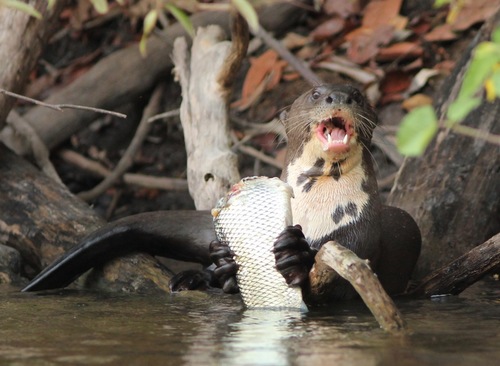
The giant otter or giant river otter is a South American carnivorous mammal. It is the longest member of the weasel family, Mustelidae, reaching up to 1.8 m. Atypical of mustelids, the giant otter is a social species, with family groups typically supporting three to eight members. The groups are centered on a dominant breeding pair and are extremely cohesive and cooperative. Although generally peaceful, the species is territorial, and aggression has been observed between groups. The giant otter is diurnal, being active exclusively during daylight hours. It is the noisiest otter species, and distinct vocalizations have been documented that indicate alarm, aggression, and reassurance.
🛡️ Conservation Status
endangered
en
📌 Name
The giant otter has a handful of other names. In Brazil it is known as ariranha, from the Tupi word , or onça-d'água, meaning water jaguar. In Spanish, river wolf () and water dog () are used occasionally (though the latter also refers to several different animals) and may have been more common in the reports of explorers in the 19th and early 20th centuries. All four names are in use in South America, with a number of regional variations. "Giant otter" translates literally as and in Spanish and Portuguese, respectively. Among the Achuar people, they are known as wankanim, and among the Makushi as turara. The genus name, Pteronura, is derived from the Ancient Greek words (, feather or wing) and (, tail), a reference to its distinctive, wing-like tail.
📌 Taxonomy and evolution
research institute]]
The otters form the subfamily Lutrinae within the mustelids and the giant otter is the only member of the genus Pteronura. Two subspecies are currently recognized by the canonical Mammal Species of the World, P. b. brasiliensis and P. b. paraguensis. Incorrect descriptions of the species have led to multiple synonyms (the latter subspecies is often P. b. paranensis in the literature). P. b. brasiliensis is distributed across the north of the giant otter range, including the Orinoco, Amazon, and Guianas river systems; to the south, P. b. paraguensis has been suggested in Paraguay, Uruguay, southern Brazil, and northern Argentina, P. b. paraguensis is supposedly smaller and more gregarious, with different dentition and skull morphology. Carter and Rosas, however, rejected the subspecific division in 1997, noting the classification had only been validated once, in 1968, and the P. b. paraguensis type specimen was very similar to P. b. brasiliensis. Biologist Nicole Duplaix calls the division of "doubtful value". An extinct genus, Satherium, is believed to be ancestral to the present species, having migrated to the New World during the Pliocene or early Pleistocene. The giant otter shares the South American continent with three of the four members of the New World otter genus Lontra: the Neotropical river otter, the southern river otter, and the marine otter. (The North American river otter (Lontra canadensis) is the fourth Lontra member.) The giant otter seems to have evolved independently of Lontra in South America, despite the overlap. The smooth-coated otter (Lutrogale perspicillata) of Asia may be its closest extant relative; similar behaviour, vocalizations, and skull morphology have been noted. Giant otter fossil remains have been recovered from a cave in the Brazilian Mato Grosso.
Phylogenetic analysis by Koepfli and Wayne in 1998 found the giant otter has the highest divergence sequences within the otter subfamily, forming a distinct clade that split away 10 to 14 million years ago. They noted that the species may be the basal divergence among the otters or fall outside of them altogether, having split even before other mustelids, such as the ermine, polecat, and mink.
📌 Physical characteristics
in Brazil, showing its identifying throat marks]]
, allowing for a very powerful bite in this species.]]
The giant otter is clearly distinguished from other otters by morphological and behavioural characteristics. It has the greatest body length of any species in the mustelid family, although the sea otter may be heavier. Males are between in length from head to tail and females between . The animal's well-muscled tail can add a further to the total body length. Early reports of skins and living animals suggested exceptionally large males of up to ; intensive hunting likely reduced the occurrence of such massive specimens. Weights are between for males and for females.
The giant otter has the shortest fur of all otter species; it is typically chocolate brown, but may be reddish or fawn, and appears nearly black when wet. The fur is extremely dense, so much so that water cannot penetrate to the skin. Guard hairs trap water and keep the inner fur dry; the guard hairs are approximately 8millimeters (of an inch) in length, about twice as long as the fur of the inner coat. Its velvety feel makes the animal highly sought after by fur traders and has contributed to its decline. Individuals can be identified from birth by unique markings of white or cream fur on the throat and under the chin. The ears are small and rounded. The legs are short and stubby and end in large webbed feet tipped with sharp claws. Well suited for an aquatic life, it can close its ears and nose while underwater.
At the time of Carter and Rosas's writing, vision had not been directly studied, but field observations show the animal primarily hunts by sight; above water, it is able to recognize observers at great distances. The fact that it is exclusively active during the day further suggests its eyesight should be strong, to aid in hunting and predator avoidance. In other otter species, vision is generally normal or slightly myopic, both on land and in water. The giant otter's hearing is acute and its sense of smell is excellent.
The species possesses 2n = 38 chromosomes.
📌 Biology and behaviour
The giant otter is large, gregarious, and diurnal. Early travelers' reports describe noisy groups surrounding explorers' boats, but little scientific information was available on the species until Duplaix's groundbreaking work in the late 1970s. Concern over this endangered species has since generated a body of research.
📌 Vocalizations
The giant otter is an especially noisy animal, with a complex repertoire of vocalizations. All otters produce vocalizations, but by frequency and volume, the giant otter may be the most vocal. Duplaix identified nine distinct sounds, with further subdivisions possible, depending on context. Quick hah barks or explosive snorts suggest immediate interest and possible danger. A wavering scream may be used in bluff charges against intruders, while a low growl is used for aggressive warning. Hums and coos are more reassuring within the group. Whistles may be used as advance warning of nonhostile intent between groups, although evidence is limited. Newborn pups squeak to elicit attention, while older young whine and wail when they begin to participate in group activities. An analysis published in 2014 cataloged 22 distinct types of vocalization in adults and 11 in neonates. Each family of otters was shown to have its own unique audio signature.
📌 Social structure
The giant otter is a highly social animal and lives in extended family groups. Group sizes are anywhere from two to 20 members but likely average between three and eight, and larger figures may reflect two or three family groups temporarily feeding together. At least one case of a change in alpha relationship has been reported, with a new male taking over the role; the mechanics of the transition were not determined. One tentative theory for the development of sociality in mustelids is that locally abundant but unpredictably dispersed prey causes groups to form. One fight was directly observed in the Brazilian Pantanal in which three animals violently engaged a single individual near a range boundary. While not rare among large predators in general, intraspecific aggression is uncommon among otter species; Ribas and Mourão suggest a correlation to the animal's sociability, which is also rare among other otters.
📌 Reproduction and life cycle
, Brazil]]
– the newly dug white sand is a sign of recent activity at this den.]]
Giant otters build dens, which are holes dug into riverbanks, usually with multiple entrances and multiple chambers inside. They give birth within these dens during the dry season. In Cantão State Park, otters dig their reproductive dens on the shores of oxbow lakes starting around July, when waters are already quite low. They give birth between August and September, and the young pups emerge for the first time in October and November, which are the months of lowest water when fish concentrations in the dwindling lakes and channels are at their peak. This makes it easier for the adults to catch enough fish for the growing young, and for the pups to learn how to catch fish. The entire group, including nonreproductive adults, which are usually older siblings to that year's pups, collaborates to catch enough fish for the young.
Details of giant otter reproduction and life cycle are scarce, and captive animals have provided much of the information. Females appear to give birth year round, although in the wild, births may peak during the dry season. The estrous cycle is 21 days, with females receptive to sexual advances between three and 10 days. Study of captive specimens has found only males initiate copulation. Research over five years on a breeding pair at the Cali Zoo in Colombia found the average interval between litters was six to seven months, but as short as 77 days when the previous litter did not survive. Males actively participate in rearing cubs and family cohesion is strong; older, juvenile siblings also participate in rearing, although in the weeks immediately after birth, they may temporarily leave the group.
In the wild, it has been suggested, although not systematically confirmed, that tourists cause similar stresses: disrupted lactation and denning, reduced hunting, and habitat abandonment are all risks.
The longest documented giant otter lifespan in the wild is eight years. In captivity, this may increase to 17, with an unconfirmed record of 19. The animal is susceptible to a variety of diseases, including canine parvovirus. Parasites, such as the larvae of flies and a variety of intestinal worms, also afflict the giant otter. Other causes of death include accidents, gastroenteritis, infanticide, and epileptic seizures.
📌 Hunting and diet
The giant otter is an apex predator, and its population status reflects the overall health of riverine ecosystems. It feeds mainly on fish, including cichlids, perch, characins (such as piranha), and catfish. One full-year study of giant otter scats in Amazonian Brazil found fish present in all fecal samples. Fish from the order Perciformes, particularly cichlids and perch, were seen in 97% of scats, and Characiformes, such as characins, in 86%. Fish remains were of medium-sized species that seem to prefer relatively shallow water, to the advantage of the visually oriented giant otter. Prey species found were also sedentary, generally swimming only short distances, which may aid the giant otter in predation. The giant otter seems to be opportunistic, taking whatever species are most locally abundant. If fish are unavailable, it will also take crabs, other crustaceans, snakes, and even small caimans and anacondas.
The species can hunt singly, in pairs, and in groups, relying on sharp eyesight to locate prey. In some cases, supposed cooperative hunting may be incidental, a result of group members fishing individually in close proximity; truly coordinated hunting may only occur where the prey cannot be taken by a single giant otter, such as with small green anacondas and juvenile black caiman. The giant otter seems to prefer prey fish that are generally immobile on river bottoms in clear water. Prey chase is rapid and tumultuous, with lunges and twists through the shallows and few missed targets. The otter can attack from both above and below, swiveling at the last instant to clamp the prey in its jaws. Giant otters catch their own food and consume it immediately; they grasp the fish firmly between the forepaws and begin eating noisily at the head.
📌 Ecology
=== Habitat ===
, Brazil]]
The species is amphibious, although primarily terrestrial. It occurs in freshwater rivers and streams, which generally flood seasonally. Other water habitats include freshwater springs and permanent freshwater lakes. ]]
Giant otters use areas beside rivers for building dens, campsites, and latrines. They clear significant amounts of vegetation while building their campsites. One report suggests maximum areas long and wide, well-marked by scent glands, urine, and feces to signal territory. Giant otters may adopt preferred locations perennially, often on high ground. These can become quite extensive, including "backdoor" exits into forests and swamps, away from the water.
Research generally takes place in the dry season and an understanding of the species' overall habitat use remains partial. An analysis of dry season range size for three otter groups in Ecuador found areas between . Utreras Population densities varied with a high of reported in Suriname and with a low of found in Guyana.
📌 Predation and competition
Adult giant otters living in family groups have no known serious natural predators; however, there are some accounts of black caimans in Peru and yacare caimans in the Pantanal preying on giant otters. Pups are more vulnerable, and may be taken by black caiman, While the two species are sympatric (with overlapping ranges) during certain seasons, there appeared to be no serious conflict. The smaller neotropical otter is far more shy, less noisy, and less social; at about a third the weight of the giant otter, it is more vulnerable to predation, hence, a lack of conspicuousness is to its advantage. The neotropical otter is active during twilight and darkness, reducing the likelihood of conflict with the diurnal giant otter. Its smaller prey, different denning habits, and different preferred water types also reduce interaction.
📌 Conservation status
The IUCN listed the giant otter as "endangered" in 1999; it had been considered "vulnerable" under all previous listings from 1982 when sufficient data had first become available. It is regulated internationally under Appendix I of the Convention on International Trade in Endangered Species of Wild Fauna and Flora (CITES) meaning commercial trade in specimens (including parts and derivatives) is prohibited.
📌 Threats
The animal faces a variety of critical threats. Poaching has long been a problem. Statistics show between 1959 and 1969 Amazonian Brazil alone accounted for 1,000 to 3,000 pelts annually. The species was so thoroughly decimated, the number dropped to just 12 in 1971. The implementation of CITES in 1973 finally brought about significant hunting reductions, The animal's relatively late sexual maturity and complex social life makes hunting especially disastrous.
More recently, habitat destruction and degradation have become the principal dangers, and a further reduction of 50% is expected in giant otter numbers within the 25 years after 2020 (about the span of three generations of giant otters). Specific threats from human industry include unsustainable mahogany logging in parts of the giant otter range,
Other threats to the giant otter include conflict with fishermen, who often view the species as a nuisance (see below). Ecotourism also presents challenges: while it raises money and awareness for the animals, by its nature it also increases human effect on the species, both through associated development and direct disturbances in the field.
📌 Distribution and population
]]
The giant otter has lost as much as 80% of its South American range. The species has likely been extirpated from southern Brazil, but in the west of the country, decreased hunting pressure in the critical Pantanal has led to very successful recolonization; an estimate suggests 1,000 or more animals in the region.
As of 2020, the IUCN estimates that there may be 4,569 otters living in Brazil. Duplaix returned to the country in 2000 and found the giant otter still present on the Kaburi Creek, a "jewel" of biodiversity, although increased human presence and land use suggests, sooner or later, the species may not be able to find suitable habitat for campsites. In a report for World Wildlife Fund in 2002, Duplaix was emphatic about the importance of Suriname and the other Guianas: Bolivia designated wetlands larger than the size of Switzerland as a freshwater protected area in 2001; these are also home to the giant otter.
📌 Interactions with indigenous peoples
Throughout its range, the giant otter interacts with indigenous groups, who often practice traditional hunting and fishing. A study of five indigenous communities in Colombia suggests native attitudes toward the animal are a threat: the otters are often viewed as a nuisance that interferes with fishing, and are sometimes killed. Even when told of the importance of the species to ecosystems and the danger of extinction, interviewees showed little interest in continuing to coexist with the species. School children, however, had a more positive impression of the animal.
In Suriname, the giant otter is not a traditional prey species for human hunters, which affords some protection. One difference in behavior was seen in the country in 2002: the normally inquisitive giant otters showed "active avoidance behavior with visible panic" when boats appeared. Logging, hunting, and pup seizure may have led groups to be far more wary of human activity.
The Bororó people have a legend on the origin of tobacco smoking: those who used the leaf improperly by swallowing it were punished by being transformed into giant otters; the Bororo also associate the giant otter with fish and with fire. A Ticuna legend has it that the giant otter exchanged places with the jaguar: the story says jaguar formerly lived in the water and the giant otter came to the land only to eat. The indigenous Kichwa peoples from Amazonian Peru believed in a world of water where Yaku runa reigned as mother of the water and was charged with caring for fish and animals. Giant otters served as Yaku runa's canoes. A Maxacali creation story suggests that the practice of otter fishing may have been prevalent in the past.