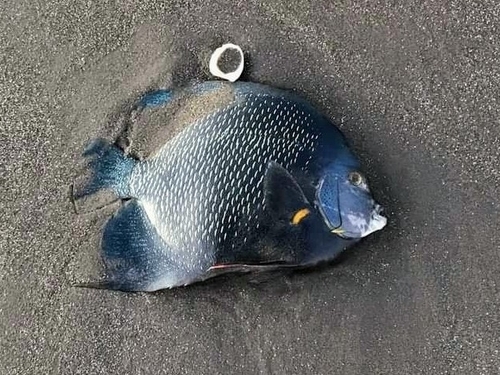
Pomacanthus paru, also known by its common name the French angelfish, is a slow growing coral reef fish from the Caribbean. The species is of the family Pomacanthidae, which contains other species of marine angelfish. Its closest relative is the grey angelfish.
📌 Taxonomy
The French angelfish was first formally described as Chaetodon paru by the German physician and naturalist Marcus Elieser Bloch (1723–1799) with the type locality given as Brazil and Jamaica. The species is placed by some authorities in the subgenus Pomacanthus,. The specific name of this species, paru is the Portuguese name for this species.
📌 Distribution
French angelfish can be found in the western Atlantic from Florida to the Gulf of Mexico and down towards Brazil and the Caribbean,
📌 Feeding
French angelfish live in and around coral reefs and rocky shores. As adults, these fish primarily feed on sponges with around 70% of their diet consisting of sponges. help to grind up pieces of sponges. In contrast, juvenile French angelfish feed by consuming ectoparasites on larger fishes. As a result, juveniles spend a huge portion of their time at or near their cleaning stations.
As juvenile French angelfish grow in size, they become more generalist when it comes to species of sponge they eat, eating around twelve to fifteen sponge species, which is similar to their adult diet. This shows there is a direct relationship between the size of the juvenile and how much sponges contribute to their diet, with large juveniles eating more sponges than smaller juveniles.
📌 Juvenile cleaning stations
Like juveniles of some other angelfish species, juvenile French angelfish are well documented cleaner fish; many larger fish species allow or implore them to approach to feed on ectoparasites, mucus, dead tissue, and other undesirable particles.
In the Caribbean, certain patches of the ocean floor may be used by young green sea turtles as "cleaning stations". At such cleaning stations, multiple species of cleaner fish of varying families coexist and provide cleaning services to the turtles as well other fish that seek cleaning services. At these stations, juvenile P. paru primarily clean the sea turtles' heads, carapace, and plastron.
📌 Biology
French angelfish are common on rocky and coral reefs where it is normally encountered in pairs, frequently in the vicinity of sea fans. Its diet comprises sponges, and tunicates. These pairs are highly territorial, and typically both vigorously defending their territory from their neighbours. Juveniles act as cleaner fish and establish cleaning stations. Species recorded as being clients of juvenile French angelfish, include jacks, snappers, morays, grunts, surgeonfishes and wrasses. They can produce a knocking sound when alarmed.
In many fish species, the age of an individual can be estimated by analyzing its otoliths. In French angelfish, an opaque band forms on the sagittae otolith with every year of growth. A 2016 study of French angelfish otoliths found that the oldest specimen in the study was 27 years old.
📌 Parasites
In a captive specimen in Georgia, researchers found endoparasites (parasites that live within the host body) of the genus Enterogyrus on its foregut wall. The way in which these parasites attach themselves to their host was unusual, as the parasites attached themselves perpendicularly to the folds in the foregut.
📌 Reproduction
In French angelfish, there are no obvious courtship displays or clear sexual dimorphism between the sexes. The species forms monogamous pairs, unlike its closest relative, the grey angelfish, which mates in polygamous groups.
📌 Conservation
According to the IUCN red list of endangered animal species, the French angelfish is currently listed as least concern. However, it is very possible that in the coming years this fish species moves from least concern to near threatened or even vulnerable. This is in large part due to the marine pet trade, also known as the marine ornamental trade. In Brazil alone, the French angelfish is the fifth most exported in the Brazilian fish trade. In addition, French angelfish are also caught as bycatch.
The longevity of large-bodied pomacanthids, their slow growth, their late sexual maturity, along with heavy exploitation of them from the aquarium trade, puts French angelfish and related species at risk of becoming more endangered from human impacts, as the slow rate by which these fish reproduce means they cannot quickly replenish their population.
📌 Importance to humans
The French angelfish is common in the aquarium trade, collection and export to the United States and European markets being common in Brazil. It has been bred in captivity. It is harvested for food, its flesh being considered highly palatable, although it has been reported to be a source of ciguatera poisoning in humans.