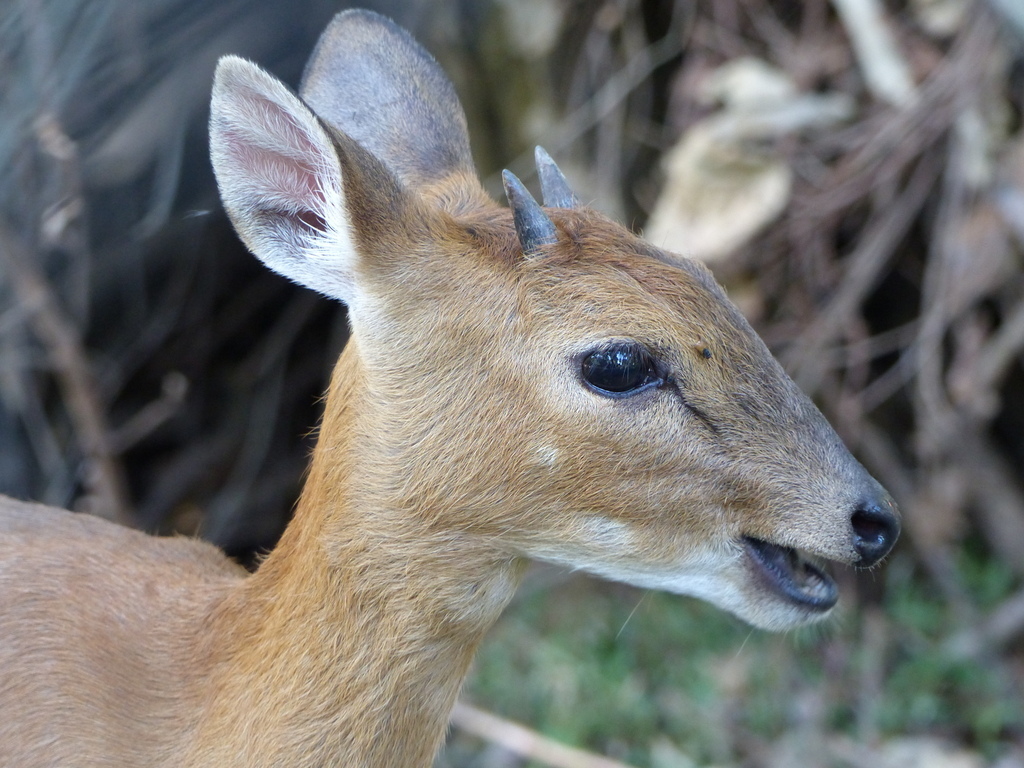
The four-horned antelope, also called chousingha, is a small bovid antelope native to central, South and Western India, along with a smaller population in Nepal. The sole member of the genus Tetracerus, the chousingha was first scientifically described in 1816 by French zoologist Henri Marie Ducrotay de Blainville. Three regional subspecies are currently recognised. The four-horned antelope has a yellowish-tan, sometimes reddish or goldenrod coat. It is slender with thin legs and a short tail. It stands nearly 55โ64ย cm (22โ25ย in) at the shoulder and weighs about 17โ22ย kg (37โ49ย lb). Its four horns are unique among antelopes and distinguish it from most other bovids. The longer pair of straight, spike-like horns is atop its head between the ears, while the other, shorter pair is on the forehead; its posterior horns are always longer than the anterior horns, which may even present as merely fur-covered "studs". While the posterior horns measure 8โ12ย cm (3.1โ4.7ย in), the anterior ones are usually 2โ5ย cm (0.79โ1.97ย in) long.
๐ก๏ธ Conservation Status
vulnerable
vu
๐ Etymology
The scientific name of the four-horned antelope is Tetracerus quadricornis. The generic name Tetracerus is the combination of two Greek words: tetra meaning "four" The specific name quadricornis is derived from two Latin words: meaning "four" and "horn". The four-horned antelope is known by several vernacular names: chausingha, chowsingha, chousingha (Hindi for "four horns"), doda, (mainly in central India) (Hindi); (Kannada); (Nepalese); (Tamil).
๐ Taxonomy and phylogeny
The four-horned antelope is the sole member of the genus Tetracerus, and is placed under the family Bovidae. The species was first described by French zoologist Henri Marie Ducrotay de Blainville in 1816.
The authority for Tetracerus is variously indicated according to interpretations of the International Code of Zoological Nomenclature. The name was first published in an 1825 publication by English naturalist Thomas Hardwicke but cited the English zoologist William Elford Leach โ probably by an editor โ as the authority in a footnote at the end of the publication. Philip Sclater and Oldfield Thomas listed Hardwicke as the genus authority by virtue of his being the author of the publication. However, Leach is now identified as the appropriate authority based on Article 50.1.1 of the Zoological Code. this was seconded by a similar study in 1999. The following cladogram is based on the 1992 study:
* T. q. iodes (Hodgson, 1847): distributed north of the Ganges in Nepal
* T. q. quadricornis (de Blainville, 1816): distributed in peninsular India
* T. q. subquadricornutus (Elliot, 1839) distributed in the Western Ghats and southern India
๐ Evolution
Though Boselaphini has no African representation today, fossil evidence supports its presence in the continent as early as the late Miocene โ the two living antelopes of this tribe, in fact, have been found to have a closer relationship with the earliest bovids (like Eotragus species) than do the other bovids. This tribe originated at least 8.9 Mya, in much the same area where the four-horned antelope occurs today, and may represent the most "primitive" of all living bovids, having changed the least since the origins of the family. The extant and extinct boselaphine forms show similar development of the horn cores (the central bony part of the horn). It is thought that ancestral bovids had a diploid chromosome number of 58 which has reduced in Tetracerus to 38 through a process of concatenation of some chromosomes.
Fossils of Protragocerus labidotus and Sivoreas eremita dating back to the late Miocene have been discovered in the Ngorora formation (Kenya). Fossils from the same period have also been excavated in the eastern Mediterranean region. Other Miocene fossils of boselaphines discovered are of Miotragocerus, Tragocerus and Tragoportax. Fossils of Miotragoceros are not apparent in Africa (only M. cyrenaicus has been reported from the continent), but have significant presence in the Shiwalik Hills in India and Pakistan, as do several Tragoportax species. A 2005 study suggested the migration of Miotragoceros to eastern Asia around 8 Mya. Alan W. Gentry of the Natural History Museum reported the presence of another boselaphine, Mesembriportax, from Langebaanweg (South Africa).
Evidence of early humans hunting four-horned antelope during the Mesolithic period (5,000 to 8,000 years ago) have been found in the Kurnool caves of southern India and similar evidence has been found from the Chalcolithic period (3,000 years ago) in Orissa, eastern India.
๐ Ecology and behaviour
The four-horned antelope is diurnal (active mainly during the day), though it mainly rests or ruminates in dense undergrowth at noon. Though solitary by nature, the four-horned antelope may form loose groups of three to five. Groups consist of one or more adults, sometimes accompanied by juveniles. Males and females hardly interact, except in the mating season. Submissive display consists of shrinking the body, lowering the head and pulling the ears back. leopards, and dholes.
๐ Reproduction
Breeding behaviour of the four-horned antelope has not been well studied. The age at which sexual maturity is gained is doubted; two captive females had their first parturition at less than two years. The breeding season in Panna National Park probably lasts from May to July, and from June to August in Mudumalai National Park. The male approaches the female in a relaxed gait, giving out low coughs. The two may kneel and push against each other with the necks intertwined. The male makes a few short mounting attempts; the female may be foraging all the while without any reaction. Gestation lasts about eight months, followed by the birth of one or two calves. The newborn has a head-and-body length of , and weighs . Juveniles are kept concealed for the first few weeks of birth. Births in Mudumalai National Park peak from February to April. Juveniles remain with their mothers for about a year.
๐ Distribution and habitat
]]
The four-horned antelope is confined to the Indian subcontinent, occurring widely in disjunct and small populations. It ranges from the foothills of the Himalayas in the north to the Deccan Plateau in the south. Most of the existing populations lives in India, and lower numbers in adjoining Nepal.
It inhabits open, dry deciduous forests in flat to hilly terrain. It prefers areas close to water that are covered with grasses or heavy undergrowth, for security. As many Ungulates are skittish by nature, the chousingha, notably, generally keeps away from human settlements; research suggests that human activities, construction, and feral dogs all adversely affect chousingha numbers, thus areas of less human habitation support more stable chousingha populations.
The four-horned antelope was once common throughout deciduous forests in India, but the population has declined over time. In 2001, it was estimated to comprise about 10,000 mature individuals, with a decreasing trend.
๐ Threats and conservation
The four-horned antelope is classified as vulnerable on the IUCN Red List. It is threatened by the loss of its natural habitat due to agricultural expansion.
The four-horned antelope is protected under Schedule I of the Indian Wildlife Protection Act of 1972; the population in Nepal is listed in CITES Appendix III.
*Gir National Park in Gujarat;
*Sariska Tiger Reserve in Rajasthan;
*Bandhavgarh National Park, Bori Wildlife Sanctuary, Kanha National Park, Pachmarhi Biosphere Reserve, Panna Tiger Reserve, Pench Tiger Reserve, Sanjay National Park, Satpura National Park in Madhya Pradesh;
*Tadoba Andhari Reserve in Maharashtra;
*Kumbhalgarh Wildlife Sanctuary, Ranthambore National Park, Rangayyanadurga Fourโhorned antelope Wildlife Sanctuary in Karnataka.