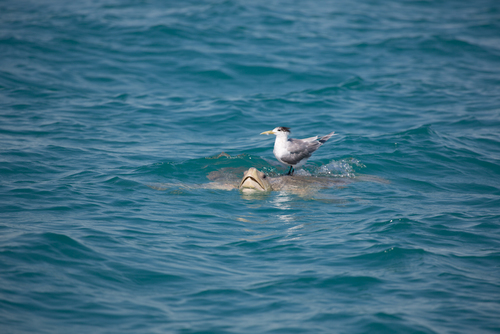
The Australian flatback sea turtle is a species of sea turtle in the family Cheloniidae. The species is endemic to the sandy beaches and shallow coastal waters of the Australian continental shelf. This turtle gets its common name from the fact that its shell has a flattened, lower dome than the other sea turtles. It can be olive green to grey with a cream underside. It averages from 76 to 96ย cm in carapace length and can weigh from 70 to 90ย kg. The hatchlings are larger than other sea turtle hatchlings when they hatch and emerge from their nests.
๐ Taxonomy
The flatback sea turtle is the sole species in the Natator genus, which has no subspecies, but was originally described as Chelonia depressa in 1880 by American herpetologist Samuel Garman. The genus Natator (meaning "swimmer") was created in 1908 by Australian ichthyologist Allan Riverstone McCulloch, and in the same scientific paper he described what he thought to be a new species, Natator tessellatus, thereby creating a junior synonym. In 1988 Swiss paleontologist Rainer Zangerl assigned the flatback sea turtle to the genus Natator as the new combination Natator depressus. Because Chelonia is feminine, and Natator is masculine, the specific name was changed from depressa to depressus.
๐ Distribution and habitat
The flatback sea turtle has the smallest range of the seven sea turtles. It is found in the continental shelf and coastal waters of tropic regions. It does not travel long distances in the open ocean for migrations like other sea turtles. It can typically be found in waters of or less in depth. It does not have a global distribution like the other sea turtles. The flatback sea turtle can be found along the coastal waters of Northern Australia, the Tropic of Capricorn, and the coastal areas of Papua New Guinea and Indonesia.
The distribution of nesting sites can be found across Queensland, the Northern Territory, and Western Australia, with the greatest concentration found in Queensland, in the Gulf of Carpentaria. The habitats that females prefer for nesting sites are sandy beaches in tropical and subtropical areas, avoiding beaches fronted by intertidal coral reef flats. They prefer beaches where the sand temperature can be in the range of at nest depth. These temperatures help determine the hatchling's sex, and can lead to female-biased hatchling ratios in nesting sites with darker sand that absorbs more heat.
๐ Life history
===Early life===
Flatback hatchlings have grey backs with dark outlined scutes, a white belly, and blue eyes. Different nesting sites have different seasons, which can vary year-by-year. In eastern Queensland, clutches begin to hatch during the beginning of December until late March, with a peak in hatchling emergence during February. A flatback sea turtle hatchling is larger than other sea turtle hatchlings with its carapace length averaging around . Its large size helps protect it from some of the predators after hatching, and allows it to also be a stronger swimmer. The hatchlings tend to stay close to shore and lack the pelagic phase of other sea turtles. They absorb their egg's yolk sac in the nest and continue to be nourished by it for a few days, while emerging and entering the sea, until they begin feeding on the macroplankton present in their surface-dwelling environment. Once they are large enough, they begin feeding on soft-bodied invertebrates, such as soft corals and jellyfish, and occupying soft-bottomed benthic habitats.
๐ Reproduction
A flatback sea turtle is sexually mature anywhere between 7โ50 years of age, and an adult female will nest every two to three years. Mating occurs while the male and female are out at sea; therefore, the males will never return to shore after they hatch. The flatback nesting sites can only be found along the coast of Australia, on soft sandy beaches without intertidal coral reefs. A female will return to the same beach for her subsequent clutches within the same nesting season. She will return for other nesting seasons, as well. The nesting season depends on the area of the site and can range from October to January, such as in southern Queensland, or can last the entire year, such as in the northern and northwestern territories. Females lay, on average, approximately three clutches throughout the nesting season, with intervals of 15 days between nestings. While using her front flippers to dig, the female will clear away the dry sand located at the top. After she clears the sand, the female will create an egg chamber using her back flippers. After she has laid her eggs, she will then cover the nest again using her back flippers, while also tossing sand back with her front flippers.
The number of eggs in a flatback sea turtle's clutch are fewer than other sea turtles. It will have an average of approximately 50 eggs laid each time in a clutch, while other sea turtles may lay up to 100-150 eggs in a clutch. The eggs are large within these clutches, at about long. The sex of the flatback turtle hatchling is determined by the temperature of the sand that the egg is in. If the temperature is below , the hatchling will be a male, and if the temperature is above this 29 ยฐC it will be female.
๐ Predators
The flatback sea turtle is preyed upon by both terrestrial and aquatic organisms. The terrestrial predators it must face are dingos, invasive red foxes, feral dogs, and feral pigs. The hatchlings also face predation from crabs, sea birds, and juvenile saltwater crocodiles on their journey to the waters. Once in the water, the hatchlings can be preyed upon by big fish and even sharks. Due to their large size when they are born and their strong swimming skills, the likelihood of capture is lowered.
๐ Conservation
===Status===
On the International Union for the Conservation of Nature or the IUCN's official website the flatback sea turtle is listed as data deficient. However, the flatback sea turtle is listed as vulnerable nationally in Australia. It is the least endangered of all of the sea turtles. Unlike other sea turtles, there is not a big human demand for the meat of the flatback sea turtle. It does not swim far from shore; thus, it does not get caught in nets as often as other sea turtles. These reasons can contribute to why it is not in more danger of extinction.
๐ Threats
All marine turtles are faced with threats such as habitat loss, the wildlife trade, collection of eggs, collection of meat, fishery bycatch, pollution, and climate change. However, the increased temperatures did not reduce the hatchling body size or their success, but it did accelerate the development of the embryo. This study found a higher pivotal temperature (the temperature that produces an equal number of males and females) than had previously been described, which suggests that some populations may have adapted to maintain large number of hatchlings of both sexes even under the effects of climate change. Instead, climate change may threaten flatback turtles by increasing the frequency or intensity of tropical storms and raising sea levels, which may result in the loss of nests or entire nesting sites. Since this species is very loyal to its nesting sites and has a long development time and lifespan, they are less able to adapt to changes in the environment within a short time.
๐ Conservation methods
In 2003, a recovery plan was set in place nationally to help this species along with other sea turtles. This plan aims to reduce mortality rates through actions within commercial fisheries and to maintain a sustainable harvest by Indigenous people. Monitoring programs are being developed and integrated, along with managing factors that affect the reproductive success of this species. In Kakadu National Park, a monitoring program has already been set up for this species. This species' critical habitat is being identified for protection. There are also efforts to enhance the spread of information about the flatback sea turtle as well as cooperation and actions internationally.
==References==