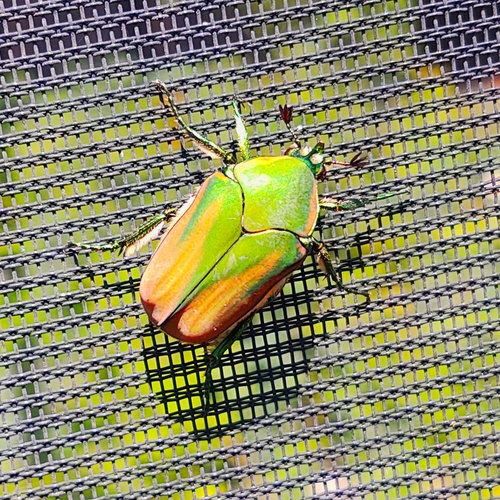
The figeater beetle is a member of the scarab beetle family in the subfamily Cetoniinae, comprising a group of beetles commonly called flower chafers, since many of them feed on pollen, nectar, or petals. Its habitat covers primarily the southwestern United States and Mexico, extending south to northern South America. Within the figeater beetle's cuticle, twisted fibers are arranged in stacked layers. When light hits those layers, it bends and creates a distinct iridescent color. Figeater beetles are often mistaken for green June beetles and occasionally Japanese beetles, which occur in the Eastern US. C. mutabilis are also named by the synonym C. texana.
📌 Life cycle
After mating, eggs are laid in decaying matter or compost piles, which provide sustenance for the emerging larvae. Oviposition takes place over an extended period of about three months, beginning in early August and continuing until the end of October. Eggs measure approximately 1.8 mm wide and 2.3 mm long and have a whitish color. Larvae are white with a yellow-brown head. Figeater beetle larvae are sometimes called "back crawlers" because although larvae have legs, they are ineffective for movement. Instead of using their legs, larvae roll onto their backs and push forward with rows of bristles to move in a wave-like manner. Adult figeater beetles grow to about . They are active during daylight hours, often congregating in the shade of trees near choice breeding grounds to find mates. A wild figeater beetle's entire life cycle lasts 12 months.
📌 Adult morphology
Adult figeater beetles have green elytra and prothorax, along with a distinct clypeal horn. The abdominal segments reveal the sex of the figeater beetle. Sex can be determined by analyzing abdominal segments, which are covered in hairs in females but are smooth in males. Within the same population, female figeater beetles exhibit larger sizes than male figeater beetles.
📌 Taxonomy
C. mutabilis is often confused with the green June beetle (Cotinis nitida). Both are members of the flower beetle subfamily (Cetoniinae), and are similar in appearance, but the green June beetle is smaller, and its range is in the Eastern United States. They are also occasionally mistaken for Japanese beetles (Popillia japonica), which also occur in the Eastern U.S.
Taxonomic research conducted between 1833 and 1915 described 31 taxa that are no longer considered separate species. C. mutabilis has the widest geographical range out of any species in the genus. Many of these, such as C. texana Casey, C. abdominalis Casey, and C. arizonica Casey, are now considered synonyms of C. mutabilis, meaning they are no longer recognized as distinct subspecies but rather are variations of C. mutabilis.
📌 Habitat and distribution
Distribution of C. mutabilis ranges from the U.S. to northern South America and has been recorded in almost all of Mexico. Figeater beetles have geographically expanded northward in recent decades. The first recording of figeater beetles in Nevada was in 1967. The first recording in Utah was in 2009, and the first recording in Colorado was in 2012. Expansion has been associated with climate change and agricultural activity, which have created suitable new habitats for the figeater. In Arizona, the increasing use of irrigation in agriculture has created favorable moist soil breeding conditions, leading to an increase of figeater beetle populations. As figeater habitats expand, they can have positive effects on vegetation by acting as possible pollinators. However, figeater beetles may pose an economic risk to farmers by damaging fruit crops.
📌 Thermoregulation
Unlike most beetles, figeater beetles are endothermic and are able to generate heat through the metabolic activity of their flight muscles. Even when resting and not in direct contact with the sun, figeater beetles are able to keep their thoracic temperatures up to 12 degrees Celsius warmer than the surrounding air. Their thoracic temperature can reach between 32-39 degrees Celsius before flight and, during flight, can range from 30-42 degrees Celsius. Figeater beetles have also been observed basking in the sun, which can increase their thoracic temperatures by 7-10 degrees Celsius.
📌 Phoresis
Figeater beetles interact with other species as a host in a phoretic relationship with the pseudoscorpion species Lustrochernes minor. The first recorded phoretic association between C. mutabilis and L. minor was in Oaxaca, Mexico, in 2019. The L. minor pseudoscorpions participate in passive phoresy, meaning they do not grab onto the figeater beetle but instead sit beneath the figeater beetle's elytra. The commensal relationship benefits the pseudoscorpions by allowing them to travel distances they would be unable to travel by themselves. The exact mechanisms of how pseudoscorpions get under the elytra are still unknown, but it is hypothesized that the pseudoscorpions living in soil may have encountered adult figeater beetles as they emerge from the ground after pupation.
📌 Natural enemies
A significant natural enemy is the fungus Metarrhizium anisophiae, which targets larvae during the third instar. When fungus completely takes over their body, killing the larvae and leaving their body hardened and white.
📌 Environmental interaction
Figeater beetles have been utilized as a reliable bioindicator to monitor soil arsenic levels. Larvae feed underground, subjecting them to arsenic contaminated soil. This makes them particularly susceptible to accumulating arsenic over time. High soil arsenic levels are positively correlated with the high arsenic levels measured within figeater beetle bodies.
📌 Flight muscles
Figeater beetles have asynchronous flight muscles, allowing the wings to beat at higher frequencies without having to send a new nerve impulse after each contraction, which is characteristic of synchronous muscles. Before flight, a nerve signal activates the flight muscles, causing an initial contraction. This contraction then moves the wings in an oscillatory manner and is sustained by the wings and thorax, rather than the input of a new neural input. This allows figeater beetles to spend less energy during flight by reducing the energy expenditure required to activate their flight muscles. When figeater beetles fly, their wings move at approximately 90 cycles per second. The measured respiratory quotient of the figeater beetle's flight muscles is 0.83, which indicates that figeater beetles do not rely exclusively on either carbohydrates or pure fat as their primary energy sources for flight. The respiratory quotient of their flight muscles closely resembles that of the metabolic pathway that converts proline to alanine, although it has not been directly determined.
📌 Structure and coloration
Figeater beetles have a glossy, metallic iridescence that is attributed to light-reflecting structures within the cuticle. Three structural layers make up the cuticle. The layers consist of the outermost epicuticle, a middle exocuticle, and an innermost endocuticle. The outer exocuticle contains helicoidal fibrous chitin protein lamellae called Bouligand structures, which gives figeater beetles the iridescent and metallic shine by selectively reflecting left-handed polarized light. These color variations come from variations in how tightly the chitin fibrils are wound, which is a property of cuticle pitch. The pitch is quantified by the distance it takes to complete one helical turn, and variations in pitch across different cuticle layers determine the color. When longer pitch yellowish cuticles are scratched, exposing the shorter pitch inner layer, the cuticle displays a greenish color. This phenomenon is due to pitch differences, which differ depending on the depth they are located within the cuticle, which reflect different wavelengths of light.
Genetic polymorphism has historically led researchers to describe the same species under different taxonomic names. Different color variations are more prominent in different regions. In central Mexico, distinctly green and black variations are found in the same geographical area without producing offspring with intermediate appearances.
📌 Cultural significance
Figeater beetle legs have been used in jewelry production by humans during the early Basketmaker II society and were worn to display high social status. Two necklaces constructed using the legs of figeater beetles have been recovered from the Bears Ears National Monument in Utah and have been dated to approximately 70-60 BCE.