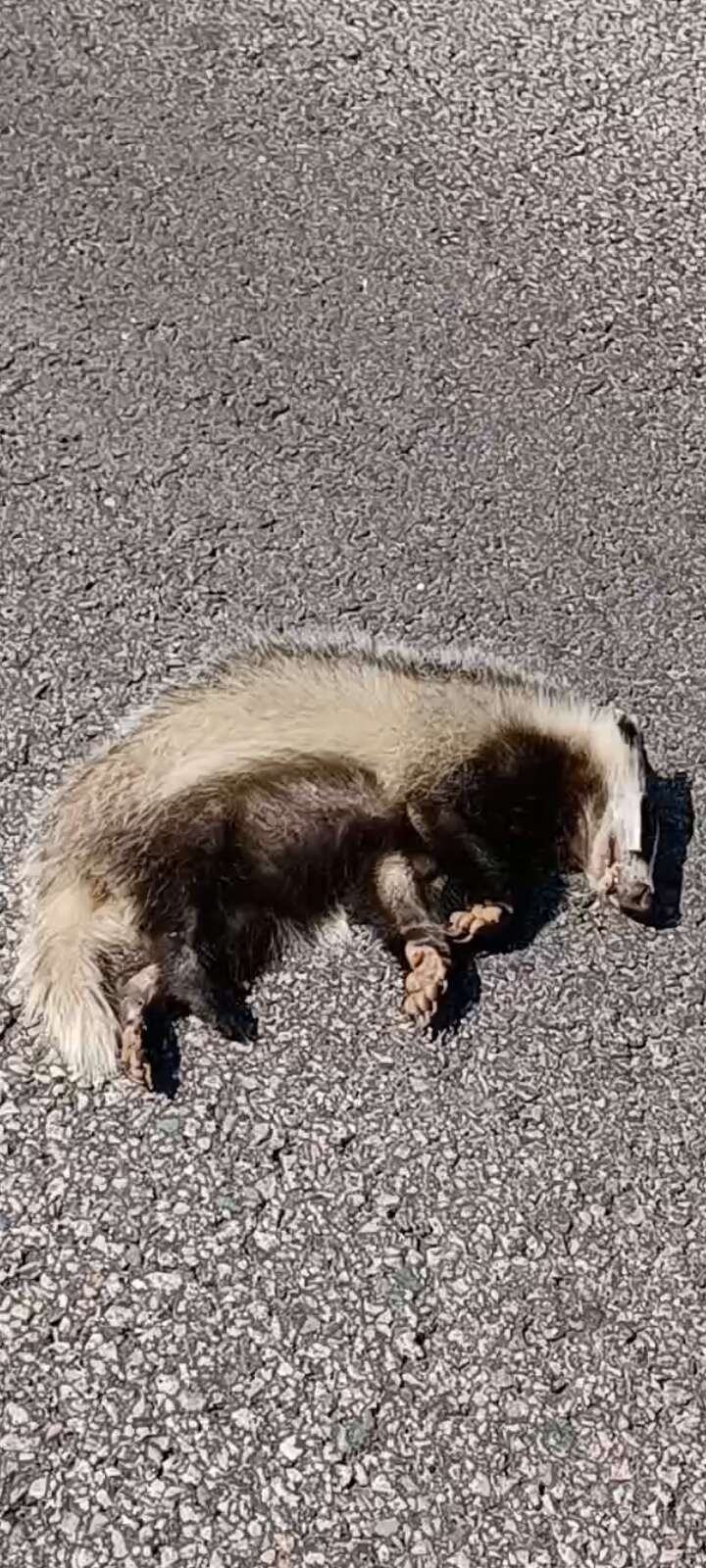
The European badger, also known as the Eurasian badger, is a badger species in the family Mustelidae native to Europe and West Asia and parts of Central Asia. It is classified as least concern on the IUCN Red List, as it has a wide range and a large, stable population size which is thought to be increasing in some regions. Several subspecies are recognized, with the nominate subspecies predominating in most of Europe. In Europe, where no other badger species commonly occurs, it is generally just called the "badger".
📌 Nomenclature
The source of the word "badger" is uncertain. The Oxford English Dictionary states it probably derives from "badge" + -ard, a reference to the white mark on its forehead that resembles a badge, and may date to the early 16th century. The French word ('digger') has also been suggested as a source. A male badger is a boar, a female is a sow, and a young badger is a cub. A badger's home is called a sett. Badger colonies are often called clans.
The far older name "brock" (), () is a Celtic loanword (cf. Gaelic and Welsh , from Proto-Celtic ) meaning 'grey'. and from these words the common Romance terms for the animal evolved (Italian , French —now is more common—, Catalan , Spanish , Portuguese ) except Asturian .
Until the mid-18th century, European badgers were variously known in English as brock, pate, grey, and bawson. The name "bawson" is derived from "bawsened", which refers to something striped with white. "Pate" is a local name that was once popular in northern England. The name "badget" was once common, but only used in Norfolk, while "earth dog" was used in southern Ireland. The badger is commonly referred to in Welsh as a ('earth pig').
📌 Taxonomy
Ursus meles was the scientific name used by Carl Linnaeus in 1758, who described the badger in his work Systema Naturae.
📌 Evolution
The species likely evolved from the Chinese Meles thorali of the early Pleistocene. The modern species originated during the early Middle Pleistocene, with fossil sites occurring in Episcopia, Grombasek, Süssenborn, Hundsheim, Erpfingen, Koněprusy, Mosbach 2, and Stránská Skála. A comparison between fossil and living specimens shows a marked progressive adaptation to omnivory, namely in the increase in the molars' surface areas and the modification of the carnassials. Occasionally, badger bones are discovered in earlier strata, due to the burrowing habits of the species.
📌 Subspecies
In the 19th and 20th centuries, several badger type specimens were described and proposed as subspecies. , eight subspecies were recognized as valid taxa, but four (canescens, arcalus, rhodius, severzovi) are now considered to belong to a distinct species, the Caucasian badger (M. canescens).
{| class="wikitable collapsible" font=90%
|- bgcolor="#115a6c"
!Subspecies
!Trinomial authority and synonyms
!Description
!Range
|-style="vertical-align: top;"
|Common badger (M. m. meles)
|Linnaeus, 1758
}}
|A large subspecies with a strongly developed sagittal crest, it has a soft pelage and relatively dense underfur. The back has a relatively pure silvery-grey tone, while the main tone of the head is pure white. The dark stripes are wide and black, while the white fields fully extend along the upper and lateral parts of the neck. It can weigh up to 20–24 kg in autumn, with some specimens attaining even larger sizes.
|Continental Europe, except for the Iberian Peninsula. Its eastern range encompasses the European area of the former Soviet Union eastward to the Volga, Crimea, Ciscaucasia, and the northern Caucasus
|-style="vertical-align: top;"
|Iberian badger (M. m. marianensis)
|Graells, 1897
|
|Spain and Portugal
|-style="vertical-align: top;"
|Kizlyar badger (M. m. heptneri)
|Ognev, 1931
|A large subspecies, it exhibits several traits of the Asian badger, namely its very pale, dull, dirty-greyish-ocherous colour and narrow head stripes.
|Steppe region of northeastern Ciscaucasia, the Kalmytsk steppes and the Volga delta
|-style="vertical-align: top;"
|Norwegian badger (M. m. milleri)
|Baryshnikov, Puzachenko and Abramov, 2003
|This subspecies has a smaller skull and smaller teeth than the nominate badger subspecies in Sweden and Finland.
|Southwestern Norway, west of Telemark
|-
|}
📌 Fur
badger]]
In winter, the fur on the back and flanks is long and coarse, consisting of bristly guard hairs with a sparse, soft undercoat. The belly fur consists of short, sparse hairs, with skin being visible in the inguinal region. Guard hair length on the middle of the back is in winter. Prior to the winter, the throat, lower neck, chest and legs are black. The belly is of a lighter, brownish tint, while the inguinal region is brownish-grey. The general colour of the back and sides is light silvery-grey, with straw-coloured highlights on the sides. The tail has long and coarse hairs, and is generally the same colour as the back. Two black bands pass along the head, starting from the upper lip and passing upwards to the whole base of the ears. The bands sometimes extend along the neck and merge with the colour of the upper body. The front parts of the bands are , and widen to in the ear region. A wide, white band extends from the nose tip through the forehead and crown. White markings occur on the lower part of the head, and extend backwards to a great part of the neck's length. The summer fur is much coarser, shorter and sparser, and is deeper in colour, with the black tones becoming brownish, sometimes with yellowish tinges.
📌 Distribution and habitat
The European badger is native to most of Europe. Its range includes Albania, Armenia, Austria, Belarus, Belgium, Bosnia and Herzegovina, Bulgaria, Crete, Croatia, Czech Republic, Denmark, Estonia, Finland, France, Georgia, Germany, Great Britain, Greece, Hungary, Ireland, Italy, Latvia, Lithuania, Luxembourg, Macedonia, Moldova, Montenegro, Netherlands, Norway, Poland, Portugal, Romania, Russia, Serbia, Slovakia, Slovenia, Spain, Sweden, Switzerland and Ukraine. They are common in European Russia, with 30,000 individuals having been recorded there in 1990. They are abundant and increasing throughout their range, partly due to a reduction in rabies in Central Europe. In the UK, badgers experienced a 77% increase in numbers during the 1980s and 1990s.
The European badger is found in deciduous and mixed woodlands, clearings, spinneys, pastureland and scrub, including Mediterranean maquis shrubland. It has adapted to life in suburban areas and urban parks, although not to the extent of red foxes. In mountainous areas it occurs up to an altitude of .
📌 Behaviour and ecology
===Social and territorial behaviour===
European badgers are the most social of badgers, It is mainly males that are involved in territorial aggression. A hierarchical social system is thought to exist among badgers and large powerful boars seem to assert dominance over smaller males. Large boars sometimes intrude into neighbouring territories during the main mating season in early spring.
Sparring and more vicious fights generally result from territorial defense in the breeding season. However, in general, animals within and outside a group show considerable tolerance of each other. Boars tend to mark their territories more actively than sows, with their territorial activity increasing during the mating season in early spring. Badgers groom each other very thoroughly with their claws and teeth. Grooming may have a social function. They are crepuscular and nocturnal in habits. and emit a piercing scream when alarmed or frightened.
📌 Denning behaviour
Like other badger species, European badgers are burrowing animals. However, the dens they construct (called setts) are the most complex, and are passed on from generation to generation. The number of exits in one sett can vary from a few to fifty. These setts can be vast, and can sometimes accommodate multiple families. When this happens, each family occupies its own passages and nesting chambers. Some setts may have exits which are only used in times of danger or play. A typical passage has a wide base and a height. Three sleeping chambers occur in a family unit, some of which are open at both ends. The nesting chamber is located from the opening, and is situated more than a underground, in some cases . Generally, the passages are long. The nesting chamber is on average , and are high.
Badgers dig and collect bedding throughout the year, particularly in autumn and spring. Sett maintenance is usually carried out by subordinate sows and dominant boars. The chambers are frequently lined with bedding, brought in on dry nights, which consists of grass, bracken, straw, leaves and moss. Up to 30 bundles can be carried to the sett on a single night. European badgers are fastidiously clean animals which regularly clear out and discard old bedding. During the winter, they may take their bedding outside on sunny mornings and retrieve it later in the day. A sett is almost invariably located near a tree, which is used by badgers for stretching or claw scraping. Badgers defecate in latrines, which are located near the sett and at strategic locations on territorial boundaries or near places with abundant food supplies.
📌 Reproduction and development
Estrus in European badgers lasts four to six days and may occur throughout the year, though there is a peak in spring. Sexual maturity in boars is usually attained at the age of twelve to fifteen months but this can range from nine months to two years. Males are normally fecund during January–May, with spermatogenesis declining in summer. Sows usually begin ovulating in their second year, though some exceptionally begin at nine months. They can mate at any time of the year, though the main peak occurs in February–May, when mature sows are in postpartal estrus and young animals experience their first estrus. Matings occurring outside this period typically occur in sows which either failed to mate earlier in the year or matured slowly. Mating lasts for fifteen to sixty minutes, though the pair may briefly copulate for a minute or two when the sow is not in estrus. A delay of two to nine months precedes the fertilized eggs implanting into the wall of the uterus, though matings in December can result in immediate implantation. Ordinarily, implantation happens in December, with a gestation period lasting seven weeks. Cubs are usually born in mid-January to mid-March within underground chambers containing bedding. In areas where the countryside is waterlogged, cubs may be born above ground in buildings. Typically, only dominant sows can breed, as they suppress the reproduction of subordinate females. Although many cubs are sired by resident males, up to 54% can be fathered by boars from different colonies. Dominant sows may kill the cubs of subordinates. Cubs are born pink, with greyish, silvery fur and fused eyelids. Neonatal badgers are in body length on average and weigh , with cubs from large litters being smaller. By three to five days, their claws become pigmented, and individual dark hairs begin to appear. Their eyes open at four to five weeks and their milk teeth erupt about the same time. They emerge from their setts at eight weeks of age, and begin to be weaned at twelve weeks, though they may still suckle until they are four to five months old. Subordinate females assist the mother in guarding, feeding and grooming the cubs. Cubs fully develop their adult coats at six to nine weeks. In areas with medium to high badger populations, dispersal from the natal group is uncommon, though badgers may temporarily visit other colonies. Badgers can live for up to about fifteen years in the wild.
📌 Winter sleep
Badgers begin to prepare for winter sleep during late summer by accumulating fat reserves, which reach a peak in October. During this period, the sett is cleaned and the nesting chamber is filled with bedding. Upon retiring to sleep, badgers block their sett entrances with dry leaves and earth. They typically stop leaving their setts once snow has fallen. In Russia and the Nordic countries, European badgers retire for winter sleep from late October to mid-November and emerge from their setts in March and early April. In areas such as England and Transcaucasia, where winters are less harsh, badgers either forgo winter sleep entirely or spend long periods underground, emerging in mild spells.
📌 Relationships with other non-human predators
challenging two badgers moving towards a bird feeder at night]]
European badgers have few natural enemies. While normally docile, badgers can become extremely aggressive and ferocious when cornered, making it dangerous for predators to target them. Grey wolves (Canis lupus), Eurasian lynxes (Lynx lynx) and brown bears (Ursus arctos), Europe's three largest remaining land predators, and large domestic dogs (C. familiaris) can pose a threat to adult badgers, though deaths caused by them are quantitatively rare as these predators are often limited in population due to human persecution and usually prefer easier, larger prey like ungulates, while badgers may fight viciously if aware of a predator and cornered without an escape route. They may live alongside red foxes (Vulpes vulpes) in isolated sections of large burrows. However, cases are known of badgers driving vixens from their dens and destroying their litters without eating them. Golden eagles (Aquila chrysaetos) are known predators of European badgers and attacks by them on badger cubs are not infrequent, including cases where they have been pulled out directly from below the legs of their mothers, and even adult badgers may be attacked by this eagle species when emerging weak and hungry from hibernation. Eurasian eagle owls (Bubo bubo) may also take an occasional cub and other large raptors such as white-tailed eagles (Haliaeetus albicilla) and greater spotted eagle (Clanga clanga) are considered potential badger cub predators. Raccoon dogs may extensively use badger setts for shelter. There are many known cases of badgers and raccoon dogs wintering in the same hole, possibly because badgers enter hibernation two weeks earlier than the latter, and leave two weeks later. In exceptional cases, badger and raccoon dog cubs may coexist in the same burrow. Badgers may drive out or kill raccoon dogs if they overstay their welcome.
📌 Diseases and parasites
Bovine tuberculosis (bovine TB) caused by Mycobacterium bovis is a major mortality factor in badgers, though infected badgers can live and successfully breed for years before succumbing. The disease was first observed in badgers in 1951 in Switzerland where they were believed to have contracted it from chamois (Rupicapra rupicapra) or roe deer (Capreolus capreolus). It was detected in the United Kingdom in 1971 where it was linked to an outbreak of bovine TB in cows. The evidence appears to indicate that the badger is the primary reservoir of infection for cattle in the southwest of England, Wales and Ireland. Since then there has been considerable controversy as to whether culling badgers will effectively reduce or eliminate bovine TB in cattle.
Badgers are vulnerable to the mustelid herpesvirus-1, as well as rabies and canine distemper, though the latter two are absent in Great Britain. Other diseases found in European badgers include arteriosclerosis, pneumonia, pleurisy, nephritis, enteritis, polyarthritis and lymphosarcoma.
Internal parasites of badgers include trematodes, nematodes and several species of tapeworm.
📌 Conservation
The International Union for Conservation of Nature rates the European badger as being of least concern. This is because it is a relatively common species with a wide range and populations are generally stable. In Central Europe it has become more abundant in recent decades due to a reduction in the incidence of rabies. In other areas it has also fared well, with increases in numbers in Western Europe including Great Britain. However, in some areas of intensive agriculture it has reduced in numbers due to loss of habitat and in others it is hunted as a pest.
📌 Cultural significance
's The Wind in the Willows]]
in The Tale of Mr. Tod]]
Badgers play a part in European folklore and are featured in modern literature. In Irish mythology, badgers are portrayed as shape-shifters and kinsmen to Tadg, the king of Tara and foster father of Cormac mac Airt. In one story, Tadg berates his adopted son for having killed and prepared some badgers for dinner. In German folklore, the badger is portrayed as a cautious, peace-loving Philistine, who loves more than anything his home, family and comfort, though he can become aggressive if surprised. He is a cousin of Reynard the Fox, whom he uselessly tries to convince to return to the path of righteousness.
The "Frances" series of children's books by Russell and Lillian Hoban depicts an anthropomorphic badger family.
In T. H. White's Arthurian series The Once and Future King, the young King Arthur is transformed into a badger by Merlin as part of his education. He meets with an older badger who tells him "I can only teach you two things – to dig, and love your home."
A villainous badger named Tommy Brock appears in Beatrix Potter's 1912 book The Tale of Mr. Tod. He is shown kidnapping the children of Benjamin Bunny and his wife Flopsy, and hiding them in an oven at the home of Mr. Tod the fox, whom he fights at the end of the book. The portrayal of the badger as a filthy animal which appropriates fox dens was criticized from a naturalistic viewpoint, though the inconsistencies are few and employed to create individual characters rather than evoke an archetypical fox and badger. A wise old badger named Trufflehunter appears in C. S. Lewis' Prince Caspian, where he aids Caspian X in his struggle against King Miraz.
A badger takes a prominent role in Colin Dann's The Animals of Farthing Wood series as second in command to Fox. The badger is also the house symbol for Hufflepuff in the Harry Potter book series. The Redwall series also has the Badger Lords, who rule the extinct volcano fortress of Salamandastron and are renowned as fierce warriors. The children's television series Bodger & Badger was popular on CBBC during the 1990s and was set around the mishaps of a mashed potato-loving badger and his human companion.
An unnamed badger is part of Bosnian Serb writer Petar Kočić's satirical play Badger on Tribunal in which local farmer David Štrbac attempts to sue a badger for eating his crops. It is actually highly critical towards Austro-Hungarian rule in Bosnia and Herzegovina at the beginning of the 20th century. In honor of Kočić and his Badger, satirical theater in Banja Luka is named Jazavac (Badger).
📌 Heraldry
]]
European badger appears on the coat of arms of the municipality of Luhanka in Central Finland, referring to the former importance of the fur trade in the locality. The badger is also the title animal of the Nurmijärvi municipality in Uusimaa, Finland, where it is a very common mammal.
📌 Hunting
European badgers are of little significance to hunting economies, though they may be actively hunted locally. Methods used for hunting badgers include catching them in jaw traps, ambushing them at their setts with guns, smoking them out of their earths and through the use of specially bred dogs such as Fox Terriers and Dachshunds to dig them out. Badgers are, however, notoriously durable animals; their skins are thick, loose and covered in long hair which acts as protection, and their heavily ossified skulls allow them to shrug off most blunt traumas, as well as shotgun pellets.
📌 Badger-baiting
Badger-baiting was once a popular blood sport, in which badgers were captured alive, placed in boxes, and attacked with dogs. In the UK, this was outlawed by the Cruelty to Animals Act 1835 and again by the Protection of Animals Act 1911. Moreover, the cruelty towards and killing of the badger constitute offences under the Protection of Badgers Act 1992 (c. 51), and further offences under this act are inevitably committed to facilitate badger-baiting (such as interfering with a sett, or the taking or the very possession of a badger for purposes other than nursing an injured animal to health). If convicted, badger-baiters may face a sentence of up to six months in jail, a fine of up to £5,000, and other punitive measures, such as community service or a ban from owning dogs.
📌 Culling
Many badgers in Europe were gassed during the 1960s and 1970s to control rabies. Until the 1980s, badger culling in the United Kingdom was undertaken in the form of gassing, to control the spread of bovine tuberculosis (bTB). Limited culling resumed in 1998 as part of a 10-year randomized trial cull which was considered by John Krebs and others to show that culling was ineffective. Some groups called for a selective cull, while others favoured a programme of vaccination, and vets support the cull on compassionate grounds as they say that the illness causes much suffering in badgers. led by the Department for Environment, Food and Rural Affairs (Defra), however, this was later deferred with a wide range of reasons given. In August 2013, a full culling programme began where about 5,000 badgers were killed over six weeks in West Somerset and Gloucestershire by marksmen with high-velocity rifles using a mixture of controlled shooting and free shooting (some badgers were trapped in cages first). The cull caused many protests with emotional, economic and scientific reasons being cited. The badger is considered an iconic species of the British countryside, though is not endangered. It was claimed by shadow ministers that "The government's own figures show it will cost more than it saves...", and Lord Krebs, who led the Randomised Badger Culling Trial in the 1990s, said the two pilots "will not yield any useful information". A scientific study of culling from 2013 to 2017 has shown a reduction of 36–55% incidence of bovine tuberculosis in cattle.
📌 Tameability
]]
There are several accounts of European badgers being tamed. Tame badgers can be affectionate pets, and can be trained to come to their owners when their names are called. They are easily fed, as they are not fussy eaters, and will instinctively unearth rats, moles and young rabbits without training, though they do have a weakness for pork. Although there is one record of a tame badger befriending a fox, they generally do not tolerate the presence of cats and dogs, and will chase them.
📌 Uses
using badger hair]]
Badger meat is eaten in some districts of the former Soviet Union, though in most cases it is discarded.
The hair of the European badger has been used for centuries for making sporrans and shaving brushes. Sporrans are traditionally worn as part of male Scottish highland dress. They form a bag or pocket made from a pelt and a badger or other animal's mask may be used as a flap. The pelt was also formerly used for pistol furniture.
📌 Works cited
* |page=227}}
* |page=188}}
*
*
*
*
*
*
*
*
📌 Badgers and TB in the UK
* [https://web.archive.org/web/20070807063236/http://www.defra.gov.uk/animalh/tb/culling/index.htm DEFRA (UK government department) position on badgers and TB]
* [https://web.archive.org/web/20050903221413/http://www.defra.gov.uk/animalh/tb/publications/krebs.htm Executive summary of the Krebs Report Bovine Tuberculosis in Cattle and Badgers 1997]
* [https://web.archive.org/web/20070807063236/http://www.defra.gov.uk/animalh/tb/culling/index.htm The Randomised Badger Culling Trial]
* [https://web.archive.org/web/20041205044107/http://www.defra.gov.uk/science/publications/2004/GodfreyReport_BovineTBEpidemiology.pdf Godfray Report, Independent Scientific Review of the Randomised Badger Culling Trial and Associated Epidemiological Research, March 2004. PDF format]
Category:Mammals described in 1758
Category:Badgers
Category:Mammals of Asia
Category:Mammals of Azerbaijan
Category:Mammals of Europe
Category:Mammals of the Middle East
Category:Fauna of Turkey
Category:Fauna of Syria
Category:Fauna of Lebanon
Category:Articles containing video clips
Category:Extant Middle Pleistocene first appearances
Category:Animal taxa named by Carl Linnaeus
Category:Fauna of Albania