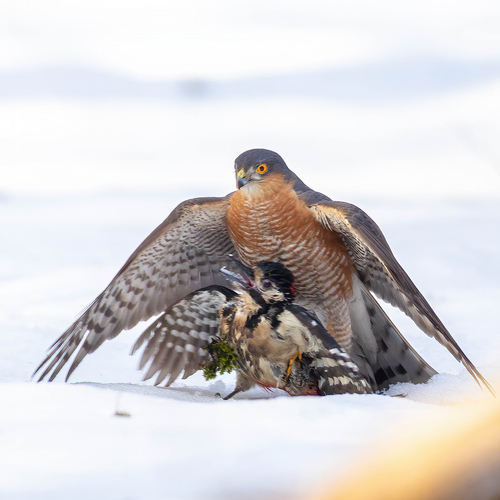
The Eurasian sparrowhawk, also known as the northern sparrowhawk or simply the sparrowhawk, is a small bird of prey in the family Accipitridae. Adult male Eurasian sparrowhawks have bluish grey upperparts and orange-barred underparts; females and juveniles are brown above with brown barring below. The female is up to 25% larger than the male – one of the greatest size differences between the sexes in any bird species. Though it is a predator which specialises in catching woodland birds, the Eurasian sparrowhawk can be found in any habitat and often hunts garden birds in towns and cities. Males tend to take smaller birds, including tits, finches and sparrows; females catch primarily thrushes and starlings but are capable of killing birds weighing 500 g (18 oz) or more.
📌 Taxonomy
Within the family Accipitridae, the Eurasian sparrowhawk is a member of the large genus Accipiter, which consists of small to medium-sized woodland hawks. Most of the Old World members of the genus are called sparrowhawks or goshawks. The species' name dates back to the Middle English word sperhauk and Old English spearhafoc, a hawk which hunts sparrows. The Old Norse name for the Eurasian sparrowhawk, sparrhaukr, was thought to have been coined by Vikings who encountered falconry in England. English folk names for the Eurasian sparrowhawk include blue hawk, referring to the adult male's colouration, as well as hedge hawk, spar hawk, spur hawk and stone falcon.
The Eurasian sparrowhawk was described by Carl Linnaeus in his 1758 landmark 10th edition of Systema Naturae as Falco nisus, but moved to its present genus by French zoologist Mathurin Jacques Brisson in 1760. The current scientific name is derived from the Latin accipiter, meaning 'hawk', and nisus, the sparrowhawk. According to Greek mythology Nisus, the king of Megara, was turned into a sparrowhawk after his daughter, Scylla, cut off his purple lock of hair to present to her lover (and Nisus' enemy), Minos.
The Eurasian sparrowhawk forms a superspecies with the rufous-chested sparrowhawk of eastern and southern Africa, and possibly the Madagascar sparrowhawk. Geographic variation is clinal, with birds becoming larger and paler in the eastern part of the range compared to the western part. Within the species itself, six subspecies are generally recognised:
* A. n. nisus, the nominate subspecies, was described by Linnaeus in 1758. It breeds from Europe and West Asia to western Siberia and Iran; northern populations winter south to the Mediterranean, Northeast Africa, Arabia and Pakistan.
* A. n. nisosimilis was described by Samuel Tickell in 1833. It breeds from central and eastern Siberia east to Kamchatka and Japan, and south to northern China. This subspecies is wholly migratory, wintering from Pakistan and India eastwards through Southeast Asia and southern China to Korea and Japan; some even reach Africa. It is very similar to, but slightly larger than, the nominate subspecies.
* A. n. melaschistos was described by Allan Octavian Hume in 1869. It breeds in mountains from Afghanistan through the Himalayas and southern Tibet to western China, and winters in the plains of South Asia. Larger and longer-tailed than nisosimilis, it has dark slate-coloured upperparts, and more distinct rufous barring on the underparts.
* A. n. wolterstorffi, described by Otto Kleinschmidt in 1900, is resident in Sardinia and Corsica. It is the smallest of all the subspecies, darker on the upperparts and more barred below than the nominate subspecies.
* A. n. granti, described by Richard Bowdler Sharpe in 1890, is confined to Madeira and the Canary Islands. It is small and dark.
* A. n. punicus, described by Erlanger in 1897, is resident in Northwest Africa north of the Sahara. It is very similar to nisus, being large and pale.
📌 Distribution and habitat
A widespread species throughout the temperate and subtropical parts of the Old World,
This species is prevalent in most woodland types in its range, and also in more open country with scattered trees. Eurasian sparrowhawks prefer to hunt the edges of wooded areas, but migrant birds can be seen in any habitat. The increased proportion of medium-aged stands of trees created by modern forestry techniques have benefited Accipiter nisus, according to a Norwegian study. Unlike its larger relative the Eurasian Goshawk, it can be seen in gardens and in urban areas and will even breed in city parks if they have a certain density of tall trees.
Eurasian sparrowhawks from colder regions of northern Europe and Asia migrate south for the winter, some to north Africa (some as far as equatorial east Africa) and India; members of the southern populations are resident or disperse. Juveniles begin their migration earlier than adults and juvenile females move before juvenile males. Analysis of ringing data collected at Heligoland, Germany, found that males move further and more often than females; of migrating birds ringed at Kaliningrad, Russia, the average distance moved before recovery (when the ring is read and the bird's whereabouts reported subsequently) was for males and for females.
A study of Eurasian sparrowhawks in southern Scotland found that ringed birds which had been raised on "high grade" territories were recovered in greater proportion than birds which came from "low grade" territories. This suggested that the high grade territories produced young which survived better. The recovery rate also declined with increased elevation of the ground. After the post-fledging period, female birds dispersed greater distances than did males.
📌 Behaviour and ecology
=== Diet and predation ===
]]
(Columba palumbus)]]
The Eurasian sparrowhawk is a major predator of smaller woodland birds, though only 10% of its hunting attacks are successful. these include its blunted wings, which allow it to fly through narrow gaps in hedges and fences, and its long, square-edged tail, which the bird uses to aid itself in carrying out tight turns, such as those required to negotiate close stands of trees.
Male Eurasian sparrowhawks regularly kill birds weighing up to and sometimes up to or more; females can tackle prey up to or more. A recent study found that on average, female sparrowhawk prey were two and a half times heavier than that of the male. The weight of food consumed by adult birds daily is estimated to be for males and for females. During one year, a pair of Eurasian sparrowhawks could take 2,200 house sparrows, 600 common blackbirds or 110 wood pigeons. are sometimes caught but insects are eaten only very rarely.
Another study found that the risk of predation for a bird targeted by a Eurasian sparrowhawk or Eurasian Goshawk increased 25-fold if the prey was infected with the blood parasite Leucocytozoon, and birds with avian malaria were 16 times more likely to be killed.
📌 Predators
Natural predators of the Eurasian sparrowhawk include the barn owl, the tawny owl, the Eurasian Goshawk, the peregrine falcon, the golden eagle, the eagle owl, the red fox, the stone marten and the pine marten.
📌 Reproduction and breeding
The eggs are pale blue with brown spots and each measure x , and weigh about of which 8% is shell in a healthy egg. Usually a clutch of four or five eggs is laid. The eggs are generally laid in the morning with an interval of 2–3 days between each egg. If a clutch is lost, up to two further eggs may be laid that are smaller than the earlier eggs.
The altricial, downy chicks hatch after 33 days of incubation. After hatching, the female cares for and feeds the chicks for the first 8–14 days of life, and also during bad weather after that. The male provides food, up to six kills per day in the first week increasing to eight per day in the third and 10 per day in the last week in the nest, by which time the female is also hunting.
By 24–28 days after hatching, the young birds start to perch on branches near the nest and take their first flight. They are fed by their parents for a further 28–30 days, staying close to the nest while growing and practicing flying. At this stage they are extremely vocal, and their cries to their parents can often be heard a considerable distance away. The young hawks disperse after their parents stop provisioning them. Though they receive the same amount of food, male chicks (roughly half the size of females) mature more quickly and seem to be ready to leave the nest sooner. In a study in the Forest of Ae, south-west Scotland, it was found that 21% of nestlings over two days old died, with the causes of death being starvation, wet weather, predation and desertion by the parents. The parasite Leucocytozoon toddi can be passed from parent to nestling at the nest, possibly because of the number of birds sharing a small space, thus allowing transmission.
The Eurasian sparrowhawk breeds in well-grown, extensive areas of woodland, often coniferous or mixed, preferring forest with a structure neither too dense nor too open, to allow a choice of flight paths. The nest can be located in the fork of a tree, often near the trunk and where two or three branches begin, on a horizontal branch in the lower canopy, or near the top of a tall shrub. If available, conifers are preferred. A new nest is built every year, generally close to the nest of the previous year, and sometimes using an old wood pigeon (A. n. melaschistos frequently uses the old nests of jungle crows) nest as a base; the male does most of the work. The structure, made of loose twigs up to long, has an average diameter of . When the eggs are laid, a lining of fine twigs or bark chippings is added.
During the breeding season, the adult male Eurasian sparrowhawk loses a small amount of weight while feeding his mate before she lays eggs, and also when the young are large and require more food. The weight of the adult female is highest in May, when laying eggs, and lowest in August after the breeding cycle is complete. A study suggested that the number of eggs and subsequent breeding success are dependent on the female maintaining a high weight while the male is feeding her.
Sexual maturity is reached at between 1–3 years. Most Eurasian sparrowhawks stay on the same territory for one breeding season, though others keep the same one for up to eight years. A change of mate usually triggers the change in territory. Older birds tend to stay in the same territory; failed breeding attempts make a move more likely. The birds which kept the same territories had higher nest success, though it did not increase between years; females which moved experienced more success the year after changing territory.
📌 Lifespan and demography
The oldest known wild Eurasian sparrowhawk lived more than two decades; it was found dead in Denmark 20 years and 3 months after having been ringed. The typical lifespan is four years. Data analysis by the British Trust for Ornithology shows that the proportion of juveniles surviving their first year of life is 34%; adult survival from one year to the next is 69%. Birds in their first year of life weigh less than adults, and are especially light in the first two months after reaching independence. There is probably high mortality, especially for young males, during this time. A study in southern Scotland suggested that the greater mortality in young male birds may be due to their smaller size and the smaller size of their prey, which means that they can "last less long between meals". Their size also means that their range of prey is restricted. It has been estimated that a female Eurasian sparrowhawk of average weight could survive for seven days without feeding – three days longer than a male of average weight.
A study of female Eurasian sparrowhawks found "strong evidence" that their rate of survival increased for the first three years of life, and declined for the last five to six years. Senescence (ageing) was the cause of the decline as the birds became older.
📌 Threats
=== Pollutants ===
The Eurasian sparrowhawk population in Europe crashed in the second half of the 20th century. The decline coincided with the introduction of cyclodiene insecticides – aldrin, dieldrin and heptachlor – used as seed dressings in agriculture in 1956. The chemicals accumulated in the bodies of grain-eating birds and had two effects on top predators like the Eurasian sparrowhawk and peregrine falcon: the shells of eggs they laid were too thin, causing them to break during incubation; and birds were poisoned by lethal concentrations of the insecticides. Sub-lethal effects of these substances include irritability, convulsions and disorientation. In west Germany, around 80% of nests before the 1950s produced young, but only 54% were successful in the 1960s and '70s.
In the United Kingdom, the species almost became extinct in East Anglia, where the chemicals were most widely used; in western and northern parts of the country, where the pesticides were not used, there were no declines. The Royal Society for the Protection of Birds bought its Coombes Valley nature reserve in Staffordshire because it was the only Eurasian sparrowhawk breeding site left in the English Midlands.
In the UK, the use of cyclodienes as seed dressings for autumn-sown cereals was banned in 1975 and the levels of the chemicals present in the bird population began to fall. The population has largely recovered to pre-decline levels, with an increase seen in many areas, for example northern Europe. In Sweden, the population also decreased drastically from the 1950s, but recovered again once organochlorines were banned in the 1970s.
In the UK, the failure rate at the egg stage had decreased from 17% to 6% by the year 2000, and the population had stabilised after reaching a peak in the 1990s. A study of the eggs of Dutch Eurasian sparrowhawks found that contamination with Dichlorodiphenyldichloroethylene (DDE) – a "very persistent compound" produced when DDT breaks down – continued into the 1980s, though a decline in the number of clutches with broken eggs during the 1970s suggested decreasing levels of the chemical.
Body tissue samples from Eurasian sparrowhawks are still analysed as part of the Predatory Bird Monitoring Scheme conducted by the UK government's Joint Nature Conservation Committee. Although the average liver concentrations of polychlorinated biphenyls (PCBs) in Eurasian sparrowhawks were lower in birds that died in 2005 compared to those that died in 2004, there was not a significant or consistent decline in residues between 2000 and 2005.
📌 Conflict with humans
The Eurasian sparrowhawk's adaptation for feeding on birds has brought it into conflict with humans;
📌 Falconry
in Georgia.]]
The Eurasian sparrowhawk has been used in falconry for centuries and was favoured by Emperor Akbar the Great (1542–1605) of the Mughal Empire. There is a tradition of using migrant Eurasian sparrowhawks to catch common quail in Tunisia and Georgia, where there are 500 registered bazieri (sparrowhawkers) and a monument to bazieri in the city of Poti. Eurasian sparrowhawks are also popular in Ireland. At Cap Bon in Tunisia, and in Turkey, thousands are captured each year by falconers and used for hunting migrant common quails. Although they were formerly released at the end of the season, many are now kept because of the scarcity of migrants.
In 17th century England, the Eurasian sparrowhawk was used by priests, reflecting their lowly status; whereas in the Middle Ages, they were favoured by ladies of noble and royal status because of their small size. The falconer's name for a male Eurasian sparrowhawk is a "musket"; this is derived from the Latin word musca, meaning 'a fly', via the Old French word moschet.
"An austringer [falconer] undertaking to train a sparrowhawk should be in no doubt that he is taking on one of the most difficult hawks available." A female Eurasian sparrowhawk is considered a bad choice for a novice and the male is very difficult and demanding, even for an experienced handler. They have been described as "hysterical little hawks" but are also praised as courageous and providing "sport of the highest quality". Philip Glasier describes Eurasian sparrowhawks as "in many ways superior to hunting with a larger short-wing [hawk]" and "extremely hard to tame". They are best suited for small quarry such as common starlings and common blackbirds but are also capable of taking common teal, Eurasian magpies, pheasants and partridges. A 19th century author remarked that this species was "the best of all hawks for landrails", now known as corn crakes. In 1735, the Sportsman's Dictionary noted that "... she will serve in the winter as well as in the summer, and will fly at all kind of game more than the falcon. If a winter sparrowhawk prove good, she will kill the pye, the chough, the jay, woodcock, thrush, black-bird, fieldfare, and divers[e] other birds of the like nature."
📌 In culture
In Slavic mythology, the sparrowhawk, known as krahui or krahug, is a sacred bird in Old Bohemian songs and lives in a grove of the gods. Holy sparrowhawks perch on the branches of an oak tree that grows from the grave of a murdered man, and "publish the foul deed". It also features in Teutonic mythology. In some areas of England, it was believed that the common cuckoo turned into a Eurasian sparrowhawk in winter.