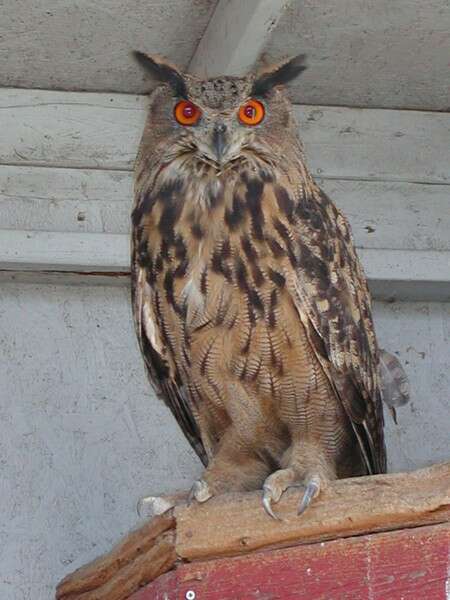
The Eurasian eagle-owl is a species of eagle-owl, a type of bird that resides in much of Eurasia. It is often just called the eagle-owl in Europe and Asia.
π Standard measurements and physiology
Among standard measurements for the Eurasian eagle-owl, the wing chord measures , the tail measures long, the tarsus measures , and the total length of the bill is . Generally, owls do not have talons as proportionately large as those of accipitrids, but have stronger, more robust feet relative to their size. Accipitrids use their talons to inflict organ damage and blood loss, whereas typical owls use their feet to constrict their prey to death, the talons serving only to hold the prey in place or provide incidental damage. The talons of the Eurasian eagle-owl are very large and not often exceeded in size by diurnal raptors. Unlike the great horned owls, the overall foot size and strength of the Eurasian eagle-owl is not known to have been tested, but the considerably smaller horned owl has one of the strongest grips ever measured in a bird.
The feathers of the ear tufts in Spanish birds (when not damaged) were found to measure from . Given the uncomplicated structure of their ear openings and relatively shallow, undefined facial discs, hunting by ear is secondary to hunting by sight in eagle-owls; this seems to be true for Bubo in general. More sound-based hunters such as the aforementioned species likely focus their hunting activity in more complete darkness. Also, owls with white throat patches such as the Eurasian eagle-owl are more likely to be active in low-light conditions in the hours before and after sunrise and sunset rather than the darkest times in the middle of the night. The boreal and barn owls, to extend these examples, lack obvious visual cues such as white throat patches (puffed up in displaying eagle-owls), again indicative of primary activity being in darker periods.
π Distinguishing from other species
The great size, bulky, barrel-shaped build, erect ear tufts, and orange eyes render this as a distinctive species. Other than general morphology, the above features differ markedly from those of two of the next largest subarctic owl species in Europe and western Asia, which are the great grey owl and the greyish to chocolate-brown Ural owl (Strix uralensis), both of which have no ear tufts and have a distinctly rounded head, rather than the blocky shape of the eagle-owl's head.
The long-eared owl has a somewhat similar plumage to the eagle-owl, but is considerably smaller (an average female eagle-owl may be twice as long and 10 times heavier than an average long-eared owl). Long-eared owls in Eurasia have vertical striping like that of the Eurasian eagle-owl, while long-eared owls in North America show a more horizontal striping like that of great horned owls. Whether these are examples of mimicry either way is unclear but it is known that both Bubo owls are serious predators of long-eared owls. The same discrepancy in underside streaking has also been noted in the Eurasian and American representations of the grey owl. A few other related species overlap minimally in range in Asia, mainly in East Asia and the southern reaches of the Eurasian eagle-owl's range. Three fish owls appear to overlap in range, the brown (Ketupa zeylonensis) in at least northern Pakistan, probably Kashmir, and discontinuously in southern Turkey, the tawny (K. flavipes) through much of eastern China, and Blakiston's fish owl in the Russian Far East, northeastern China, and Hokkaido. Fish owls are distinctively different looking, possessing more scraggy ear tufts that hang to the side rather than sit erect on top of the head, and generally have more uniform, brownish plumages without the contrasting darker streaking of an eagle-owl. The brown fish owl has no feathering on the tarsus or feet, and the tawny has feathering only on the upper portion of the tarsi, but the Blakiston's is nearly as extensively feathered on the tarsi and feet as the eagle-owl. Tawny and brown fish owls are both slightly smaller than co-occurring Eurasian eagle-owls, and Blakiston's fish owls are similar or slightly larger than co-occurring large northern eagle-owls. Fish owls, being tied to the edges of fresh water, where they hunt mainly fish and crabs, also have slightly differing, and more narrow, habitat preferences.
In the lower Himalayas of northern Pakistan and Jammu and Kashmir, along with the brown fish owl, the Eurasian eagle-owl at the limit of its distribution may co-exist with at least two to three other eagle-owls. One of these, the dusky eagle-owl (K. coromandus) is smaller, with more uniform tan-brownish plumage, untidy uniform light streaking rather than the Eurasian's dark streaking below and an even less well-defined facial disc. The dusky is usually found in slightly more enclosed woodland areas than Eurasian eagle-owls. Another is possibly the spot-bellied eagle-owl (K. nipalensis), which is strikingly different looking, with stark brown plumage, rather than the warm hues typical of the Eurasian, bold spotting on a whitish background on the belly, and somewhat askew ear tufts that are bold white with light brown crossbars on the front. Both species may occur in some parts of the Himalayan foothills, but they are not currently verified to occur in the same area, in part because of the spot-bellied's preference for dense, primary forest. Most similar, with basically the same habitat preferences and the only one verified to co-occur with the Eurasian eagle-owls of the race B. b. turcomanus in Kashmir is the Indian eagle-owl (B. bengalensis). The Indian species is smaller, with a bolder, blackish facial disc border, more rounded and relatively smaller wings, and partially unfeathered toes. Far to the west, the pharaoh eagle-owl (B. ascalaphus) also seemingly overlaps in range with the Eurasian, at least in Jordan. Although also relatively similar to the Eurasian eagle-owl, the pharaoh eagle-owl is distinguished by its smaller size, paler, more washed-out plumage, and the diminished size of its ear tufts.
π Moulting
The Eurasian eagle-owls' feathers are lightweight and robust, but nevertheless need to be replaced periodically as they become worn. In the Eurasian eagle-owl, this happens in stages, and the first moult starts the year after hatching with some body feathers and wing coverts being replaced. The next year, the three central secondaries on each wing and three middle tail feathers are shed and regrow, and the following year, two or three primaries and their coverts are lost. In the final year of this postjuvenile moult, the remaining primaries are moulted and all the juvenile feathers will have been replaced. Another moult takes place during years 6β12 of the bird's life. This happens between June and October after the conclusion of the breeding season, and again it is a staged process with six to nine main flight feathers being replaced each year. Such a moulting pattern lasting several years is repeated throughout the bird's life.
π Taxonomy
The Eurasian eagle-owl was formally described by the Swedish naturalist Carl Linnaeus in 1758 in the tenth edition of his Systema Naturae under the binomial name Strix bulbo. Although Linnaeus specified the "habitat" as "Europa" the type locality is restricted to Sweden. The Eurasian eagle-owl is now placed in the genus Bubo that was introduced by AndrΓ© DumΓ©ril in 1805.
The genus Bubo with about 10 extant species includes many of the larger owl species in the world today. Based on an extensive fossil record and a central distribution of extant species on that continent, Bubo appears to have evolved into existence in Africa, although early radiations seem to branch from southern Asia, as well. Addirionally, while some authors have considered fishing owls as possibly inclusive with Bubo, they are also distinct and belong in the genus Scotopelia.
The Pharaoh eagle-owl, distributed in the Arabian Peninsula and sections of the Sahara Desert through North Africa where rocky outcrops are found, was until recently considered a subspecies of the Eurasian eagle-owl. The Pharaoh eagle-owl apparently differs about 3.8% in mitochondrial DNA from the Eurasian eagle-owl, well past the minimum genetic difference to differentiate species of 1.5%. The Indian eagle-owl (B. bengalensis) was also considered a subspecies of the Eurasian eagle-owl until recently, but its smaller size, distinct voice (more clipped and high-pitched than the Eurasian), and the fact that it is largely allopatric in distribution (filling out the Indian subcontinent) with other Eurasian eagle-owl races has led to it being considered a distinct species. The mitochondrial DNA of the Indian species also appears considerably distinct from the Eurasian species.
The fourth and most famous derivation of the evolutionary line that includes the Eurasian eagle-owl is the great horned owl, which appears to have been the result of primitive eagle-owls spreading into North America. According to some authorities, the great horned owls and Eurasian eagle-owls are barely distinct as species, with a similar level of divergence in their plumages as the Eurasian and North American representations of the great grey owl or the long-eared owl. Eurasian eagle-owls in captivity have produced apparently healthy hybrids with both the Indian eagle-owl and the great horned owl.
π Subspecies
, B. b. turcomanus]]
, Germany]]
, B. b. hemachalana]]
* B. b. hispanus (Rothschild and Hartert, 1910) β Also known as the Spanish eagle-owl or the Iberian eagle-owl. This subspecies mainly occurs on the Iberian Peninsula, where it occupies a majority of Spain and scattered spots in Portugal. The Spanish eagle-owl is the most similar in plumage to the nominate subspecies amongst other subspecies, but tends to be a somewhat lighter, more greyish colour, with generally lighter streaking and a paler belly. In males, wing chord length can range from and in females from . Wingspans in this subspecies can vary from , averaging about . Among standard measurements of B. b. hispanus, the tail is , the total bill length is and the tarsus is . Adult male B. b. hispanus from Spain weigh , averaging , while females weigh from , averaging . the nominate subspecies inhabits continental Europe from near the Arctic Circle in Norway, Sweden, Finland, the southern Kola Peninsula, and Arkhangelsk where it ranges north to about latitude 64Β° 30' N., southward to the Baltic Sea, central Germany, to southeastern Belgium, eastern, central, and southern France to Northern Spain and parts of Italy including Sicily, and through Central and Southeastern Europe to Greece. It intergrades with B. b. ruthenus in northern Russia around the basin of the upper Mezen River and in the eastern vicinity of Gorki Leninskiye, Tambov and Voronezh, and intergrades with B. b. interpositus in northern Ukraine. This is a medium-sized race, measuring in wing chord length in males and . The total bill length is . Another set of Finnish eagle-owls averaged somewhat larger still, with males averaging and females averaging . The subspecies seems to follow Bergmann's rule in regards to body size decreasing closer to the Equator, as specimens from central Europe average in body mass and those from Italy average about . The weight range for eagle-owls in Italy is . The nominate subspecies is perhaps the darkest of eagle-owl subspecies. Many nominate birds are heavily overlaid with broad black streaking over the upper-parts, head and chest. While generally a brownish base-colour, many nominate owls can appear rich rufous, especially about the head, upper-back and wing primaries. The lower belly is usually a buff brown, as opposed to whitish or yellowish in several other subspecies. This subspecies replaces the nominate in eastern Russia from about latitude 660 N. in the Timan-Pechora Basin south to the western Ural Mountains and the upper Don and lower Volga Rivers. B. b. interpositus ranges from southern Russia, south of the nominate, with which it intergrades in northern Ukraine, from Bessarabia and the steppes of Ukraine north to Kyiv and Kharkiv then eastward to the Crimea, the Caucasus and Transcaucasia to northwestern and northern Iran (Elburz, region of Tehran, and probably the southern Caspian districts), and through Asia Minor south to Syria and Iraq but not to the Syrian desert where it is replaced by the pharaoh eagle-owl. The latter and B. b. interpositus reportedly hybridize from western Syria south to southern Palestine. This subspecies is distributed from the Ural Mountains of western Siberia and Bashkiria to the mid Ob River and the western Altai Mountains, north to limits of the taiga, the most northerly distribution known in the species overall. This subspecies is physically the most distinctive of all the Eurasian eagle-owls, and is sometimes considered the most "beautiful and striking". This subspecies is found in central Siberia from about the Ob eastward to Lake Baikal, north to about latitudes 580 to 590 N on the Yenisei River, south to the Altai, Tarbagatai and the Saur Mountain ranges and in Tannu Tuva and Khangai Mountains in northwestern Mongolia, grading into B. b. sibiricus near Tomsk in the west and into B. b. ussuriensis in the east of northern Mongolia. The zone of intergradations with the latter in Mongolia seems to be quite extensive, with intermediate eagle-owls being especially prevalent around the Tuul River Valley, resulting in owls intermediate in coloration between B. b. yenisseensis and B. b. ussuriensis.
* B. b. ussuriensis (Poljakov, 1915) β Would presumably be also known as the Ussuri eagle-owl. This subspecies ranges from southeastern Siberia, to the south of the range of B. b. jakutensis, southward through eastern Transbaikal, Amurland, Sakhalin, Ussuriland and the Manchurian portion of the Chinese provinces of Shaanxi, Shanxi and Hebei. Going on wing chord length, B. b. ussuriensis is slightly smaller than the various subspecies from further north in Siberia. Males have a wing chord length of and females are . It is distributed from Kazakhstan between the Volga and upper Ural Rivers, the Caspian Sea coast and the former Aral Sea, but replaced in that country by B. b. omissus in the mountainous south and in the coastal region of the Mangyshlak Peninsula by B. b. gladkovi. Out of Kazakhstan, the range of B. b. turcomanus continues through the Transbaikal and the Tarim Basin to western Mongolia. The plumage background colour is pale, yellowish-buff. The dark patterns on the upper- and underparts is paler, less well-defined and more shattered than in B. b. interpositus. Dark longitudinal patterning on the under-parts discontinue above the belly. B. b. turcomanus is greyer than B. b. hemalachanus but is otherwise somewhat similar-looking. This subspecies is unique in that it seems to shun mountainous and obvious rocky habitats in favor of low hills, plateaus, lowlands, steppes, and semideserts at or near sea-level. B. b. omissus is native to Turkmenistan and adjacent regions of northeastern Iran and western Xinjiang. The range of B. b. nikolskii appears to extend from the Balkan Mountains and Kopet Dagh in southern Transcaspia eastward to southeastern Uzbekistan or to perhaps southwestern Tadzhikistan, then southward 290 N. It may range north to Iran, Afghanistan and Baluchistan south to the region of Kalat, or at about latitude of Hindu Kush. In Iran, B. b. nikolskii is replaced by B. b. interpositus in the north, and probably also in the northwest, and probably by B. b. hemalachana in Badakhshan, part of northeastern Afghanistan. The birds of southern Tadzhikistan found west of the Pamirs are more or less intermediate between B. b. omissus and B. b. hemachalana. The range of B. b. hemachalana extends from the Himalayas, from Pakistan through Jammu and Kashmir and Ladakh to at least Bhutan, also living in Tibet. Its range continues also westward to the Tian Shan system in Russian Turkestan, west to the Karatau, north to the Dzungarian Alatau, east to at least the Tekkes Valley in Xinjiang, and south to the regions of Kashgar, Yarkant and probably the western Kunlun Mountains. This bird is partly migratory, descending to the plains of Turkmenistan with colder winter weather, and apparently reaches northern Balochistan. This subspecies is physically similar to B. b. turcomanus but the background colour is more light yellowish-brown and less buff. The dark patterns on the upperparts and underparts are more expressed and less regular than in B. b. turcomanus and B. b. omissus and the general colour from the mantle to the ear tufts is a more consistent brownish colour than most other abutting races. B. b. hemachalana differs from B. b. yenisseensis by being much more yellow on the rump, under tail coverts, and outer tail feathers, rather than grayish or whitish, and the ground coloration of its body is more yellowish above, and is less whitish below. Dark longitudinal pattern on the under-parts cover the forebelly. B. b. kiautschensis is much darker, more tawny and rufous, and slightly smaller than B. b. ussuriensis. According to museum accounts, it resembles the nominate subspecies from Europe (though obviously considerably disparate in distribution) rather closely in coloration but differs from it by being paler, more mottled, and less heavily marked with brown on the upper parts, by having narrower dark shaft streaks on the under parts, which average also duller and more ocher, and by averaging smaller.
* B. b. swinhoei (Hartert, 1913) β This subspecies could be also known as the South Chinese eagle-owl. It is endemic to southeastern China. A quite rufescent form, it is somewhat similar to B. b. kiautschensis. In this smallish subspecies, the wing chord measures in both sexes. This is a rather poorly known and described subspecies and is considered invalid by some authorities.
π Distribution
The Eurasian eagle-owl is one of the most widely distributed of all owl species, although it is far less wide-ranging than the short-eared owl (Asio flammeus) and long-eared owl and lacks the circumpolar range of boreal species such as great grey owl, boreal owl and northern hawk owl (Surnia ulula).
The Eurasian eagle-owl's range in Russia is truly massive, with the species apparently nearly unbound by habitat, with their distribution only excluding them from the true Arctic zone, i.e. their range stops around the tree line. If not the most densely populated species, they almost certainly stand as Russia's most widely distributed owl species. From Russia, they are found throughout Central Asia, residing continuously in each nation from Kazakhstan down to Afghanistan. In Asia Minor, they are found broadly in Georgia, Azerbaijan and somewhat so in western and southern Turkey but is quite sporadic in distribution overall in Turkey. A spotty range also exists in the Middle East in Syria, Iraq, Lebanon, Israel, Palestine, Jordan and western Iran, the species being found broadly only in north and western Iran. In South Asia, the Eurasian eagle-owl is found mostly often in northern Pakistan, northern Nepal and Bhutan and more marginally into far northern India. This species resides throughout Mongolia, almost the entirety of China (mainly absent only from southern Yunnan and southern Guangxi). From China and eastern Russia, the Eurasian eagle-owl is found throughout Korea, Sakhalin, the Kuril Islands and rarely into Japan in northern Hokkaido. Besides the Kurils, the farthest eastern part of the range for this species is in Magadan in the Russian Far East.
π Behaviour
The Eurasian eagle-owl is largely nocturnal in activity, as are most owl species, with its activity focused in the first few hours after sunset and the last few hours before sunrise. In the northern stretches of its range, partial diurnal behaviour has been recorded, including active hunting in broad daylight during the late afternoon. In such areas, full nightfall is essentially non-existent at the peak of summer, so eagle-owls must presumably hunt and actively brood at the nest during daylight. Vocalizations in a Spanish study begin no sooner than 29 minutes after sunset and end no later than 55 minutes before sunrise. The territorial song, which can be heard at great distance, is a deep resonant ooh-hu with emphasis on the first syllable for the male, and a more high-pitched and slightly more drawn-out uh-hu for the female.
β the owl in this photograph is being pursued by a group of carrion crows (Corvus corone).]]
The Eurasian eagle-owl rarely assumes the so-called "tall-thin position", which is when an owl adopts an upright stance with plumage closely compressed and may stand tightly beside a tree trunk. Among others, the long-eared owl is among the most often reported to sit with this pose. Usually when seen flying during the day, it is due to being disturbed or displaced from its roost by humans or mobbing animals, such as crows. Even those near the northern limits of their range, where winters are harsh and likely to bear little in food, the eagle-owl does not leave its native range. In 2020, a study presented evidence of a short distance distribution by adult eagle-owls in the fall subsequent to breeding, with 5 adults found to move over away from their nests. There are additionally claimed cases from Russia of Eurasian eagle-owls moving south for the winter, as the icebound, infamously harsh climate there may be too severe even for these hardy birds and their prey. Similarly, Eurasian eagle-owls living in the Tibetan highlands and Himalayas may in some anecdotal cases vacate their normal territories when winter hits and move south. In both of those examples, these are old, unverified reports and there is no evidence whatsoever of consistent, annual migration by Eurasian eagle-owls and the birds may eke out a living on their normal territories even in the sparsest times.
π Territoriality
Eurasian eagle-owls are strictly territorial and will defend their territories from interloping eagle-owls year around, but territorial calling appears to peak around October to February. Territories are established by the male eagle-owl, who selected the highest points in the territory from which to sing. The high prominence of singing perches allows their song to be heard at greater distances and lessens the need for potentially dangerous physical confrontations in the areas where territories may meet. In January and February, the primary function for vocalization becomes for the purpose of courtship. More often than not, eagle-owls will pair for life but usually engage in courtship rituals annually, most likely to re-affirm pair bonds. When calling for the purposes of courtship, males tend to bow and hoot loudly but do so in a less contorted manner than the male great horned owl. Courtship in the Eurasian eagle-owl may involve bouts of "duetting", with the male sitting upright and the female bowing as she calls. There may be mutual bowing, billing and fondling before the female flies to a perch where coitus occurs, usually taking place several times over the course of a few minutes.
π Nests
The male selects breeding sites and advertises their potential to the female by flying to them and kneading out a small depression (if soil is present) and making staccato notes and clucking noises. Several potential sites may be presented, with the female selecting one. Like all owls, Eurasian eagle-owls do not build nests or add material but nest on the surface or material already present. Eurasian eagle-owls normally nest on rocks or boulders, most often utilizing cliff ledges and steep slopes, as well as crevices, gullies, holes or caves. Rocky areas that also prove concealing woodlots as well as, for hunting purposes, that border river valleys and grassy scrubland may be especially attractive. If only low rubble is present, they will nest on the ground between rocks. This is contrary to the indication that ground nests are selected only if rocky areas or other bird nests are unavailable, as many will utilize ground nests even where large bird nests seem to be accessible. Tree holes being used for nesting sites are even more rarely recorded than nests constructed by other birds. While it may be assumed that the eagle-owl is too large to utilize tree hollows, when other large species like the great grey owl have never been recorded nesting in one, the even more robust Blakiston's fish owl nests exclusively in cavernous hollows. The Eurasian eagle-owl often uses the same nest site year after year.
π Parental behaviour
In Engadin, Switzerland, the male eagle-owl alone hunts until the young are 4 to 5 weeks old and the female spends all her time brooding at the nest. After this point, the female gradually resumes hunting from both herself and the young and thus provides a greater range of food for the young. The response of Eurasian eagle-owls to humans approaching at the nest is quite variable. The species is often rather less aggressive than some other owls, including related species like the spot-bellied eagle-, great horned and snowy owls, many of the northern Strix species, and even some rather smaller owl species, which often fearlessly attack any person found to be nearing their nests. Occasionally, if a person climbs to an active nest, the adult female eagle-owl will do a distraction display, in which they feign an injury. This is an uncommon behavior in most owls and is most often associated with small birds trying to falsely draw the attention of potential predators away from their offspring. Also, aggressive encounters involving eagle-owls around their nest, despite being historically uncommon, apparently have increased in recent decades in Scandinavia. The discrepancy of aggressiveness at the nest between the Eurasian eagle-owl and its Nearctic counterpart may be correlated to variation in the extent of nest predation that the species endured during the evolutionary process.
π Eggs and offspring development
]]
The eggs are normally laid at intervals of three days and are incubated only by the female. Laying generally begins in late winter but may be later in the year in colder habitats. During the incubation period, the female is brought food at the nest by her mate. In Central Europe, eggs average , and in Siberia, eggs average . Their eggs are only slightly larger than those of snowy owls and the nominate subspecies of great horned owl, while similar in size to those of spot-bellied eagle-owls and Blakiston's fish owls. The Eurasian eagle-owl's eggs are noticeably larger than those of Indian eagle-owl and pharaoh eagle-owls. The average clutch size, attributed as 2.7, was the lowest of any European owl per one study. One species was attributed with an even lower clutch size in North America, the great grey owl with a mean of 2.6, but the mean clutch size was much higher for the same species in Europe, at 4.05. In the Italian Alps, the mean egg-laying date was similarly February 27, but the young were more likely to be dependent later, as all fledglings were still being cared for by the end of August, and some even lingered under parental care until October.
The first egg hatches after 31 to 36 days of incubation. The eggs hatch successively; although the average interval between egg-laying is 3 days, the young tend to hatch no more than a day or two apart. Body mass increased fourteen times over from 5 days old to 60 days old in this study. In Spain, males are thought to be the first egg laid to reduce the likelihood of sibling aggression due to the size difference, thus the younger female hatchling is less likely to be killed since it is similar in size to its older sibling.
Apparently, the point at which the chicks venture out of the nest is driven by the location of the nest. In elevated nest sites, chicks usually wander out of the nest at 5 to as late as 7 weeks of age, but have been recorded leaving the nest if the nest is on the ground as early as 22 to 25 days old.
A study from southern France found the mean number of fledglings per nest was 1.67. The mean fledgling rate in the Italian Alps was 1.89, thus being similar. In the Italian Alps, heavier rainfall during breeding decreased fledgling success because it inhibited the ability of the parents to hunt and potentially exposed nestlings to hypothermia. In the reintroduced population of eagle-owls in Eifel, Germany, occupied territories produced an average of 1.17 fledglings, but not all occupying pairs attempted to breed, with about 23% of those attempting to breed being unsuccessful. While sibling owls are close in the stage between leaving the nest and fully fledged, about 20 days after leaving the nest, the family unit seems to dissolve and the young disperse quickly and directly. All told, the dependence of young eagle-owls on their parents lasts for 20 to 24 weeks. Independence in central Europe is from September to November. The young leave their parents' care normally on their own, but are also sometimes chased away by their parents.
π Status
district of Norway.]]
The Eurasian eagle-owl has a very wide range across much of Europe and Asia, estimated to be about . In Europe, the population is estimated at 19,000 to 38,000 breeding pairs, and in the whole world around 250,000 to 2,500,000 individual birds. The population trend is thought to be decreasing because of human activities, but with such a large range and large total population, the International Union for Conservation of Nature has rated the bird as being of least concern. Although roughly equal in adaptability and wideness of distribution, the great horned owl, with a total estimated population up to 5.3 million individuals, apparently has a total population that is roughly twice that of the Eurasian eagle-owl. Numerous factors, including a shorter history of systematic persecution, lesser sensitivity to human disturbance while nesting, somewhat greater ability to adapt to marginal habitats and widespread urbanization, and slightly smaller territories may play into the horned owls greater numbers in modern times. Eurasian eagle-owls are listed in Appendix II of the Convention on International Trade in Endangered Species (CITES) meaning international trade (including in parts and derivatives) is regulated.
π Longevity
The Eurasian eagle-owl is one of the longest-living owls. It can live for up to 20 years in the wild. A 19-year-old was once considered the oldest ringed eagle-owl. A record-breaking specimen, was banded in the wild and later encountered at the age of 27 years and 9 months. Healthy adults normally have no natural predators, thus are considered apex predators. The leading causes of death are man-made: electrocution, traffic accidents, and shooting frequently claim the lives of eagle-owls.
π Anthropogenic mortality
Electrocution was the greatest cause of mortality in 68% of 25 published studies, and accounted, on average, for 38.2% of the reported eagle-owl deaths. This was particularly true in the Italian Alps, where the number of dangerous, uninsulated pylons near nests was extremely high, but is highly problematic almost throughout the species' European distribution. In one telemetry study, 55% of 27 dispersing young were electrocuted within 1 year of their release from captivity, while electrocution rates of wild-born young are even higher. Mortality in the Swiss Rhine Valley was variable, in radio-tagged, released individuals, most died as a result of starvation (48%) rather than human-based causes, but 93% of the wild, untagged individuals found dead were due to human activities, 46% due to electrocution, and 43% due to collision with vehicles or trains. Insulation of pylons is thought to result in a stabilisation of the local population due to floaters taking up residence in unoccupied territories that formerly held deceased eagle-owls. Eurasian eagle-owls from Finland were found mainly to die due to electrocution (39%) and collisions with vehicles (22%). Wind turbine collisions can also be a serious cause of mortality locally.
Eagle-owls have been singled out historically as a threat to game species, thus to the economic well-being of landowners, game-keepers, and even governmental agencies, and as such, have been singled out for widespread persecution. Local extinctions of Eurasian eagle-owls have been primarily due to persecution. Examples of this include northern Germany in 1830, the Netherlands sometimes in the late 19th century, Luxembourg in 1903, Belgium in 1943, and central and western Germany in the 1960s. In trying to determine causes of death for 1476 eagle-owls from Spain, most were unknown and undetermined types of trauma. The largest group that could be determined, 411 birds, was due to collisions, more than half of which were from electrocution, while 313 were due to persecution, and merely 85 were directly attributable to natural causes. Clearly, while pylon safety is perhaps the most serious factor to be addressed in Spain, persecution continues to be a massive problem for Spanish eagle-owls. Of seven European nations where modern Eurasian eagle-owl mortality is well-studied, continual persecution is by far the largest problem in Spain, although also continues to be serious (often comprising at least half of studied mortality) in France. From France and Spain, nearly equal numbers of eagle-owls are poisoned (for which raptors might not be the main target), or shot intentionally.
π Conservation and reintroductions
While the eagle-owl remains reasonably numerous in some parts of its habitat where nature is still relatively little disturbed by human activity, such as the sparsely populated regions of Russia and Scandinavia, concern has been expressed about the future of the Eurasian eagle-owl in Western and Central Europe. There, very few areas are not heavily modified by human civilisation, thus exposing the birds to the risk of collisions with deadly man-made objects (e.g. pylons) and a depletion of native prey numbers due to ongoing habitat degradation and urbanisation.
Large reintroduction programs were instituted in Germany after the eagle-owl was deemed extinct in the country as a breeding species by the 1960s, as a result of a long period of heavy persecution. The largest reintroduction there occurred from the 1970s to the 1990s in the Eifel region, near the border with Belgium and Luxembourg. The success of this measure, consisting in more than a thousand eagle-owls being reintroduced at an average cost of US$1,500 per bird, is a subject of controversy. Those eagle-owls reintroduced in the Eifel region appear to be able to breed successfully, and enjoy nesting success comparable with wild eagle-owls from elsewhere in Europe. Mortality levels in the Eifel region, though, appear to remain quite high due to anthropogenic factors. Also, concerns exist about a lack of genetic diversity of the species in this part of Germany. Apparently, the German reintroductions have allowed eagle-owls to repopulate neighbouring parts of Europe, as the breeding populations now occurring in the Low Countries (the Netherlands, Belgium, and Luxembourg) are believed to be the result of influx from regions further to the east. Smaller reintroductions have been done elsewhere, and the current breeding population in Sweden is believed to be primarily the result of a series of reintroductions. Conversely to numerous threats and declines incurred by Eurasian eagle-owls, areas where human-dependent, non-native prey species such as brown rats (Rattus norvegicus) and rock doves (Columba livia) have flourished, have given the eagle-owls a primary food source and allowed them occupy regions where they were once marginalized or absent.
π Occurrence in Great Britain
The Eurasian eagle-owl at one time occurred naturally in Great Britain. Some, including the RSPB, have claimed that it had disappeared about 10,000β9,000 years ago, after the last ice age, but fossil remains found in Meare Lake Village indicate the eagle-owl occurring as recently as roughly 2,000 years ago in the fossil record. The lack of presence of the Eurasian eagle-owl in British folklore or writings in recent millennium may indicate the lack of occurrence by this species there. While, until the 19th century, wealthy collectors may have released unwanted eagle-owls, despite press to the contrary, no evidence of any organization or individual intentionally releasing eagle-owls recently with the intent to establish a breeding population has been found. From 1994 to 2007, 73 escaped eagle-owls were not registered as returned, while 50 escapees were recaptured. Several recorded breeding attempts have been studied, and most were unsuccessful, due in large part to incidental disturbance by humans and some due to direct persecution, with eggs having been smashed.
π Effect on conservation-dependent species
As highly opportunistic predators, Eurasian eagle-owls hunt almost any appropriately sized prey they encounter. Most often, they take whatever prey is locally common and can take a large number of species considered harmful to human financial interests, such as rats, mice, and pigeons. Eurasian eagle-owls do take rare or endangered species, as well. Among the species considered at least vulnerable (up to critically endangered as in the mink and eel, both heavily overexploited by humans) to extinction known to be hunted by Eurasian eagle-owls are Russian desman (Desmana moschata) Pyrenean desman (Galemys pyrenaicus), barbastelle (Barbastella barbastellus), European ground squirrel (Spermophilus citellus), southwestern water vole (Arvicola sapidus), European mink (Mustela lutreola), marbled polecat (Vormela peregusna), Egyptian vulture (Neophron percnopterus), greater spotted eagle (Clanga clanga), eastern imperial eagle (Aquila heliaca), houbara bustard (Chlamydotis undulata), Atlantic cod (Gadus morhua), European eel (Anguilla anguilla) and lumpfish (Cyclopterus lumpus).