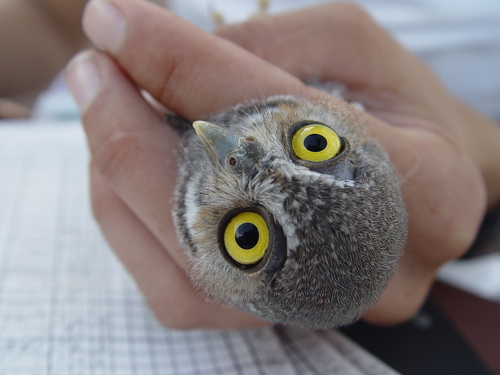
The elf owl is a small grayish-brown owl about the size of a sparrow found in the Southwestern United States, central Mexico, and the Baja California peninsula. It has pale yellow eyes highlighted by thin white "eyebrows" and a gray bill with a horn-colored tip. The elf owl frequently inhabits woodpecker holes in saguaro cacti; it also nests in natural tree cavities. It is nocturnal and feeds primarily on insects.
📌 Taxonomy
The elf owl was formally described in 1861 by the American naturalist James Graham Cooper from a specimen collected near Fort Mohave in Arizona. He coined the binomial name Athene whitneyi, choosing the specific epithet to honour the geologist Josiah Whitney. The owl is now the only species placed in the genus Micrathene that was introduced in 1866 specifically for the elf owl by American ornithologist Elliott Coues. The genus name combines the Ancient Greek mikros meaning "small" and the genus name Athene that had been introduced by Friedrich Boie in 1822.
A molecular phylogenetic study of the owls published in 2019 found that the elf owl is a sister species to the South American long-whiskered owlet (Xenoglaux loweryi) that was first described in 1977.
Four subspecies are recognized:
📌 Distribution and habitat
The elf owl is known to migrate in large groups, with patterns of migration varying depending on flock and habitat location. Some broods of elf owl migrate to the southwest United States (California, Arizona, New Mexico, and Texas) in the spring and summer for breeding. In the winter, it is found in central and southern Mexico. Migrant elf owls return north in mid-April to early May. Resident populations occur in a couple of places in south central Mexico and along the Baja peninsula.
📌 Behaviour and ecology
Elf owls feign death when handled, an adaption that encourages a predator to relax its grip so that the owl can escape. Elf owls are also notoriously territorial. Territories are established by the male and are defended by both the male and the female, and males also tend to view their chosen female mate as a territory to be defended, as well. This defense is often accomplished through the use of song. During the breeding season, elf owls are monogamous and stay in breeding pairs, but can be found in small groups during migration and when mobbing predators. Adults as well as young can be subject to predation by other predatory birds such as jays, hawks, and owls.
📌 Breeding
Elf owls usually choose abandoned, north-facing woodpecker cavities in saguaro cacti, sycamores, cottonwoods, and other hardwood trees, to raise their young. While some cavity nesters utilize vegetation as nesting substrate, elf owls have been observed removing this vegetation and prefer a bare cavity. While elf owls primarily use natural structures for their nesting, they have been known to nest in man-made structures such as telephone poles in urban areas. The most common types of mortality for these owls are predation, exposure, and inter-species as well as intra-species competition.
📌 Food and feeding
Hunting is performed mostly during nocturnal hours. Straight line flight is often deployed for this purpose but they will use an arced flight when in the vicinity of the nest and for flying to and from perches. They live in cacti much like some other birds, using the shade and climate the cacti provide.
Elf owls feed mainly on arthropods such as moths, crickets, scorpions, centipedes, and beetles. Agaves and ocotillos are ideal places for foraging, as moths and other insects may be found in their flowers. In urban areas they can be seen utilizing outdoor lights that attract bugs as areas for insect hunting. They are often seen chasing after flying insects, with a flight similar to a tyrant flycatcher's. They also feed on scorpions. Once the owl has killed the scorpion, they can be observed removing the stinger before consumption. The elf owls seem to not be bothered by scorpion stings. They will also feed on small mammals (such as kangaroo rats), reptiles (spiny lizards, earless lizards and blind snakes) and birds, on occasion.
📌 Conservation status
Populations of elf owls have continued to decline in recent years due to a continued loss of native habitats, particularly those in the desert areas of California. Human activities, like increasing water diversion and home construction, have decimated these desert and riparian areas, as well as increasingly abundant invasive species (such as the salt cedar). The destruction of habitat leaves many elf owls unable to nest, hunt, and reproduce in areas like California, Arizona, and elsewhere.
📌 In fiction
An elf owl named Gylfie is a major character in the Guardians of Ga'Hoole book series by Kathryn Lasky, and the 2010 film adaptation.