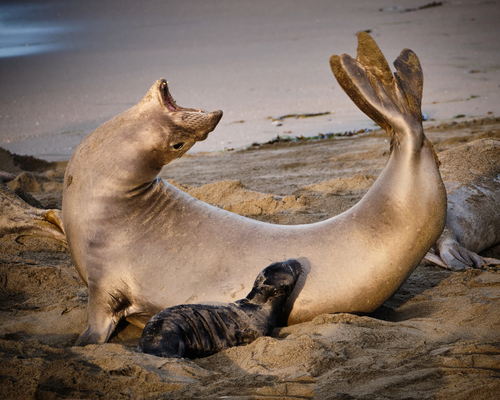
Elephant seals or sea elephants are very large, oceangoing true seals in the genus Mirounga. Both species, the northern elephant seal and the southern elephant seal, were hunted to the brink of extinction for lamp oil by the end of the 19th century, but their numbers have since recovered. They are the largest seal species. Males can weigh up to 4,000 kilograms (8,800 lb). Elephant seals get their name from the large proboscis of the adult male, reminiscent of an elephant's trunk.
📌 Taxonomy
John Edward Gray established the genus Mirounga in 1827. The generic name Mirounga is a Latinization of miouroung, which is said to have been a term for the seal in an Australian Aboriginal language. However, it is not known which language this represents.
The oldest known unambiguous elephant seal fossils are fragmentary fossils of a member of the tribe Miroungini described from the late Pliocene Petane Formation at Kaiwaka, north of Waipunga railway station in Hawke's Bay, New Zealand. Teeth originally identified as representing an unnamed species of Mirounga have been found in South Africa, and dated to the Miocene epoch; however, Boessenecker and Churchill (2016) considered these teeth almost certainly to be misidentified toothed whale (odontocete) teeth.
📌 Extant species distributions
📌 Physiology
Elephant seals spend up to 80% of their lives in the ocean. They can hold their breath for more than 100 minutes, longer than any other noncetacean mammal. Elephant seals regularly dive to beneath the ocean's surface; The average depth of their dives is about , typically for around 20 minutes for females and 60 minutes for males, as they search for their favorite foods, which are skates, rays, squid, octopuses, eels, small sharks and large fish. Their stomachs also often contain gastroliths. They spend only brief amounts of time at the surface to rest between dives (2–3 minutes).
Unlike some other marine mammals such as dolphins, elephant seals do not have unihemispheric slow-wave sleep. Instead they sleep deeply for a little less than 20 minutes at a time while sinking through the water to depths measured up to 377 metres. When near the continental shelf, where the ocean is less deep, they will often reach the bottom, which sometimes wakes them up. But more often they continue to sleep on the seabed. On average they get about two hours of sleep a day over a period of seven months, which is among the least amount of sleep of any mammal.
They are able to slow down their heartbeat (bradycardia) and divert blood flow from the external areas of the body to important core organs.
📌 Adaptations
Elephant seals have large circular eyes that have more rods than cones to help them see in low light conditions when they are diving. Given gigantism further improves heat retention by decreasing surface-area-to-volume ratio, insulation and gigantism co-evolved in elephant seals, driving their large phenotype, which is favorable for male combat and in turn lifetime reproductive success. The shape of their body also helps them maneuver well in the water, but limits their movement on land. Also, elephant seals have the ability to fast for long periods of time while breeding or molting. The turbinate process, another unique adaptation, is very beneficial when these seals are fasting, breeding, molting, or hauling out. This unique nasal structure recycles moisture when they breathe and helps prevent water loss.
Elephant seals have external whiskers called vibrissae to help them locate prey and navigate their environment. The vibrissae are connected to blood vessels, nerves, and muscles making them an important sensing tool.
Due to evolutionary changes, their ears have been modified to work extremely well underwater. The structure of the inner ear helps amplify incoming sounds, and allows these seals to have good directional hearing due to the isolation of the inner ear. In addition to these adaptations, tissues in the ear canal allow the pressure in the ear to be adjusted while these seals perform their deep dives.
📌 Breeding season
Males arrive at potential breeding sites in spring, and fast to ensure that they can mate with as many females as possible. By the time males reach eight to nine years of age, they have developed a pronounced long nose, in addition to a chest shield, which is thickened skin in their chest area. They display their dominance by showing their noses, making loud vocalisations, and altering their postures. They fight each other by raising themselves and ramming each other with their chests and teeth.
By the time females arrive, each dominating male has already established his territory on the beach. Females cluster in groups called harems, which consist of up to 50 females surrounding one alpha male. Outside of these groups, a beta bull is normally roaming around on the beach. The beta bull helps the alpha by preventing other males accessing the females. In return, the beta bull might have an opportunity to mate with one of the females while the alpha is occupied.
Birth on average only takes a few minutes, and the mother and pup have a connection due to each other's unique smell and sound. The mothers will fast and nurse up to 28 days, providing their pups with rich milk. For the last two to three days, however, females will be ready to mate, and the dominant males will pounce on the opportunity. Males and females lose up to a third of their body weight during the breeding season. The gestation period for females is 11 months, and the pupping seasons lasts from mid to late summer. The new pups will spend up to 10 additional weeks on land learning how to swim and dive.
📌 Life history
The average lifespan of a northern elephant seal is 9 years, while the average lifespan of a southern elephant seal is 21 years. Males reach maturity at five to six years, but generally do not achieve alpha status until the age of eight, with the prime breeding years being between ages 9 and 12. The longest life expectancy of a male northern elephant seal is approximately 14 years.
Females begin breeding at age 3–6, and have one pup per breeding attempt. Most adult females breed each year. Breeding success is much lower for first-time mothers relative to experienced breeders.
Females and males utilize different feeding strategies in order to maximize their reproductive success. Males feed in benthic regions with more abundant food sources, but also more abundant predators. Females feed in pelagic regions where they are less likely to find prey, but also less likely to be preyed upon. They employ these different strategies because the smaller females require less food, and with at most one pup a year it is also most important for them to have as many breeding seasons as possible in order to maximize reproductive success. On the other hand, males adopt a high risk but high reward strategy in the hopes of gaining as much mass as possible, and thus being able to have one extremely successful breeding season as an alpha.
📌 Molting
Once a year, elephant seals go through a process called molting where they shed the outer layer of hair and skin. This molting process takes up to a month to complete. When it comes time to molt, they will haul out on land to shed their outer layer, and will not consume any food during this time. The females and juveniles will molt first, followed by the sub adult males, and finally the large mature males.
📌 Predators
The main predators of elephant seals are killer whales and great white sharks. Cookiecutter sharks can take bites from their skin.
📌 Milk stealing
Sheathbills, skuas, western gulls, and African feral cats have been reported to steal milk from the elephant seals' teats.
In addition, the passerine bird blackish cinclodes will feed on the blood of wounded elephant seals.
📌 Status
The IUCN lists both species of elephant seal as being of least concern, although they are still threatened by entanglement in marine debris, fishery interactions, and boat collisions. Though a complete population count of elephant seals is not possible because all age classes are not ashore at the same time, a 2005 study of the California breeding stock estimated approximately 124,000 individuals. The animal is protected in most countries where it lives. In Mexico, the northern elephant seal is protected in the Guadalupe Island Biosphere Reserve where it was rediscovered after being believed to be extinct.