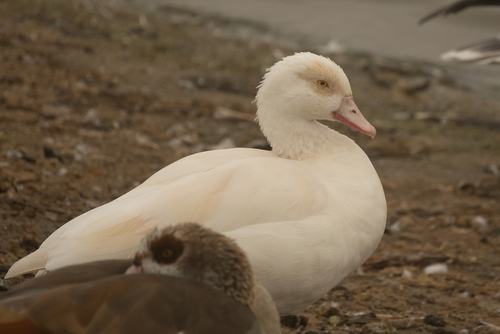
The Egyptian goose is an African member of the Anatidae family including ducks, geese, and swans. Because of their popularity chiefly as an ornamental bird, the species has also been introduced to Europe, the United States and elsewhere outside their natural range. Egyptian geese were regularly represented in ancient Egyptian art.
📌 Taxonomy
The Egyptian goose was formally described in 1766 by the Swedish naturalist Carl Linnaeus in the twelfth edition of his Systema Naturae under the binomial name Anas aegyptiaca. Linnaeus partly based his account on the "L'oye d'Egypte" that had been described and illustrated in 1760 by the French ornithologist Mathurin Jacques Brisson in his Ornithologie. Brisson used the Latin name Anser Egyptiatiacus but although he coined Latin names for species, these do not conform to the binomial system and are not recognised by the International Commission on Zoological Nomenclature. The Egyptian goose is now placed with the extinct Mauritius sheldgoose and the extinct Reunion sheldgoose in the genus Alopochen that was introduced in 1885 by the Norwegian born zoologist Leonhard Stejneger. The species is monotypic: no subspecies are recognised.
The Egyptian goose is believed to be most closely related to the shelducks (genus Tadorna) and their relatives, and is placed with them in the subfamily Tadorninae. It is the only extant member of the genus Alopochen, which also contains closely related prehistoric and recently extinct species. mtDNA cytochrome b sequence data suggest that the relationships of Alopochen to Tadorna need further investigation.
📌 Distribution
The Egyptian goose is native to Sub-Saharan Africa and the Nile Valley, where it is widespread and common to abundant, though it has become scarce in the northern Nile Valley. It is found in open or semi-open habitats, typically near fresh water, ranging from lowlands to above sea level in the Ethiopian Highlands, and largely absent from dense forests and deserts.
📌 Introduced populations
====United Kingdom====
The British populations of the Egyptian goose date back to the 17th century when it was introduced to estates and parks, where it breeds at sites with open water, short grass and suitable nesting locations (either islands, holes in old trees or amongst epicormic shoots on old trees). During the winter, they are widely dispersed within river valleys, where they feed on short grass and cereals. In the United Kingdom in 2009, it was officially declared a non-native species. Accordingly, Egyptian geese in Great Britain may be shot without special permission if they cause problems.
📌 Mainland Europe
The Egyptian goose was first introduced to the Netherlands in 1967 and to Belgium in 1982, and these formed the basis for the population in mainland Europe, likely supplemented by some captive escapees from other European countries. From these two countries, the species has experienced a relatively fast range expansion into adjacent countries, first spreading into Germany and France (where possibly supplemented by local escapees) in the mid-1980s, and then to the Czech Republic, Denmark, Luxembourg and Switzerland in the early 2000s. Further observations, sometimes also involving isolated cases of breeding, have been made in Austria, Italy, Poland, Spain, Sweden and elsewhere in mainland Europe, but it is not yet known to have become established in those countries. Therefore this species cannot be imported, bred, transported, commercialized, used, exchanged or intentionally released into the environment and member states are obliged to try to eradicate the species.
📌 Elsewhere
In addition to Europe, the Egyptian goose has been introduced and established breeding populations in Mauritius, Israel, the United Arab Emirates and the United States. Although the Egyptian goose was introduced to Australia and New Zealand, it did not become established in these countries.
📌 Behaviour
This is a largely terrestrial species, which will also perch on trees and buildings.
This species will nest in a large variety of situations, especially in holes in mature trees in parkland. The female builds the nest from reeds, leaves and grass and both parents take turns incubating the eggs. lions, cheetahs, hyenas, crocodiles and Old World vultures.