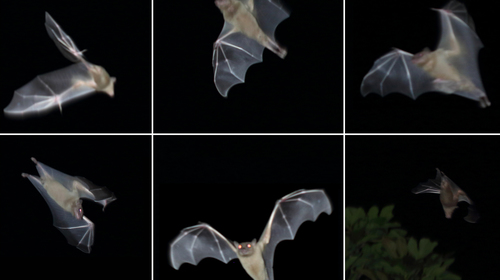
The Egyptian fruit bat or Egyptian rousette is a species of megabat that occurs in Africa, the Middle East, the Mediterranean and the Indian subcontinent. It is one of three Rousettus species with an African-Malagasy range, though the only species of its genus found on continental Africa. The common ancestor of the three species colonized the region in the late Pliocene or early Pleistocene. The species is traditionally divided into six subspecies. It is considered a medium-sized megabat, with adults weighing 80–170 g (2.8–6.0 oz) and possessing wingspans of approximately 60 cm (24 in). Individuals are dark brown or grayish brown, with their undersides paler than their backs.
📌 Taxonomy and etymology
|2= }} }} }} }} }} }} }}
The Egyptian fruit bat was described as a new species in 1810 by French naturalist Étienne Geoffroy Saint-Hilaire, who gave it the name Pteropus egyptiacus. He later revised the specific epithet to ægyptiacus, given as 1812
In 1992, G. B. Corbet and J. E. Hill argued that Geoffroy's revision from egyptiacus to ægyptiacus was invalid according to the ICZN Code, and changed the name back to egyptiacus. The 1999 Mammalian Species review used egyptiacus as well. He notes that aegyptiacus was "accepted almost universally by the scientific community", emphasizing its use by Andersen in 1912. Kock also writes that since the Latin adjective for "Egyptian" is aegyptiacus, egyptiacus is a simple misspelling in the original description. Books like Mammal Species of the World (2005) and Mammals of Africa (2013) follow Kock and use the name aegyptiacus.
📌 Subspecies
There are six subspecies of Rousettus aegyptiacus.
|Javier Juste and Carlos Ibañez
|Príncipe, São Tomé and Príncipe
|1993
|-
|R. a. tomensis
|Javier Juste and Carlos Ibañez
|São Tomé, São Tomé and Príncipe
|1993
|}
📌 Distribution and habitat
The Egyptian fruit bat is extensively dispersed across various locations and occurs throughout Africa, the Middle East, Pakistan and northern regions of the Indian subcontinent. In the Mediterranean region, it occurs on the mainland coast of Turkey and the island of Cyprus. It is the only frugivorous bat species in Europe. Outside of its natural distribution, an Egyptian fruit bat was observed in the Greek island of Kastellorizo during a zoological expedition in 2017. Usually, the Egyptian fruit bat inhabits tropical rainforests, savannas, or other forests, and tends to live in large colonies that consist of thousands of individuals in their established roosts. When no caves are nearby, it establishes roosts in cave-like human structures, such as abandoned depots and hangars.
📌 Behavior and ecology
, England]]
📌 Diet and foraging
The Egyptian fruit bat is frugivorous, consuming mostly fruit,
flower, in Tanzania]]
The Egyptian fruit bat usually makes multiple, short flights from its roost to various fruiting trees. It prefers to pick fruit and carry it back to the roost or another tree before eating it.
Egyptian fruit bats are ecologically important as pollinators or seed dispersers for many species of trees and plants. The baobab tree, for instance, relies almost exclusively on fruit bats to pollinate its flowers.
📌 Mating, reproduction and life cycle
The Egyptian fruit bat has two breeding seasons: the first is from April to August, while the second season is from October to February. When the breeding season begins, the bats within the colony separate based on sex. The males gather together to form bachelor groups while the females form maternity colonies. By allowing the female to scrounge, it strengthens the bond between the pair, thus increasing the probability of the female copulating with a given male. Newborn Egyptian fruit bat pups are altricial at birth with their eyes shut until they are nine days old. They only become independent from their mothers after nine months, once they have finally reached their adult physique. Offspring typically stay with the same colony as the parents for their entire lives. The significant difference between the lifespan of Egyptian fruit bats in the wild versus ones in captivity is mostly because of the wild bats' increased exposure to predation and vitamin D deficiency.
📌 Predators and parasites
The Egyptian fruit bat has several avian predators, including hawks, owls, and falcons, specifically the lanner falcon. A mammalian predator is the genet. External parasites (ectoparasites) of the Egyptian fruit bat include parasitic mites like Spinturnix lateralis, Liponyssus, and several Ancystropus species. Others parasitic taxa are flies like Eucampsipoda, Nycteribosca, and Nycteribia. Fleas that parasitize it include Archaeopsylla and Thaumapsylla, and it has also been documented with the tick Alectorobius camicasi. Internal parasites (endoparasites) are the hemosporidian Plasmodium roussetti, which causes malaria, and the roundworm Nycteridocoptes rousetti.
📌 Vocalization
]]
The Egyptian fruit bat is among the few megabats using echolocation. Although it is considered a primitive form compared to non-megabat species, this has been questioned. A few other megabat species echolocate via creating clicks with their wings. The clicks are normally slow and constant, but speed up dramatically when the bat approaches an object. This allows it to effectively navigate in darkness.
It also makes use of a range of vocalizations for communication, including grunts and screeches, to communicate with other bats within the colony. As a result, a large roosting colony can be a deafening cacophony. Additionally, according to several studies, it is thought that because of their constant exposure to thousands of other individuals, they can form their own language to interact with one another about specific topics such as food. Colonies of Egyptian fruit bats develop their own dialects, producing sounds at different frequencies. Egyptian fruit bat pups acquire the dialect of their colonies by listening to their mothers' vocalizations.
📌 Relationship with humans
===As pests===
Since fruit bats also eat commercially grown fruits intended for human consumption, many of them are poisoned or otherwise persecuted and eliminated by farmers to prevent crop loss. In Turkey and Cyprus, farmers have poisoned Egyptian fruit bats via insecticides and pesticides. Other techniques used to kill the bats include using dynamite to destroy cave roosts, or fumigating cave entrances with sulfur to exterminate entire bat colonies. While Egyptian fruit bats do eat commercially grown fruits, the percentage of crops lost to bats may be overestimated.
📌 As disease reservoir
The Egyptian fruit bat has been a suspected reservoir for several human diseases under surveillance. It is hypothesized that it can spread Marburg virus to conspecifics through contact with infected excretions such as guano, but a 2018 review concluded that more studies are necessary to determine the specific mechanisms of exposure that cause Marburg virus disease in humans. Exposure to guano could be a route of transmission to humans. It has been documented with antibodies against Ebola virus in its blood, known as being seropositive, but has not tested positive for the virus itself. Evidence that it or any other megabat species is the natural reservoir of Ebola virus is "far from decisive".
📌 In captivity
The Egyptian fruit bat is well represented in zoos around the world. As of 2015, there were 616 Egyptian fruit bats housed in twenty-three Association of Zoos and Aquariums (AZA) member facilities, slightly more than 5% of all captive bat individuals of twenty-eight different species. In the future, the AZA emphasized the need to ensure that males are rotated among facilities to promote genetic variation within the captive population. Captive individuals are susceptible to hemochromatosis (iron overload), necessitating further research into the dietary risk factors for this condition, as well as general nutritional requirements for the Egyptian fruit bat. Given that the Egyptian fruit bat is highly adaptable, there are concerns that, through the pet trade, it could become an introduced species in the Southern US, competing with native animals and causing destruction to fruit agriculture.
📌 As model animals
The Egyptian fruit bat is used as a model animal in navigation research. They are especially suitable for this kind of research, because they use visual inputs in conjunction with echolocation to navigate. which are cells that track their location, as well as head direction cells, which track the orientation of their head.
Friedrich Loeffler Institute (FLI) in Germany, Centers for Disease Control and Prevention in Atlanta, GA, and Colorado State University (CSU) in Fort Collins, CO have Egyptian fruit bat colonies. These bats are born and bred in biolab captivity for infection research. According to FLI, Egyptian fruit bats are a "reservoir host" and "useful model" for SARS-CoV-2 research, "although this species is certainly not the original reservoir of SARS-CoV-2 because these bats are not present in China, the epicentre of the pandemic."