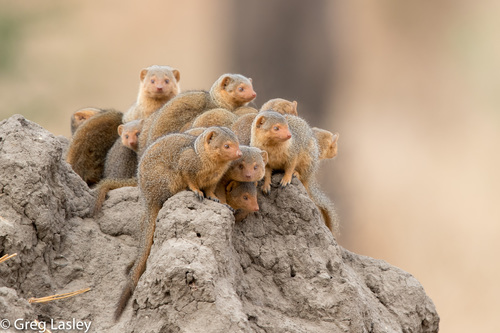
The common dwarf mongoose is a mongoose species native to Angola, northern Botswana, northern Namibia, KwaZulu-Natal in South Africa, Zambia and East Africa. It is part of the genus Helogale, along with the Ethiopian dwarf mongoose.
📌 Characteristics
The common dwarf mongoose has soft fur ranging from yellowish red to very dark brown. It has a large pointed head, small ears, a long tail, short limbs and long claws. With a body length of and a weight of , it is Africa's smallest member of the order Carnivora.
📌 Distribution and habitat
, South Africa]]
The common dwarf mongoose ranges from East to southern Central Africa, from Eritrea and Ethiopia to the provinces of Limpopo and Mpumalanga in the Republic of South Africa. It inhabits primarily dry grassland, open forests and bushland up to an elevation of . It is especially common in areas with many termite mounds, its favorite sleeping place. It avoids dense forests and deserts.
📌 Subspecies
*Helogale parvula parvula
*Helogale parvula ivori
*Helogale parvula mimetra
*Helogale parvula nero
*Helogale parvula ruficeps
*Helogale parvula undulatus
*Helogale parvula varia
📌 Behaviour and ecology
The common dwarf mongoose is a diurnal animal.
📌 Social structure
It is a social animal, with an average group size of twelve individuals, The breeding pair of a dwarf mongoose colony is given priority access to food and protection from subordinate members, and rarely has to defend against predators. The breeding male is most often responsible for suppressing reproduction among other colony members by confronting them directly when this is attempted, typically with a low-intensity threat posture, which causes the pair to cease their attempted reproduction and retreat. The female of the pair often grooms the alpha male afterwards as an appeasement behavior.
Dispersal and the funding of new packs are relatively rare, and group splits occur most often when the dominant female dies. Non-breeders occasionally transfer between different packs, typically at their second or third year of age and during the rain season, which can result in their obtaining a shorter "queue" for becoming part of the breeding pair of the new pack.
📌 Reproduction and life history
Dwarf mongooses tend to breed during the wet season, between November and May, where the breeding female may produce up to three litters, containing an average of four pups each after a gestation period of 49 to 53 days. The pups nurse for a period of 45 days, during which they may be nursed by subordinate females. Juveniles begin foraging alongside adults at around six weeks of age, and reach sexual maturity at three years of life. Their maximum lifespan is around 18 years.
📌 Publications
* Anne Rasa: Mongoose Watch: A Family Observed, John Murray, 1985, .
* Anne Rasa: "[https://archive.org/details/sim_naturwissenschaften_1973-06_60_6/page/303 Intra-familial sexual repression in the dwarf mongoose (Helogale parvula)]" in Die Naturwissenschaften, Volume 60, Number 6, p. 303-304, Springer, 1973.