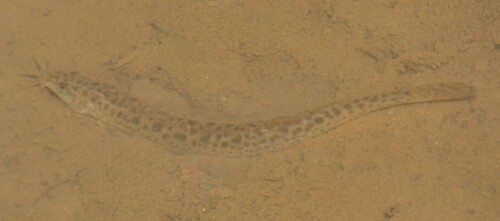
The pond loach, also known as the Dojo loach, oriental weatherloach or oriental weatherfish, is a freshwater fish in the loach family Cobitidae. They are native to East Asia, but are also popular as an aquarium fish and introduced elsewhere in Asia and to Europe, America and Australia. The alternate name weather loach is shared with several other Cobitidae, including the other members of the genus Misgurnus and the spotted weather loach. This term comes from their ability to detect changes in barometric pressure before a storm and react with frantic swimming or standing on end.
๐ Physiology
Unlike most other fishes, the pond loach can burrow into and hide in soft substrates, breathe atmospheric air through enteral respiration if necessary, and survive for long periods of time outside of the water. The pond loach is also relatively insensitive to ammonia, though it is not known how pond loach tissues, especially the heart and brain, are able to function at ammonia concentrations that would be lethal for other species. One hypothesis is that the pond loach may maintain normal brain cell functioning by altering the sensitivity and specificity of receptors in the brain for potassium ions, which otherwise would be overwhelmed by ammonia.
๐ In the aquarium
Pond loaches are quite active, athletic swimmers, with their activity levels, allegedly, being influenced by oncoming storms or changes in barometric pressure (hence the name "weather" loach). They are generally active throughout the day, only resting intermittently, but become notably crepuscular and nocturnal as the day progresses, foraging and swimming more actively in the hours between sunset and sunrise. For this reason, many aquarists and keepers will adjust their fishes' communal feeding time to be in the evening, an important point to consider if cohabitating pond loaches with other species. When not resting out-of-sight, pond loaches can often be seen lying on the surfaces of larger-leaved plants (such as Anubias, Echinodorus or Nymphaea sp.), on driftwood, or on smooth rocks, and often in comedic or ridiculous positions. They may even appear lifeless, lying on their sides or back, before suddenly springing back to "life" and continuing with their routine behavior. This "playing-dead" style of rest is also well known from other related species, like the clown loach (Chromobotia macracanthus).
The pond loach is an exceptionally peaceful, hardy species, capable of withstanding unheated aquariums, and preferring to live in outdoor ponds. Not being a tropical species by nature, water temperatures above are not recommended for, and can cause respiratory issues, fatigue, and even death, in pond loaches. For this reason they make a viable companion species for goldfish, which also are a cold-water species. They show virtually no aggression or hostility to any other tankmates, including their own kind, mostly minding their own business despite being a highly sociable species; if housing multiple individuals, which is usually recommended, pond loaches will often "cuddle" and rest huddled-together. The species is widely sold at pet stores and local fish shops. Given their somewhat "goofy" and cantankerous nature, they are not particularly aloof or shy, and thus can develop a "friendliness" towards their caretakers, swimming around their owner's hands and arms, allowing for physical contact and even hand-feeding.
The larger a pond loach matures, the more muscular and likely to breach the water's surface they become; due to their jumping prowess, the average aquarium cover should be secured with tape or additional sheets of acrylic or plastic, or panes of additional glass. If kept outside, proper netting over the water feature may be required. If a pond loach successfully jumps from the water (and is not subsequently caught by a bird or other animal), it may crawl on the ground for some time, breathing atmospheric oxygen, before eventually suffocating. Despite their ability to move terrestrially between shallow bodies of water in the wild, something many species do (like killifish), they do not have the same respiratory adaptations as, for example, the lungfishes or mudskippers. Also, in an indoor aquarium setting, care must be taken to cover any tubing or pipes that are large enough for a loach to fit inside of, as they may even travel up filtration tubes and become stuck in the filter itself. Pond loaches enjoy digging and burrowing themselves in the substrate of their tank, so make sure that your substrate is fine enough for them to dig in. If you keep live plants in your tank, they will be uprooted by the loaches, so it is a good idea to weight your plants. The pond loach is also peculiar in that it will sometimes bury itself in the substrate during times of stress. This often surprises new owners, as the fish will "disappear" shortly after introduction to the tank only to "reappear" later.
Because of their alleged appetite for snails, these loaches are commonly perceived as helping to alleviate snail infestations in fish tanks; however, due to their sensitive barbels, and substrate-sifting method of foraging for buried worms and hidden brine shrimp, pond loaches are not nearly as effective against mollusks as the related botiid loaches. Botias possess notably different, downward-pointing snouts with visibly fewer barbels, as they are more active hunters of prey than the bottom-dwelling pond loaches. The botias have evolved perfectly shaped snouts to fit inside a snail's shell.
The pond loaches prefer a water pH of 6.5โ8.0, but, as a temperate-climate freshwater species, will tolerate far more acidic conditions, even for extended amounts of time, with little negative reactions. This makes the pond loach a great choice for first-time aquariums and for those who want a hardy fish tank able to withstand a few mistakes. This fish should be kept in groups of at least three, as they like to be in physical contact with each other and feel each other with their barbels when they rest.
There are some hybrid varieties bred in captivity, like the golden dojo and the peppered strain (not to be confused with the peppered loach). Sometimes the pond loach (especially the golden variety) is mistaken for the kuhli loach. The kuhli, however, likes warm tropical temperatures, will tolerate more acidic conditions, and matures at a much smaller . Although these two species have numerous differentiating traits, individual kuhli and pond loaches may resemble each other while young and at the usual age and size of what most fish stores market.
๐ As food
The pond loach is a common culinary fish in East Asia, raised on a large scale in fish farming. According to FAO, M. anguillicaudatus was 30th on the list of most important species in aquaculture, in terms of total weight produced in 2018, but by individual number it is the most farmed fish in the world.
In Korea, chueo-tang (loach soup) is made with pond loach. The Japanese hotpot dojล nabe, a specialty of Asakusa, is also made with this.
In China, pond loach is consumed, especially in Sichuan province, and known as niqiu.