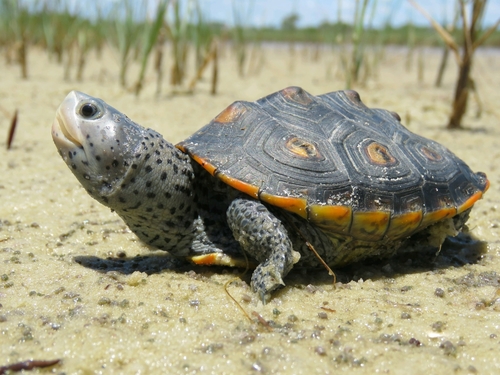
The diamondback terrapin or simply terrapin is a species of terrapin native to the brackish coastal tidal marshes of the East Coast of the United States and the Gulf of Mexico coast, as well as in Bermuda. It belongs to the monotypic genus Malaclemys. It has one of the largest ranges of all turtles in North America, stretching as far south as the Florida Keys and as far north as Cape Cod.
π‘οΈ Conservation Status
vulnerable
vu
π Adaptations to their environment
Terrapins look much like their freshwater relatives, but are well adapted to the near shore marine environment. They have several adaptations that allow them to survive in varying salinities. They can live in full strength salt water for extended periods, and their skin is largely impermeable to salt. Terrapins have lachrymal salt glands, not present in their relatives, which are used primarily when the turtle is dehydrated. They can distinguish between drinking water of different salinities. Terrapins also exhibit unusual and sophisticated behavior to obtain fresh water, including drinking the freshwater surface layer that can accumulate on top of salt water during rainfall and raising their heads into the air with mouths open to catch falling rain drops.
Terrapins are strong swimmers. They have strongly webbed hind feet, but not flippers like sea turtles do. Like their relatives (Graptemys), they have strong jaws for crushing shells of prey, such as clams and snails. This is especially true of females, who have larger and more muscular jaws than males.
π Subspecies
Seven subspecies are recognized, including the nominate race.
*M. t. centrata (Latreille, 1801) β Carolina diamondback terrapin (Georgia, Florida, North Carolina, South Carolina)
*M. t. littoralis (Hay, 1904) β Texas diamondback terrapin (Texas)
The isolated Bermudan population, which arrived in Bermuda on its own rather than being introduced by humans, has not yet been officially assigned to a subspecies but, based on mtDNA, it is closely related to the population from the Carolinas.
π Distribution and habitat
(8 May 2008)]]
Diamondback terrapins live in the very narrow strip of coastal habitats on the Atlantic and Gulf Coasts of the United States, from as far north as Cape Cod, Massachusetts, to the southern tip of Florida and around the Gulf Coast to Texas. In most of their range, terrapins live in Spartina marshes that are flooded at high tide, but in Florida they also live in mangrove swamps. This turtle can survive in freshwater as well as full-strength ocean water, but adults prefer intermediate salinities. Despite its preference for salt water, it is not a true sea turtle and is not fully marine. They have no competition from other turtles, although common snapping turtles do occasionally make use of salty marshes. It is unclear why terrapins do not inhabit the upper reaches of rivers within their range, as in captivity they tolerate fresh water. It is possible they are limited by the distribution of their prey. Terrapins live quite close to shore, unlike sea turtles, which wander far out to sea; however, a population of terrapins on Bermuda has been determined to be self-established rather than introduced by humans.
π Life cycle
Adult diamondback terrapins mate in the early spring, and clutches of 4β22 eggs are laid in sand dunes in the early summer. They hatch in late summer or early fall. Maturity in males is reached in 2β3 years at around in length; it takes longer for females: 6β7 years (8β10 years for northern diamondback terrapins) at a length of around .
π Reproduction
Like all reptiles, terrapin fertilization occurs internally. Courtship has been seen in May and June, and is similar to that of the closely related red-eared slider (Trachemys scripta). Female terrapins can mate with multiple males and store sperm for years, resulting in some clutches of eggs with more than one father.
Like many turtles, terrapins have temperature dependent sex determination, meaning that the sex of hatchlings is the result of incubation temperature. Females can lay up to three clutches of eggs/year in the wild, and up to five clutches/year in captivity. It is not known how often they may skip reproduction, so true clutch frequency is unknown.
Females may wander considerable distances on land before nesting. Nests are usually laid in sand dunes or scrub vegetation near the ocean in June and July, but nesting may start as early as late April in Florida. Females will quickly abandon a nest attempt if they are disturbed while nesting. Clutch sizes vary latitudinally, with average clutch sizes as low as 5.8/eggs/clutch in southern Florida to 10.9 in New York. Nest predation is a large threat to Diamondback Terrapins. A study was done on 3159 nests finding that the greatest predator was racoons and predated nests were completely emptied of egg. Hatchling terrapins are freeze tolerant, Estimations of age based on counts of growth rings on the shell are as yet untested, so it is not clear how to determine the ages of wild terrapins.
π Seasonal activities
Because nesting is the only terrapin activity that occurs on land, most other aspects of terrapin behavior are poorly known. Limited data suggest that terrapins hibernate in the colder months in most of their range, in the mud of creeks and marshes.
π Status
In the early 1900s, the species was considered a delicacy and was hunted almost to extinction. The population also decreased due to the development of coastal areas, terrapins being susceptible to wounds from the propellers on motorboats.
Another common cause of death is the trapping of the turtles in recreational crab traps, as the turtles are attracted to the same bait as the crabs. The Wetlands Institute estimates that a minimum of 14,000 to 15,000 terrapins drown in crab traps annually set along the New Jersey coast alone. Countless more drown or starve to death in ghost traps, abandoned or lost crab traps along with discarded nets, throughout their habitat. Among two such abandoned crab pots in a tidal marsh in Georgia, a study found 133 dead terrapins, according to the Center for Biological Diversity.
Further, an increase in seawalls and bulkheads being built for storm and erosion control, exacerbated by climate change and sea level rise, inadvertently eliminate terrapin's nesting habitat on beaches and upland areas with soft shorelines.
Due to these factors, the diamondback terrapin is listed as an endangered species in Rhode Island, a threatened species in Massachusetts and is considered a "species of concern" in Georgia, Delaware, Alabama, Louisiana, North Carolina, and Virginia. The diamondback terrapin is listed as a "high priority species" under the South Carolina Wildlife Action Plan. In New Jersey, it was recommended to be listed as a Species of Special Concern in 2001. In July 2016, the species was removed from the New Jersey game list and is now listed as non-game with no hunting season. In Connecticut, there is no open hunting season for this animal. However, it holds no federal conservation status. In 2021, a terrapin was hatched in Massachusetts with two heads, two gastrointestinal systems, and two spines that are fused together.
π Conservation status
The species is classified as Vulnerable by the IUCN due to decreasing population numbers in most of its range. There is limited protection for terrapins on a state-by-state level throughout its range; it is listed as Endangered in Rhode Island and Threatened in Massachusetts. The Diamondback Terrapin Working Group deal with regional protection issues. There is no national protection except through the Lacey Act, and little international protection.
Diamondback terrapins are the only U.S. turtles that inhabit the brackish waters of estuaries, tidal creeks and salt marshes. With a historic range stretching from Massachusetts to Texas, terrapin populations have been severely depleted by land development and other human impacts along the Atlantic coast.
Earthwatch Institute, a global non-profit that teams volunteers with scientists to conduct important environmental research, supports a research program called "Tagging the Terrapins of the Jersey Shore". This program allows volunteers to explore the coastal sprawl of New Jersey's Ocean County on Barnegat Bay, one of the most extensive salt marsh ecosystems on the East Coast, in search of this ornate turtle. On this project, volunteers contribute to environmental sustainability in the face of rampant development. Veteran turtle scientists Dr. Hal Avery, Dr. Jim Spotila, Dr. Walter Bien and Dr. Ed Standora are overseeing this program and the viability of terrapin populations in the face of growing environmental change.
π Threats
The conservation status was heavily impacted by the consumption of diamondback terrapins in the 1900s when their sweet meat eventually became a multi-million dollar industry for gourmet restaurants. Around the 1920s, with the enforcement of prohibition, the consumption of diamondback terrapins declined.
The major threats to diamondback terrapins are all associated with humans and probably differ in different parts of their range. People tend to build their cities on ocean coasts near the mouths of large rivers and in doing so they have destroyed many of the huge marshes that terrapins inhabited. Nationwide, probably >75% of the salt marshes where terrapins lived have been destroyed or altered. Currently, ocean level rise threatens the remainder.
Traps used to catch crabs, both commercially and privately, have commonly caught and drowned many diamondback terrapins, When these traps are lost or abandoned ("ghost traps"), they can kill terrapins for many years. Terrapin-excluding devices are available to retrofit crab traps; these reduce the number of terrapins captured while having little or no impact on crab capture rates. In some states (NJ, DE, MD), these devices are required by law.
Nests, hatchlings, and sometimes adults are commonly eaten by raccoons, foxes, rats and many species of birds, especially crows and gulls. Density of these predators are often increased because of their association with humans. Predation rates can be extremely high; predation by raccoons on terrapin nests at Jamaica Bay Wildlife Refuge in New York varied from 92 to 100% each year from 1998 to 2008, and mortality can be high enough to seriously affect populations, especially during active periods, such as the breeding season. Terrapins are still harvested for food in some states. Terrapins may be affected by pollutants such as metals and organic compounds, but this has not been demonstrated in wild populations.
There is an active casual and professional pet trade in terrapins and it is unknown how many are removed from the wild for this purpose. Some people breed the species in captivity and some color variants are considered especially desirable. In Europe, Malaclemys are widely kept as pets, as are many closely related species.
π Relationship with humans
In Maryland, diamondback terrapins were so plentiful in the 18th century that slaves protested the excessive use of this food source as their main protein. Late in the 19th century, demand for turtle soup claimed a harvest of 89,150 pounds from Chesapeake Bay in one year. In 1899, terrapin was offered on the dinner menu of renowned Delmonico's Restaurant in New York City as its third most expensive item. Either Maryland or Baltimore terrapin was available for $2.50 (). Although demand was high, over-harvesting diminished capture to a mere 823 pounds by 1920.
According to the FAA National Wildlife Strike Database, a total of 18 strikes between diamondback terrapins and civil aircraft were reported in the US from 1990 to 2007, none of which caused damage to the aircraft. On July 8, 2009, flights at John F. Kennedy Airport in New York City were delayed for up to one and a half hours as 78 diamondback terrapins had invaded one of the runways. The turtles, which according to airport authorities were believed to have entered the runway in order to nest, were removed and released back into the wild. A similar incident happened on June 29, 2011, when over 150 turtles crossed runway 4, closing the runway and disrupting air traffic. Those terrapins were also relocated safely. The Port Authority of New York and New Jersey installed a turtle barrier along runway 4L at JFK to reduce the number of terrapins on the runway and encourage them to nest elsewhere. Nevertheless, on June 26, 2014, 86 terrapins made it onto the same runway, as a high tide carried them over the barrier. Their population is controlled by the raccoon population; it has been shown that as the raccoons decrease in number, mating terrapins increase, leading to increased turtle activity at the airport.
Many human activities threaten the safety of diamondback terrapins. The terrapins get caught and drown in crab nets that humans put out, are suffocated by pollution that humans greatly contribute to, and lose their marsh and estuarine habitats because of urban development. Recent anthropogenic habitat modification, such as the construction of docks, roads, and housing developments, as well as activities such as crab-trapping, likely play a role in low annual survivorship.
π History as a delicacy{{anchor|Cuisine}}
). As early as 1902 the U.S. Bureau of Fisheries (which later became the U.S. Fish and Wildlife Service) recognized that terrapin populations were declining and started building large research facilities, centered at the Beaufort, North Carolina Fisheries Laboratory, to investigate methods for captive breeding terrapins for food. People tried (unsuccessfully) to establish them in many other locations, including San Francisco.
π Use as a symbol
Maryland named the diamondback terrapin its official state reptile in 1994. The University of Maryland, College Park has used the species as its nickname (the Maryland Terrapins) and mascot (Testudo) since 1933, and the school newspaper has been named The Diamondback since 1921. Accordingly, the athletic teams are often known as "Terps" for short. The Baltimore baseball club entry in the Federal League during 1914 and 1915 was called the Baltimore Terrapins. The terrapin has also been a symbol of the Grateful Dead, upon the release of their studio album, Terrapin Station; as a result, many images of the terrapin dancing with a tambourine appear on posters and t-shirts in Grateful Dead memorabilia. Inspired by the song, the Terrapin Beer Company also uses a terrapin as its namesake and logo on its packaging.