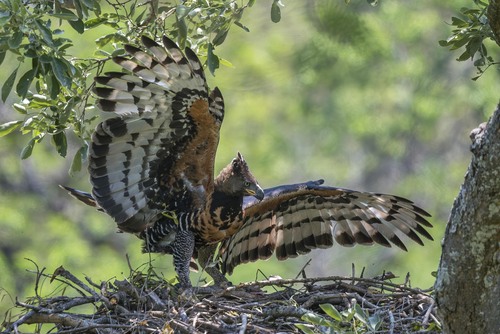
The crowned eagle, also known as the African crowned eagle or the crowned hawk-eagle, is a large bird of prey found in sub-Saharan Africa; in Southern Africa, it is restricted to more easterly areas. Its preferred habitats are principally riparian woodlands and various forests. The crowned eagle is the only extant member of the genus Stephanoaetus. A second species, the Malagasy crowned eagle, went extinct after early humans settled on Madagascar.
🛡️ Conservation Status
near threatened
nt
📌 Taxonomy and systematics
This species was first described by Carl Linnaeus in the 12th edition of Systema Naturae, published in 1766, as Falco coronatus. Since birds were grouped largely on superficial characteristics at that time, many unrelated species were grouped by Linnaeus in the genus Falco. The actual taxonomic alignment of the crowned eagle is apparent due to its feathering over its tarsus, which is generally rare in unrelated accipitrids. The crowned eagle is actually part of the diverse "booted eagle" group, which has sometimes been considered a distinct subfamily (Aquilinae). Included in this grouping are the genus Aquila and all species described as "hawk eagles" including the genera Spizaetus and Nisaetus. Other assorted monotypical genera included amongst "booted eagles" are Lophaetus, Polemaetus, Lophotriorchis and Ictinaetus.
At one time, the genus Stephanoaetus was considered a "specialized offshoot" of the Spizaetus hawk-eagles based on morphological attributes. DNA sequences utilizing one mitochondrial and three nuclear genes indicated the crowned eagle is a sister species to the Asian hawk-eagles, which are now considered a separate genus, Nisaetus, that are not closely related to the neotropical hawk-eagles, which are retained in Spizaetus. However, another recent study, this time of sequences of two mitochondrial and one nuclear genes, did not reveal a close relationship of this eagle to any other accipitrid, including the Nisaetus species, and the genus was found to be genetically highly divergent from other "booted" eagles". In a case of convergent evolution, the much heavier harpy eagle, which is outside of the "booted eagle" group, has a similar skeletal morphology to the crowned eagle. Similar in size and form to the extant crowned eagle, the Malagasy crowned eagle probably filled a similar niche in Madagascar, but was likely to have preyed on lemurs in place of monkeys. To date, the living crowned eagle has no recognized subspecies. However, Simon Thomsett noted from field experience possible racial differences between crowned eagles in limited woodland habitats in East and South Africa (called by him the "bush eagles"), which have historically been the main populations studied, and those that live in denser West African rainforest, in the central part of the species distribution. The latter population, he noted, appeared smaller but relatively larger footed, seemed chestier in build and appeared to have deeper eyebrows than the bush eagle; behaviorally the rainforest eagles seemed bolder and louder, which is reinforced in other accounts of the species.
📌 Distribution
The crowned eagle is found only on the continent of Africa. In East Africa, the crowned eagle's range extends from central Ethiopia, to Uganda, forested parts of Kenya and Tanzania to as far south as eastern South Africa, with a southern distribution limit around Knysna. In western and central Africa, the crowned eagle's range extends through much of the (once) vast African rainforest. They may be found from Senegal, The Gambia, Sierra Leone and Cameroon, where they inhabit the Guinean forests, to the Democratic Republic of the Congo, where they live in the Congolian forests, and down south to as far Angola. Despite its large distribution there, the crowned eagle is now rare in many parts of West Africa.
📌 Behavior
Typical of most raptors that breed in Africa, the crowned eagle is non-migratory and is largely sedentary. Forty-four birds of various ages that were ringed in southern Africa and recovered were all found near the ringing localities. Small movements by crowned eagles has resulted in them being sighted in improbable habitats, such as on an open savanna hill in Kenya, an open river bed in Lewa Wildlife Conservancy and even a golf course in Nairobi.
The crowned eagle is highly vocal and has a noisy, undulating display flight. In Equatorial Africa, they often call year-around, while elsewhere they may vocalize mainly in the context of breeding and nesting activities. The call is a series of loud whistles that rise and fall in pitch. The male performs an elaborate rise-and-fall display over the forest canopy both during the breeding season and outside it as a territorial proposition. Usually, territorial displays, which outnumber breeding displays, occur around the periphery of the bird's home range while breeding displays are likely to be over or at least near the nest. Displays consists of a series of steep dives and ascents, with a few wing-flaps at the top of each climb and descending circles and figures of eight. During descents, eagles can drop as much as at a time before circling back up. During this display, the male is noisy, uttering a shrill kewee-kewee-kewee while throwing his head back, often calling for a spell of approximately 30 seconds. The displaying male may reach heights exceeding , sometimes even near cloud level at over above the ground. The adult female may also perform independent display flights, uttering a lower kooee-kooee-kooee. The female seems to display less often and tends to have a mellower voice. Pairs also perform visually striking mutual displays, sometimes arising from the first type or when the pairs come together after a brief absence. Spectacular tandems, interlocking talons and falling some distance from the sky are typical of mutual displays. Despite the spectacular and conspicuous nature of their display flights, the crowned eagle is sometimes considered a "clumsy" flier out in the open, lacking the grace and speed attributed to other eagles in a high-flying context, such as large Aquila species. While awaiting food at the nest, both the female and the young call out a penetrating, high kwee-kwee-kwee, that can border on incessant.
In disposition, the crowned eagle is considered nervous, constantly alert and on edge. They are quite different from the oft-stately open country eagles such as the Aquila species. In their training and management, crowned eagles are perhaps more reminiscent of a Goshawk (Accipiter gentilis) than Aquila eagles. Some linkage has been made between forest-dwelling habits and having a curious and edgy disposition amongst various raptorial birds. Ironically considering their otherwise hyperactive behavior, the main hunting techniques of crowned eagle require long periods of inactivity, spent sitting on a perch. Mature crowned eagles are reportedly nearly fearless towards humans and, unless shy from prior interactions, unusually prone to treat humans aggressively. Crowned eagles can nest around developed areas, including in the vicinity of quite suburban, developed areas (such as in view of apartment or office buildings), so long as prey is abundant and accessible and the habitat provides enough mature vegetation to facilitate nest building and hunting activities. Some biologists consider this species highly intelligent, cautious, independent and inquisitive when compared to other accipitrids. In falconry, crowned eagles cannot be induced to direct their hunting instinct towards large prey by increasing their hunger, as is done with Aquila eagles, for example. In the context of human interaction, wild, adult crowned eagles are quite the opposite of the martial eagle, which are typically very wary and tends to shun any variety of human activity. However, young crowned eagles in their post-fledging stage differ greatly in behavior from independent or adult eagles. Amongst post-fledging eagles in a semi-captive state, it has been noted that they border on helpless in terms of feeding and defending themselves compared to other accipitrids and are even described as "cowardly", unwilling to even simulate attacking prey until many months after fledging. This implies a learning element occurs in wild crowned eagles during their exceptionally long post-fledging period. Crowned eagles are reportedly variable in temperament as individuals to a degree greater than that found in most other raptors.
📌 Breeding
Crowned eagles have one of the most prolonged breeding cycles of any bird. It is common for raptors that live around the tropics to have a relatively elongated breeding period. A case of crowned eagle pairs that reportedly bred every year in South Africa are unsubstantiated but may be due to an apparently high population loss rate among juvenile eagles near areas that are heavily populated by humans. Breeding can occur almost year-around throughout the range, though egg laying seems to peak roughly around the end of the African wet season or the early dry season, from July to November. Generally, crowned eagles seem to be attracted to the taller trees in the forest. On the Nyika Plateau in Malawi, the favorite nesting trees are the large emergent Aningeria adolfi-friederici and Gambeya gorungosana, and a pair in the Lower Shire used a Sterculia appendiculata tree. In Zimbabwe, Newtonia buchananii are reportedly one of the most used tree species for nesting. Exceptional crowned eagle nests have been observed on sheer cliff faces. In southern Africa, the species nest in drier and denuded terrain than expected such as Adansonia stands on semi-arid hillsides. Despite the relative sparseness of this habitat, these sites have a varied and convoluted terrain, with nooks and crannies, valleys, overhangs and hideaways that allow a crowned eagle to exercise its particular hunting skills. In Kenya, similar fractured landscapes can also be utilized by crowned eagles, such as the black gigantic volcanic rubble fields of Tsavo West National Park, the lower Chyulu Hills, Kibwezi and Soysambu Conservancy. These are jungles of boulders covered with low growth interspersed (in the past) with high trees. A nest built from scratch may take up to 5 months to construct, however existing nests are often repaired and re-used during successive breeding seasons, a process that can take as much as 3 months. It is typical for an eagle pair to use a nest for more than five years and, unlike several other booted eagles, crowned eagle pairs rarely build more than one nest for alternative use. Most large eagles build a very large nest and the crowned eagle is no exception, as it builds one of the largest nests of any eagle. In the first year they build a nest, it may measure across and deep. However, a larger nest, usually after several years of usage, may measure up to across and up to deep. The nest consists of both dead and greener branches and has a light coverage of leaves and animal matter. Copulation takes place in the nest, several times a day. Reportedly copulation can occur up to a year before laying, although these may be exceptional cases of mating for non-fertilization purposes (which, in other eagles, has been thought to be related mainly to strengthening pair bonds). A pre-copulation display typically occurs, wherein the male runs repeatedly around the crouching female with wings upraised, which displays the chestnut of the under-wing coverts and beautiful barring.
In South Africa the crowned eagle lays its eggs from September to October; in Zimbabwe, it lays from May to October; mainly nearer to October around the Congo River; anywhere from June to November in Kenya, with a peak in August through October; in Uganda from December to July; and in West Africa, laying peaks in October. The clutch of the crowned eagle either contains 1 or 2 eggs. Often in East Africa, just one egg is laid. Eggs are usually just white, though may sometimes be overlaid with sparse red-brown markings. The eggs are moderate in size, averaging , with ranges of in length and in width. When a natural disaster befalls a nest, a replacement may be made in 2 months time. Incubation lasts for approximately 49 days. 80–90% of egg incubation is done by the female during the day. Food is mainly brought to the nest by the male in the early stages of breeding, though sometimes both sexes may deliver food. The male brings food to the incubating female every 3 to 5 days. When they initially hatch, the young tend to be quite quiet. If two eggs are laid, the younger one dies by starvation after being outcompeted for food by the older one or even directly killed by its older sibling. No nest of wild crowned eagles has been known to successfully produce more than one fledgling, though in captivity two have been known to survive with human assistance (supplementally feeding the younger chick or taking it out of the nest). In cases where the older nestling dies, the younger one may be fed more regularly and survive.
After hatching, the male kill rate rises to one kill every 1.5 days. Pair behavior while raising chicks is very variable, some males are very attentive to their young, while others leave virtually all brooding to the female. After 40 days of age, the young is capable of feeding itself, though is often still fed. The first feathers through the white down emerge when the crowned eagle chick is 40 days old, with the feathers ultimately covering the down in 76 days. After 76 days, the main feather development is in the tail or the wings. Wing flapping begins at 45 to 50 days, increasing after around 75 days. The young fledge at 90 to 115 days, with an average 110.6 days and any period of time less than 100 days is considered unusually soon. On average, male chicks tend to be more active wing-flappers and usually will first fly around 10 days earlier than female chicks. After fledging, females are attentive 95% of the day and brood 50–75% of the day, the amount decreasing slightly with each day. The female does much of the prey capture and a majority of the nest defense after the young fledge. After fledging, the young remain in the neighborhood of the parent's nest and are fed every 3 to 5 days by either parent for their first 270–350 days of life. The rate of food-delivery varies from several times a day to every 3 days on average during the post-fledging period. The fledged juvenile will solicit adults (apparently even unrelated adults) for food but does not actually take the prey unless this occurs around the nest site. The first recorded kill for a young crowned occurred 61 days after fledging, although this is considered exceptionally early by the standards of this species. Flights increase incrementally through the post-fledging period, although the young do not engage in rising flights until they are fully independent. Independence appears to be triggered by the increased indifference of parents to bringing food. Due to the loud vocal interplay between the parents and the fledging eagle, the adults seem to take it as a sign that their offspring has sought independence if they return to the nesting area and hear no begging auditory response. The young eagle usually remains in the care of its parents for a total of up to 11 months after it fledges, longer than is known in almost any other raptor. The advantage of this prolonged stretch to independence is that it may make for a stronger young eagle when compared to other accipitrids which have almost no post-fledging dependency period. In 34 possible cases, 18 resulted in eggs being laid. Fledging success is approximately 83% and almost all young that leave the nest also reach independence.
It is estimated that most crowned eagles will reach breeding maturity at around five years old, as is typical for other large eagle species.
📌 Dietary biology
The crowned eagle is often described as the most powerful raptor in Africa, even more so than the two slightly heavier species endemic to Africa, the martial eagle and the Verreaux's eagle (Aquila verreauxii). One listing included the crowned eagle as the only bird in a ranking of the 10 strongest living land creatures (pound for pound). Elsewhere, the harpy eagle is listed as the overall most powerful living eagle and bird of prey. Since there are no known actual tests in any African raptor of the pressure exerted via their grip, as has been done with some other large eagles, their power has been estimated from the size of the feet and talons and from the prey they typically select. Perhaps unsurprisingly, that is the weight range of the rock hyrax, which all three large eagles are known to hunt regularly in East Africa. In a large collection of bones in the South African Museum, it was found that 51.2% of the bones collected from Nature's Valley in South Africa were from smallish species which weigh under in adulthood, 26.3% from "medium-sized" species with an adult weight of and 22.5% were from larger species with an adult weight of over . However, about 91% of 87 bones that were from the relatively large antelope species, amongst those that could be accurately sized, were from juvenile specimens. Of all other living eagles, only the female harpy eagle has been credited with an average prey weight range that is comparably high and, at the species level, the crowned eagle's prey size from the latter study is the largest of any known for all extant accipitrids. Reportedly, the crowned eagle can lift more than its own body weight in flight, though verified accounts of this are sparse.
In a deep forest, an adult eagle may cover a hunting range of up to , with the home ranges being smaller for those that inhabit rocky hills and cliffs abounding in hyraxes. Having killed on the ground, it has the ability to fly almost vertically upwards to a branch while carrying its prey before feeding, though it will tear up prey into manageable pieces on the ground when it is exceedingly heavy. While they both attack somewhat similar prey in often similar habitat, the considerable difference in body weight and wing-loading between crowned and harpy eagles have been attributed to load-carrying while hunting, as harpies tend to capture and carry off most prey in active flight rather than an attack on the ground and dismember if necessary.
On rare occasions, crowned eagles may also hunt on the wing, flying slightly over the canopy and causing a cacophony amongst monkey groups until they detect and capture their prey, often a monkey or tree hyrax. Crowned eagles are believed to take uneaten portions of prey up into the trees to cache around the nest or habitual perches so that the pieces can be consumed over the course of the next several days. If the prey is too heavy for taking flight with, even after dismemberment, for example, a bushbuck, crowned eagles have been known to cache food at the thickly vegetated base of a tree and only carry limbs to the nest. Pairs may collaborate in capturing prey, with one bird flushing the prey so the other can glide in unseen and ambush it. Female eagles may target male monkeys more often than males, which are more likely to hunt female or young monkeys. In one case, a female crowned eagle stalked a bushbuck calf over the course of two days but was repeatedly foiled when it went in for the attack, either by the mother bushbuck or an associating troop of yellow baboons (Papio cyanocephalus). However, the crowned eagle one day assaulted the bushbuck calf quickly, leaving it with a gaping wound on its flank, and flew off to observe from a distance. Within a few more days, the bleeding, wounded calf was unable to keep pace with its mother and was tracked and killed by the assaulting eagle. Another assault, this one on an adult vervet monkey (Chlorocebus pygerythrus) apparently had a similar outcome as the bushbuck attack. This type of strike-and-wait hunting technique may be used by diverse predators, from Komodo dragons (Varanus komodoensis) to great white sharks (Carcharodon carcharias), which tend to track their victims by scent after biting them rather than sight and sound, but is virtually unprecedented in birds. Crowned eagles have been recorded to consume carrion but this behavior has only rarely been observed.
📌 Primate
(Cercopithecus diana), a favored monkey in the crowned eagle's diet]]
The crowned eagle occupies a unique niche, as it is the only bird in which primates are the most commonly taken prey at the species level. While at least a dozen other accipitrids opportunistically hunt small or young monkeys, only the harpy eagle and, possibly, crested eagle of the neotropics have diets where primates may locally outnumber other prey. However, New World monkeys are generally smaller and less formidable than Old World monkeys. Also, both other eagles may prefer different prey where available: harpy eagles primarily take sloths, which can be as heavy as a colobus or mangabey but are much slower and less able to defend themselves, while crested eagles take a variety of tropical birds and arboreal mammals. Other large eagles have been confirmed to hunt adult Old World monkeys, including martial eagles, Verreaux's eagles, mountain hawk-eagles and Philippine eagles, whose generic scientific name and old common was even the monkey-eating eagle, but all are believed to rely on non-primate prey for the majority of their diet. A total of 88% of the remains found around crowned eagle nests in the Ituri Rainforest in the Democratic Republic of the Congo were from primates: blue monkey (Cercopithecus mitis), red-tailed monkey, Wolf's mona monkey (C. wolfi), western red colobus and a mixture of mangabeys and black-and-white colobus. In 16 nests in the Ivory Coast's Taï Forest, more than 60% of remains around the eyries were monkeys and more than 45% of remains were from Cercopithecus monkeys. About half of the Cercopithecus remains were from Diana monkey (C. diana; 44 items from 28 adults and 16 immatures), with the other half from Campbell's mona monkey (C. campbelli) and lesser spot-nosed monkey (C. petaurista), which were indistinguishable as remains. Other represented monkeys in the Taï Forest included the Western red colobus, the olive colobus (Procolobus verus) and the king colobus (Colobus polykomos). Where they overlap in range, the vervet monkey can be quite prominent as prey for crowned eagles, as their relatively small size, diurnal and terrestrial habits may make them more vulnerable.
Struhsaker and Leakey found that among both small and large species, adult male monkeys were often better represented in the diet than adult females. African primates weighing under , are almost entirely arboreal and nocturnal. Mangabeys and most colobus monkeys are larger, weighing considerably in excess of at maturity. Larger king colobus, mantled guereza and black-and-white colobus can weigh up to in adult males. Based on observation and literature, any monkey of a weight of up to may reportedly be hunted.
The crowned eagle's diet may extend to the young and juveniles of baboons and similar species. yellow baboons, olive baboons (Papio anubis), chacma baboons (P. ursinus), drills (Mandrillus leucophaeus) and mandrills (M. sphinx), all falling into the above maximum primate weight bracket and all have been successfully hunted. In South Africa, remains of three adults or subadult chacma baboons were found in the nest remain, suggesting adult female or subadult baboons can be possibly preyed upon. In many cases, baboons and drills may be actively avoided, as the adult males of these species, at up to twice as heavy as the female, are probably invulnerable to hunting and tend to be notoriously violent-tempered. In one case, olive baboons destroyed the nest of a crowned eagle pair after one of the eagles killed a baby in the baboon group. When experimentally exposed to an image of a crowned eagle, a dominant male mandrill reacted aggressively towards it, implying that they will keep eagles at bay to protect the more vulnerable members of their troop. The crowned eagle is considered a potential predator of infant chimpanzees (Pan troglodytes) and bonobos (P. paniscus), although this is unconfirmed. Although rarely observed, some monkeys will "bait" crowned eagles, which harass and provoke them. Leslie Brown described Sykes' monkeys (Cercopithecus albogularis) as rarely baiting eagles "with the insolent impunity of an expert torero with a bull".
📌 Ungulate
(Tragelaphus scriptus) is the largest animal known to be hunted by crowned eagles.]]
Outside of the rainforest, the crowned eagle's diet tends to be somewhat more diverse. While they may take monkeys on a relatively small scale, other families, largely the small antelopes and suids (specifically, the red river hog (Potamochoerus porcus)), are the leading prey. In the Matumbi Hills of Tanzania, antelope make up about 30% of the dietary intake at nests, much of this being the Suni again. Larger antelopes are also taken, mainly calves but occasionally adults weighing around or more than can be taken, including klipspringer (Oreotragus oreotragus), steenbok (Raphicerus campestris), Cape grysbok (R. melanotis), Sharpe's grysbok (R. sharpei) and about a half dozen small to medium sized duikers, especially the red forest duiker (Cephalophus natalensis) and larger common duiker (Sylvicapra grimmia). National Geographic recorded a video depicting a crowned eagle stalking a water chevrotain (Hyemoschus aquaticus) (the only African representative of a small-bodied, deer-like family) along a rainforest river but show the chevrotain evading the eagle by submerging and swimming away from it. Even bigger bushbuck and greater kudu, mainly calves, are sometimes preyed upon regularly. Crowned eagles are known to hunt fawns of other largish antelopes including Thomson's gazelle (Eudorcas thomsonii), grey rhebok (Pelea capreolus) and impala (Aepyceros melampus), and trained eagles from re-introduction programme managed to kill adult female impalas and bushbucks.
The taking of ungulates on a large scale, unlike primates, is not unique to the crowned eagle. The martial eagle was reported in Tsavo East National Park to hunt mainly dik-diks and elsewhere has exceptionally killed large duiker weighing up to . Equally or even more impressive feats of ungulate-hunting have been credited to the wedge-tailed eagle (Aquila audax) and especially the golden eagle, despite these being considered less powerful than the crowned eagle. Even a bald eagle (Haliaeetus leucocephalus), usually target aquatic preys, was reportedly witnessed killing a pregnant adult sheep ewe. The largest prey attacked by any living raptor is probably the up to domestic calves attacked and killed by golden eagles.
📌 Other prey
Hyraxes are known to be a major source of prey outsides of the rainforest. In Kenya, snakes, including venomous varieties, may regularly supplement the diet.
Domestic animals, including chicken (Gallus gallus domesticus), turkeys (Meleagris gallopavo), cats (Felis catus), small to medium-sized dogs (Canis familiaris), small pigs (Sus domesticus), lambs (Ovis aries), and goats (Capra hircus), are taken only when wild prey is greatly depleted. Juveniles and subadults, may take unconventional prey more frequently than adults.
📌 Interspecies conflicts and mortality
In the rainforest interior, the crowned eagle occupies a unique niche and it is, by far, the largest and most dominant raptorial bird in such areas. Other large predators that may exploit similar prey in the same forested habitats include leopard (Panthera pardus), African golden cat (Profelis aurata), Nile crocodile (Crocodylus niloticus), dwarf crocodile (Osteolaemus tetraspis), African rock python (Python sebae), chimpanzee and larger monkeys, like mandrill and baboons. While the reptiles usually hunt on the ground or near water, felids, large monitor lizards and baboons can be assured thieves who will climb trees and take crowned eagle kills. However, the great eagles are segregated by both their habitat preferences and main hunting techniques, which make it possible for the species to successfully nest within a few kilometers of one another. While the crowned eagle lives in denser woods and hunts from a perch, the martial eagle tends to live in more open wooded savanna habitats and tends to hunt on the wing at a high flying height (thanks to its superb vision) and the Verreaux's eagle lives in precipitous mountain habitats and tends to contour-hunt, hugging the uneven contours of the rocks while flying, only a few meters high. Like the martial eagle, the crowned eagle has been known to prey on smaller raptorial birds. This is the first confirmed instance of a monkey killing an adult crowned eagle. In one case, a female who tried to hunt an adult female baboon was found seriously wounded after a male baboon interceded, though the eagle was captured, medically treated, and lived in captivity.
📌 Relationship with humans
📌 Attacks on humans
While several smaller raptorial birds will attack humans if they come too close to the nesting site, usually these have minor consequences for the human victim. Mother crowned eagles, in the post-fledging stage, readily attack any human who comes close to the nest. Adult males may also attack humans before fledging but only do so rarely. In one case, a 7-year-old boy, of a weight of approximately , was ambushed by a crowned eagle, who gouged its talons through the boy's throat and chest. The attack was ended by a woman who came upon them and rescued the child by bludgeoning the eagle to death with a hoe. In the famed Taung deposit in South Africa, a skull from a child Australopithecus africanus, a possible ancestor of human beings, led to considerable speculation. Ultimately referred to as the Taung Child and estimated to weigh , the child became the type specimen for its species. The child appeared to have died from a clean row of piercing to its skull. Scholarly examination of the piercings has led scientists to believe that the specimen was seemingly killed by an eagle, of which the crowned eagle is the most likely candidate. This predatory relationship has led to much hypothesizing as to whether Stephanoaetus eagles may have partially shaped human evolution, with small early primate ancestors having evolved towards larger body sizes and larger brains due to the reduced probability of eagle predation with these features.
📌 Conservation status
in the DRC holds a dead adult crowned eagle.]] The crowned eagle is fairly common in suitable habitat, though at the population level, its numbers have shown a decline in sync with deforestation. Declines appear to be widespread and may be increasing due to the often fevered pace of clear-cutting. Like the martial eagle, the crowned has throughout modern history been persecuted by farmers, who maintain that the bird is a threat to their livestock. It is a multibillion-dollar business with some 5 million tons (mostly small antelopes and monkeys, the crowned eagle's staple diet) being killed each year. In just 500 million acres of the Congo Basin owned by 8 countries the weight equivalent to 40.7 million humans is removed each year (or 740,000 bull elephants). The effect of this unsustainable culling is to severely depress or remove the large, medium and small wildlife species of the forests. Crowned eagles require some of "bush meat" a year and thus directly compete with the industry. In some cases, crowned eagles have reportedly even been shot by primate conservationists in a misguided attempt to mitigate their predation of declining primate species. Several wildlife rehabilitation centers in Africa house crowned eagles. Due to their high-strung dispositions, tendency for aggression towards humans and resistance to hunting prey via coercion and hunger, the crowned eagle is often considered to be poorly suited for falconry. However, there are several eagles of this species used as such in England and sometimes in Africa, where they have been reportedly used to cull locally overpopulated feral dogs.