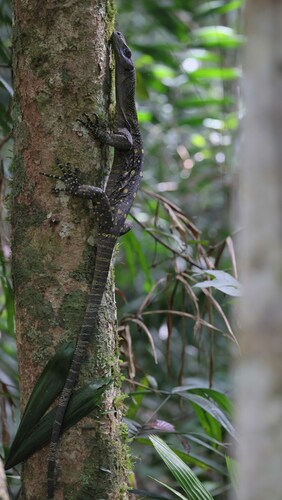
The crocodile monitor, also known as the Papuan monitor or Salvadori's monitor, is a species of monitor lizard endemic to New Guinea. It is the largest monitor lizard in New Guinea and is one of the longest lizards, verified at up to 255 cm (100 in). Its tail is exceptionally long, with some specimens having been claimed to exceed the length of the Komodo dragon, however less massive.
📌 Taxonomy
Varanus salvadorii was first described as Monitor salvadorii by Wilhelm Peters and Giacomo Doria in 1878 based on a female specimen with a snout-to-vent length of , and a long tail.
There are no formally recognized subspecies of V. salvadorii, but the captive reptile market distinguishes those from Sorong, Jayapura and Merauke based on the color of their snout and the overall brightness of their color pattern.
📌 Etymology
The generic name, Varanus, is derived from the Arabic waral (), meaning a large type of lizard. The term "monitor" is thought to have come about from confusion between waral and the German ', meaning "warning". The term "goanna" came about as a corruption of the name "iguana". The specific name, salvadorii, is derived from a Latinization of Tommaso Salvadori, an Italian ornithologist who worked in New Guinea.
📌 Evolution
The genus Varanus originated in Asia about 40 million years ago (Mya). Around 15 Mya, a tectonic connection between Australia and Southeast Asia allowed the varanids to spread into what is now the Indonesian archipelago.
Based upon DNA sequences of three nuclear and two mitochondrial genes, cladistic analysis identifies the crocodile monitor as a member of a species cluster that includes the lace monitor (V. varius) and the Komodo dragon (V. komodoensis). Morphological considerations suggest that the megalania (V. priscus) was also a member of the group. Monitors apparently colonized Australasia from Asia about 32 Mya; the varius clade then arose about 17 Mya.
📌 Distribution
The largest of the seven species of monitors found on the island of New Guinea, crocodile monitors occur in both the state Papua New Guinea and the Indonesian region of West Papua. It inhabits the high and low canopies of the lowland rainforests and coastal mangrove swamps, sometimes venturing out of these areas during floods in the rainy seasons. No detailed field investigation data are available for V. salvadorii, so the full extent of its range is unknown. Its remote and generally inaccessible habitat is an obstacle to detailed study of this monitor in its natural habitat.
📌 Biology and morphology
]]
A characteristic feature of the crocodile monitor is its blunt, bulbous snout, which makes it look different from every other monitor on New Guinea, and suggested the common name "tree crocodile". The tail is banded yellow and black and is extremely long.
Its teeth are long, straight, and sharp. Its claws are prominent and strongly curved. Males reach a considerably larger size than females in both weight and length, and also tend to have a more robust head.
📌 Respiration
in the background]]
Like many monitor species, the crocodile monitor has mammal-like aerobic abilities; a positive pressure gular pump in the animal's throat assists lung ventilation. The evolutionary development of the gular pump is functionally analogous to that of the diaphragm in mammals, which ventilates the lung independently of locomotion. Even amongst monitors, the crocodile monitor is one of the most agile species, quickly running up tree trunks and leaping from branch to branch.
📌 Size
The crocodile monitor's typical reported length is less than with a matching body mass of about . Such a weight is questionable for healthy individuals of this slender species, and a review of healthy captive adults found that a typical weight was up to . The average size of crocodile monitors caught in one study was with a weight of , but these must have been young specimens.
Crocodile monitors are unique among extant varanid species in that the tail is much longer than the snout-to-vent length in both juveniles and adults. The tail generally is 2–2.7 times the snout-to-vent length.
Crocodile monitors upon hatching measure about long and they reach maturity when about . Reports of the maximal length vary greatly and are the subject of much dispute. It possibly attains the greatest length among extant species of lizards, although it is considerably less massive than the Komodo dragon. Crocodile monitors have been confirmed to reach up to in length (record by a specimen at Museum Koenig). Some have been claimed to be much larger, including an individual from Konedobu that reportedly was long, one from Kikori that reportedly was and an individual from Port Moresby that reportedly was long, but these sizes are unverified.
📌 Behavior
]]
The crocodile monitor is a highly arboreal lizard. It can hang onto branches with its rear legs, and occasionally use its tail as a prehensile grip. The primary function of the tail, however, is as a counterbalance when leaping from branch to branch. This species occasionally is seen in the pet trade, but has a reputation for aggression and unpredictability. Although they are known to rest and bask in trees, they sleep on the ground or submerged in water. One fatality was reported from a bite in 1983 when a Papuan woman was bitten and later died from an infection.
📌 Reproduction
Reproduction of crocodile monitors has only been observed in captivity, so nothing is known about its reproduction in the wild. The egg clutches, comprising four to 12 eggs, are deposited around October to January, with the eggs showing a difference in dimensions, a phenomenon for which no explanation is known. Dimensions vary from , while weight varies from . Most clutches laid in captivity have been infertile, and only four successful breedings have been documented thus far. Hatchlings are about long and weigh around . Like those of many other monitors, hatchling crocodile monitors are more colourful than adults and feed primarily on insects and small reptiles.
📌 Conservation
Varanus salvadorii is currently protected under the CITES Appendix II, which requires an exportation permit for international trade. It is not listed as a threatened species on the IUCN Red List or on the Endangered Species Act. It faces threats from deforestation and poaching, as it is hunted and skinned by native peoples, who consider the monitor an evil spirit that "climbs trees, walks upright, breathes fire, and kills men", to make drums.