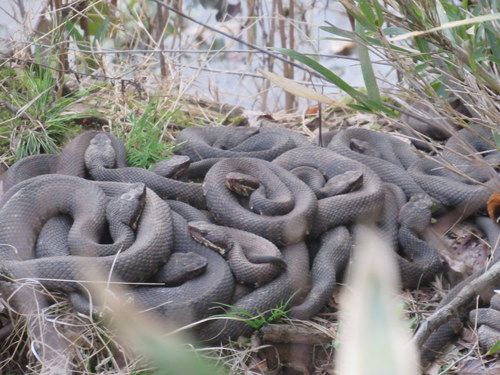
Agkistrodon piscivorus is a species of venomous snake, a pit viper in the subfamily Crotalinae of the family Viperidae. It is one of the world's few semiaquatic vipers, and is native to the Southeastern United States. As an adult, it is large and capable of delivering a painful and potentially fatal bite. When threatened, it may respond by coiling its body and displaying its fangs. Individuals may bite when feeling threatened or being handled in any way. It tends to be found in or near water, particularly in slow-moving and shallow lakes, streams, and marshes. It is a capable swimmer, and like several species of snakes, is known to occasionally enter bays and estuaries and swim between barrier islands and the mainland.
๐ Taxonomy and etymology
===Common names===
This is a list of common names for A. piscivorus, some of which also refer to other species:
*aquatic moccasin
*black moccasin
*black snake
*black water viper
*blunt-tail moccasin
*Congo
*copperhead
*cottonmouth
*cotton-mouthed snake
*cottonmouth rattler
*cottonmouth water moccasin
*gaper:[https://nas.er.usgs.gov/queries/factsheet.aspx?SpeciesID=1197 USGS]
*gapper
*highland moccasin
*lake moccasin
*lowland moccasin
*mangrove rattler
*moccasin
*moccasin snake
*North American cottonmouth snake
*North American water moccasin
*North American water viper
*pond moccasin
*pond rattler
*river moccasin
*river rattler
*rusty moccasin
*saltwater rattler
*short-tailed moccasin
*short-tail rattler
*small-tailed cottonmouth
*snap-jaw
*stub-tail
*stub-tail snake
*stump moccasin
*stump-tail moccasin
*stump-tail viper
*swamp lion
*swamp moccasin
*swamp rattler
*Texas moccasin
*trap jaw
*Troost's moccasin
*true horn snake
*true water moccasin
*viper
*water copperhead
*water mamba
*water moccasin
*water mokeson
*water pilot
*water pit rattler
*water pit viper
*water rattlesnake
*water viper
*white-mouth moccasin
*white-mouth rattler
*worm-tailed viper
๐ Subspecies and taxonomic history
For many decades, one species with three subspecies were formally recognized: eastern cottonmouth, A. p. piscivorus (Lacรฉpรจde, 1789); western cottonmouth, A. p. leucostoma (Troost, 1836); and Florida cottonmouth, A. p. conanti Gloyd, 1969. However, a molecular (DNA) based study was published in 2014, applying phylogenetic theories (one implication being no subspecies are recognized), changing the long-standing taxonomy. The resulting and current taxonomic arrangement recognizes two species and no subspecies. The western cottonmouth (A. p. leucostoma) was synonymized with the eastern cottonmouth (A. p. piscivorus) into one species (with the oldest published name, A. p. piscivorus, having priority). The Florida cottonmouth (A. p. conanti) is now recognized as a separate species.
* Agkistrodon piscivorus (Lacรฉpรฉde, 1789),
* Agkistrodon conanti Gloyd, 1969, Florida cottonmouth (south Georgia and Florida peninsula)
{| class="wikitable"
! Previous taxonomy
! Current taxonomy (as of 2014)
! Geographic range
|-
|Eastern cottonmouth
Agkistrodon piscivorus piscivorus (Lacรฉpรจde, 1789)
|Northern cottonmouth
Agkistrodon piscivorus (Lacรฉpรจde, 1789)
|The United States in Delmarva Peninsula, the Atlantic Coastal Plain and lower Piedmont of North and South Carolina, to eastern Georgia including outer banks and offshore islands.
|-
|Western cottonmouth
Agkistrodon piscivorus leucostoma (Troost, 1836)
|Northern cottonmouth
Agkistrodon piscivorus (Lacรฉpรจde, 1789)
|The United States, most of Alabama along coast of the Gulf of Mexico, including many offshore islands, to central Texas, and north to Oklahoma, Missouri, Illinois, and Indiana
|-
|Florida cottonmouth
Agkistrodon piscivorus conanti Gloyd, 1969
|Florida cottonmouth
Agkistrodon conanti Gloyd, 1969
|style="width:40%"|The United States, in southern Georgia and Florida peninsular, including many offshore islands
|}
๐ Anatomy and description
Agkistrodon piscivorus is the largest species of the genus Agkistrodon. Adults commonly exceed in total length (including tail); females are typically smaller than males. Total length, per one study of adults, was . Average body mass has been found to be in males and in females. Occasionally, individuals may exceed in total length, especially in the eastern part of the range, with a record specimen of 189.2 cm (74.5 in).
Although larger ones have purportedly been seen in the wild, according to Gloyd and Conant (1990), the largest recorded specimen of A. p. piscivorus was in total length, based on a specimen caught in the Dismal Swamp region and given to the Philadelphia Zoological Garden. This snake had apparently been injured during capture, died several days later, and was measured when straight and relaxed.
Many would assume that the morphology of an aquatic snake should have a small, narrow head that tapers towards the back to minimize drag in the water, especially when capturing prey. However, the pit vipers, and particularly cottonmouths, display a contradicting structure, with its bulky, triangular head, which would be assumed to be poorly suited to water, yet it is not the case.
The broad head is distinct from the neck, and the snout is blunt in profile with the rim of the top of the head extending forwards slightly further than the mouth. Substantial cranial plates are present, although the parietal plates are often fragmented, especially towards the rear. A loreal scale is absent. Six to 9 supralabials and eight to 12 infralabials are seen. At midbody, it has 23โ27 rows of dorsal scales.
Juvenile and subadult specimens generally have a more contrasting color pattern, with dark crossbands on a lighter ground color. The ground color is then tan, brown, or reddish-brown. The tip of the tail is usually yellowish, becoming greenish-yellow or greenish in subadults, and then black in adults. On some juveniles, the banding pattern can also be seen on the tail.
This species is often confused with the copperhead, A. contortrix. This is especially true for juveniles, but differences exist. A. piscivorus has broad, dark stripes on the sides of its head that extend back from the eyes, whereas A. contortrix has only a thin, dark line that divides the pale supralabials from the somewhat darker color of the head. The watersnakes of the genus Nerodia are also similar in appearance, being thick-bodied with large heads, but they have round pupils, no loreal pit, a single anal plate, subcaudal scales that are divided throughout, and a distinctive overall color pattern.
๐ Venom
Agkistrodon piscivorus venom is more toxic than that of A. contortrix, and is rich with powerful cytotoxic venom that destroys tissue. Although deaths are rare, the bite can leave scars, and on occasion, require amputation. Absent an anaphylactic reaction in a bitten individual, however, the venom does not cause systemic reactions in victims and does not contain neurotoxic components present in numerous rattlesnake species. Bites can be effectively treated with CroFab antivenom; this serum is derived using venom components from four species of American pit vipers (the eastern and western diamondback rattlesnakes, the Mojave rattlesnake, and the cottonmouth).
Bites from the cottonmouth are relatively frequent in the lower Mississippi River Valley and along the coast of the Gulf of Mexico, although fatalities are rare. Additionally, larger snakes are more likely to strike than smaller snakes.
Brown (1973) gave an average venom yield (dried) of 125 mg, with a range of 80โ237 mg, along with values of 4.0, 2.2, 2.7, 3.5, 2.0 mg/kg IV, 4.8, 5.1, 4.0, 5.5, 3.8, 6.8 mg/kg IP and 25.8 mg/kg SC for toxicity.
Symptoms commonly include ecchymosis and swelling. The pain is generally more severe than bites from the copperhead, but less so than those from rattlesnakes (Crotalus spp.). The formation of vesicles and bullae is less common than with rattlesnake bites, although necrosis can occur. Myokymia is sometimes reported. However, the venom has strong proteolytic activity that can lead to severe tissue destruction.
๐ Geographic range
]]
A. piscivorus is found in the eastern US from the Great Dismal Swamp in southeast Virginia, south through the Florida peninsula and west to Arkansas, eastern and southern Oklahoma, and western and southern Georgia (excluding Lake Lanier and Lake Allatoona). A few records exist of the species being found along the Rio Grande in Texas, but these are thought to represent disjunct populations, now possibly eradicated. The type locality given is "Carolina", although Schmidt (1953) proposed this be restricted to the area around Charleston, South Carolina. Snakes observed in the northern areas of this range are typically larger older individuals.
Campbell and Lamar (2004) mentioned this species as being found in Alabama, Arkansas, Florida, Georgia, Illinois, Indiana, Kentucky, Louisiana, Mississippi, Missouri, North Carolina, Oklahoma, South Carolina, Tennessee, Texas, and Virginia. Maps provided by Campbell and Lamar (2004) and Wright and Wright (1957) also indicate its presence in Western and Middle Tennessee and extreme southeastern Kansas, and limit it to the western part of Kentucky.
In Georgia, it is found in the southern half of the state up to a few kilometers north of the Fall Line with few exceptions. Its range also includes the Ohio River Valley as far north as southern Indiana, and it inhabits many barrier islands off the coasts of the states where it is found.
๐ Behavior and ecology
, the white mouth giving it the nickname "cottonmouth".]]
watersnakes such as the common watersnake, although there is substantial similarity.]]
(Nerodia sipedon) swimming a nonvenomous species, is often mistaken for the cottonmouth.]]
In the United States, especially in the south, A. piscivorus are often falsely characterized as aggressive. In tests designed to measure the various behavioral responses by wild specimens to encounters with people, 23 of 45 (51%) tried to escape, while 28 of 36 (78%) resorted to threat displays and other defensive tactics. Only when they were picked up with a mechanical hand were they likely to bite. 36% of those picked up attempted to bite. Furthermore, less than 20% attempted to bite when stepped on. None of the snakes attempted to bite when researchers stood next to them. Many of its common names, including "cottonmouth" and "gaper", refer to this behavior, while its habit of snapping its jaws shut when anything touches its mouth has earned it the name "trap jaw" in some areas. Other defensive responses can include flattening the body A. piscivorus usually holds its head at an angle around 45ยฐ when swimming or crawling.
This species may be active during the day and at night, but on bright, sunny days, they are usually found coiled or stretched out in the shade. In the morning and on cool days, they can often be seen basking in the sunlight. They often emerge at sunset to warm themselves on warm ground (i.e., sidewalks, roads) and then become very active throughout the night, when they are usually found swimming or crawling.
In the north, they hibernate during the winter. Niell (1947, 1948) made observations in Georgia, and noted they were one of the last species to seek shelter, often being found active until the first heavy frosts. At this point, they moved to higher ground and could be found in rotting pine stumps by tearing away the bark. These snakes could be quite active upon discovery and would then attempt to burrow more deeply into the soft wood or escape to the nearest water. In southeastern Virginia, Wood (1954) reported seeing migratory behavior in late October and early November. During a period of three or four days, as many as 50 individuals could be seen swimming across Back Bay from the bayside swamps of the barrier islands to the mainland. He suggested this might have something to do with hibernating habits. In the southern parts of its range, hibernation may be short or omitted altogether.
๐ Hunting and diet
Raymond Ditmars (1912) described A. piscivorus as carnivorous. Its diet includes mammals, birds, amphibians, fish, eggs, insects, other snakes, small turtles, and juvenile alligators. Cannibalism has also been reported. Normally, though, the bulk of its diet consists of fish and frogs. On occasion, juvenile specimens feed on invertebrates. Fish are captured by cornering them in shallow water, usually against the bank or under logs. They take advantage when bodies of water begin to dry up in the summer or early fall and gorge themselves on the resulting high concentrations of fish and tadpoles. They are surprisingly unsuccessful at seizing either live or dead fish under water.
Conant (1929) gave a detailed account of the feeding behavior of a captive specimen from South Carolina. When prey was introduced, the snake quickly became attentive and made an attack. Frogs and small birds were seized and held until movement stopped. Larger prey was approached in a more cautious manner; a rapid strike was executed after which the snake would withdraw. In 2.5 years, the snake had accepted three species of frogs, including a large bullfrog, a spotted salamander, water snakes, garter snakes, sparrows, young rats, and three species of mice.
There have been several studies focusing on the types of prey that cottonmouths consume, and analyzing the differences between juveniles, adult males, and adult females. It has been found that adult males and females target different prey types and sizes. Observations and stomach analyses show that adult males consume fish, whereas adult females mainly consume other squamates, in particularly snakes. In this same research, it was concluded that the prey size increased with the size of the snake for both juvenile and adults, both male and female.
Young individuals have yellowish or greenish tail tips and engage in caudal luring. The tail tip is wriggled to lure prey, such as frogs and lizards, within striking distance. Wharton (1960) observed captive specimens exhibiting this behavior between 07:20 and 19:40 hours, which suggests it is a daytime activity. Burmese pythons are an invasive species in Florida with the capacity to inflict great damage to the local ecosystem, so it is hoped that A. piscivorus may be in the process of modifying its diet to enable it to hunt the pythons.
๐ Natural predators
Agkistrodon piscivorus is preyed upon by snapping turtles (Chelydra serpentina), falcons, American alligators (Alligator mississippiensis), horned owls (Bubo virginianus), eagles, red-shouldered hawks (Buteo lineatus), loggerhead shrikes (Lanius ludovicianus), and large wading birds, such as herons, cranes, and egrets.
It is also preyed upon by ophiophagous snakes, including their own species. Humphreys (1881) described how a specimen was killed and eaten by a captive kingsnake. On the other hand, Neill (1947) reported captive kingsnakes (Lampropeltis getula) were loath to attack them, being successfully repelled with "body blows". Also called body-bridging, this is a specific defensive behavior against ophiophagous snakes, first observed in certain rattlesnake (Crotalus) species by Klauber (1927), that involves raising a section of the middle of the body above the ground to varying heights. This raised loop may then be held in this position for varying amounts of time, shifted in position, or moved towards the attacker. In the latter case, it is often flipped or thrown vigorously in the direction of the assailant. In A. piscivorus, the loop is raised laterally, with the belly facing towards the attacker.
๐ Reproduction
Agkistrodon piscivorus is ovoviviparous, with females usually giving birth to one to sixteen live young and possibly as many as 20. Litters of six to eight are the most common. Neonates are in length (excluding runts), with the largest belonging to A. p. conanti and A. p. leucostoma the smallest. If weather conditions are favorable and food is readily available, growth is rapid and females may reproduce at less than three years of age and a total length of as little as . They will also only reproduce every other year, unless optimal conditions are met for them to go through the reproduction process. Cottonmouths breed seasonally, and they are believed to be monogamous. The young are born in August or September, while mating may occur during any of the warmer months of the year, at least in certain parts of its range.
๐ Facultative parthenogenesis
Parthenogenesis is a natural form of reproduction in which growth and development of embryos occur without fertilization. A. piscivorus can reproduce by facultative parthenogenesis, that is, they are capable of switching from a sexual mode of reproduction to an asexual mode. This likely involves recombination at the tips of the chromosomes, which leads to genome wide homozygosity. The result is the expression of deleterious recessive alleles and often to developmental failure (inbreeding depression). Both captive-born and wild-born A. piscivorus specimens appear to be capable of this form of parthenogenesis.
๐ Conservation status
The species A. piscivorus is classified as least concern on the IUCN Red List (v3.1, 2007).
Constant persecution of the species and drainage of wetland habitat prior to development has taken a heavy toll on local populations. Despite this, it remains a common species in many areas. One reason cottonmouths are hunted is for their skin, which is often used as a form of leather.
In Indiana, the cottonmouth is listed as an endangered species.