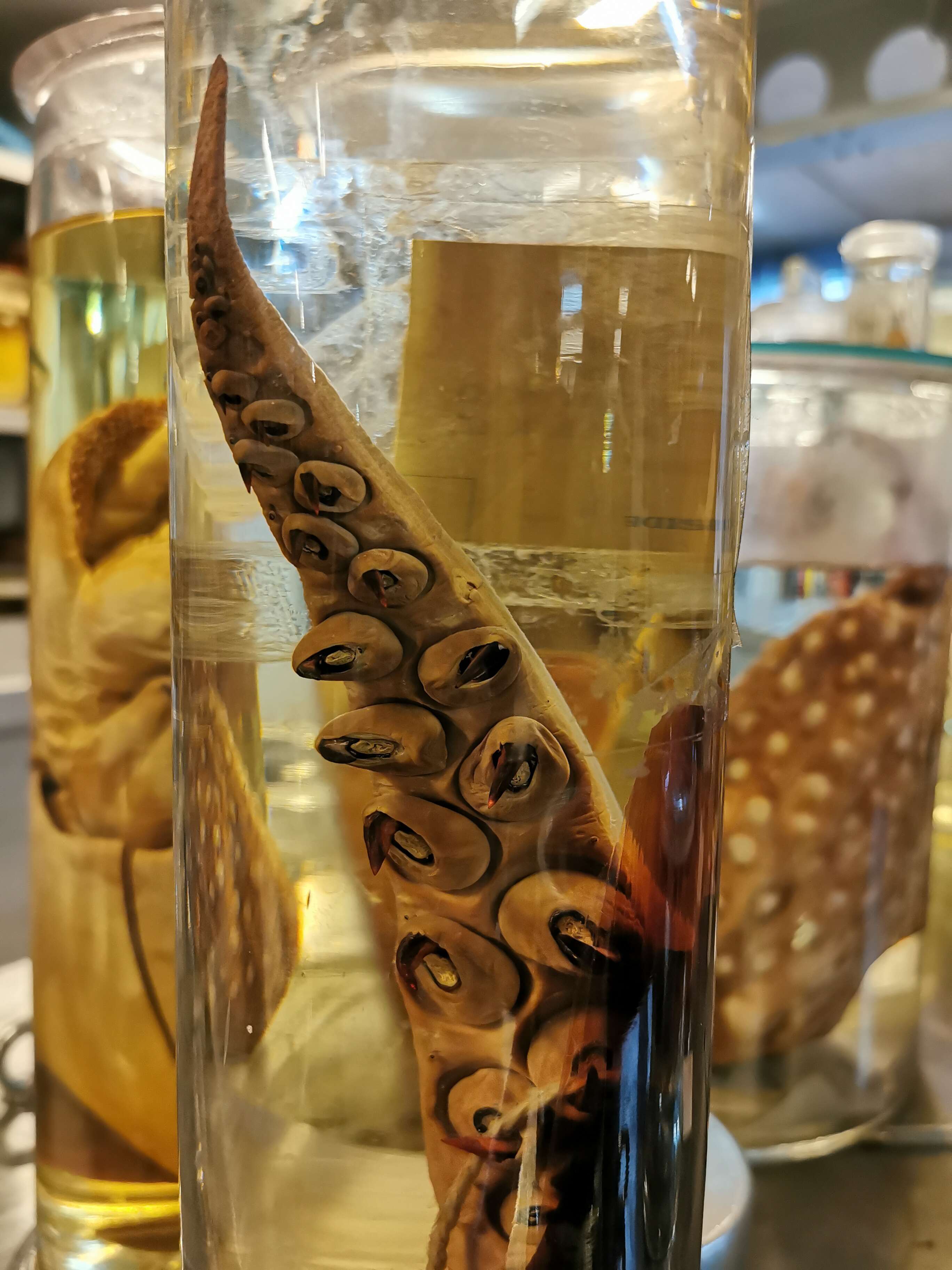
The colossal squid (Mesonychoteuthis hamiltoni) is a species of very large squid belonging to the family Cranchiidae, that of the cockatoo squids, or glass squids. It is sometimes called the Antarctic cranch squid or giant squid and is believed to be the largest squid species in terms of mass. It is the only recognized member of the genus Mesonychoteuthis.
📌 Morphology
The colossal squid shares features common to all squids: a mantle for locomotion, one pair of gills, a beak or tooth, and certain external characteristics like eight arms and two tentacles, a head, and two fins. In general, the morphology and anatomy of the colossal squid are the same as any other squid. There are squids in other families that also have hooks, but no other squid in the family Cranchiidae.
📌 Distribution and habitat
The squid's known range extends thousands of kilometres north of Antarctica to southern South America, southern South Africa, and the southern tip of New Zealand, making it primarily an inhabitant of the circumantarctic Southern Ocean. Colossal squid are also often sighted near Cooperation Sea and Ross Sea because of its prey and competitor, the Antarctic toothfish. The squid's vertical distribution appears to correlate directly with age. Young squid are found between , adolescent squid are found and adult squid are found primarily within the mesopelagic (approximately 200 to 1,000 meters below the surface) and bathypelagic regions (1,000 to 4,000 m below the surface) of the open ocean.
📌 Behavior
=== Feeding ===
While little is known about their behavior, colossal squid are thought to feed primarily on small fish, such as lanternfish and deep-sea smelt, which have been found as stomach contents in adult specimens. They also attack larger fish; of 8,000 Antarctic toothfish brought aboard by trawlers between 2011 and 2014, seventy-one showed clear signs of attack by colossal squid. A study in the Prydz Bay region of Antarctica found squid remains in a female colossal squid's stomach, suggesting the possibility of cannibalism within this species. Studies measuring the δ15N content of the chitinous beaks of cephalopods to determine trophic ecology levels have demonstrated that the colossal squid is a top predator that is positively correlated with its increased size. This new confirmation of the colossal squid's trophic level suggests that it likely preys on large fishes, such as the Patagonian toothfish, and smaller squids, according to its size, and that its predators include sperm whales and sleeper sharks.
📌 Metabolism
The colossal squid is thought to have a very slow metabolic rate, needing only around of prey daily for an adult with a mass of . Estimates of its energy requirements suggest it is a slow-moving ambush predator, using its large eyes primarily for prey-detection rather than engaging in active hunting.
📌 Predation
Many sperm whales have scars on their backs that are believed to be caused by the hooks of colossal squid. Colossal squid are a major prey item for sperm whales in the Antarctic; 14% of the squid beaks found in the stomachs of these sperm whales are those of the colossal squid, which indicates that colossal squid likely make up 77% of the biomass consumed by these whales. Many other animals also feed on colossal squid, including the beaked whales, such as southern bottlenose whales and Cuvier's and Baird's beaked whales. Other possible predators include the pilot whale, killer whales, larger southern elephant seals, Patagonian toothfish, southern sleeper sharks (Somniosus antarcticus), Antarctic toothfish, and albatrosses (e.g., the wandering and sooty albatrosses).
📌 Reproduction
Not much is known about the colossal squid's reproductive cycle, although it does have two distinct sexes. Many species of squid, however, develop sex-specific organs as they age and develop. The adult female colossal squid has been discovered in much shallower waters, likely implying that females spawn in shallower waters rather than at their usual depth. Additionally, the colossal squid has a high possible fecundity reaching over 4.2 million oocytes, which is quite high compared to other squids in such cold waters. Colossal squid oocytes have been observed at sizes ranging from as large as to as small as . Sampling of colossal squid ovaries show an average of 2,175 eggs per gram. Young squid are thought to spawn near the summer time at surface temperatures from .
📌 Vision
For pelagic organisms of similar weight to the colossal squid, such as the swordfish, the average eye diameter required for visual detection is 10 cm, but the colossal squid's are as large as . This allows for an increase in visual detection strategies, including reduced diffraction blurring and greater contrast distinction, which must be extremely beneficial to the colossal squid to justify the large energetic expenses to grow, move, camouflage, and maintain these eyes. Symbiotic bacteria reside within these photophores and luminesce through chemical reaction.
It is hypothesized that the colossal squid's eyes can detect predator movement beyond , which is the upper limit of the sperm whale's sonar range.
📌 Hearing
Squid have been found to detect the movement of sound waves via organs called statocysts (similar to the human cochlea). Squid statocysts likely respond to low-frequency sounds less than 500 Hz, similar to pelagic fish.
📌 History of discovery
The colossal squid, species Mesonychoteuthis hamiltoni, was discovered in 1925.
In 1981, an adult specimen was discovered; in 2003, a second specimen was collected.
Most of the time, full colossal squid specimens are not collected; as of 2015, only 12 complete colossal squids had ever been recorded, with only half of these being full adults. Beak remnants of the colossal squid are commonly collected; 55 beaks of colossal squids have been recorded in total. Less commonly (four times), a fin, mantle, arm, or tentacle of a colossal squid has been collected.
📌 First collected specimens
The species was first discovered in the form of two arm crowns found in the stomach of a sperm whale in the winter of 1924–1925. This species, named Mesonychoteuthis hamiltoni after E. Hamilton who made the initial discovery, was formally described by Guy Coburn Robson in 1925.
📌 Entire collected specimens
In 1981, a Soviet trawler in the Ross Sea, off the coast of Antarctica, caught a large squid with a total length of over , which was later identified as an immature female of M. hamiltoni. In 2003, a complete specimen of a subadult female was found near the surface with a total length of and a mantle length of 2.5 m (8 feet 3 inches). In 2005, the first full living specimen was captured at a depth of while taking a toothfish from a longline off South Georgia Island. Although the mantle was not brought aboard, its length was estimated at over 2.5 m (8 feet 3 inches), and the tentacles measured . The animal is thought to have weighed between .
📌 Largest known specimen
characteristically inflated.]]
The largest recorded specimen was a female, which are thought to be larger than males, captured in February 2007 by a New Zealand fishing boat in the Ross Sea off Antarctica. The specimen was initially estimated to measure about 10 metres in total length and weigh about 450 kg.
📌 Defrosting and dissection, April–May 2008
Thawing and dissection of the specimen took place at the Museum of New Zealand Te Papa Tongarewa. Media reports suggested scientists at the museum were considering using a giant microwave to defrost the squid because thawing it at room temperature would take several days and it would likely begin to decompose on the outside while the core remained frozen. However, they later opted for the more conventional approach of thawing the specimen in a bath of salt water. After thawing, it was found that the specimen was 495 kg with a mantle length of 2.5 m and a total length of only 4.2 m, probably because the tentacles shrank once the squid was dead.
Parts of the specimen have been examined:
*The beak is considerably smaller than some found in the stomachs of sperm whales, suggesting that some other colossal squid are much larger than this one.
*Inspection of the specimen with an endoscope revealed ovaries containing thousands of eggs.
📌 Exhibition
The Museum of New Zealand Te Papa Tongarewa began displaying this specimen from 13 December 2008. The exhibition was closed between 2018 and 2019, but it was reopened for public viewing at Te Papa.
📌 Filming in natural habitat
In 2022–23 there were several attempts made by scientists, including an ocean exploration non-profit called KOLOSSAL, to find and film the colossal squid in its natural habitat for the first time to learn more about its biology and ecological behavior. The science team used a tourism vessel to survey 36 locations throughout the Southern Ocean and may have filmed a small juvenile colossal squid for the first time. Researchers have confirmed that that video is of a species of glass squid, but due to marine snow, the footage has been harder to confirm without a DNA analysis, and may instead represent Galiteuthis glacialis or a new species of glass squid unknown to science.
On 9 March 2025, for the first time, a confirmed colossal squid was filmed in its natural environment during an expedition near the South Sandwich Islands in the South Atlantic Ocean. The squid, a juvenile measuring around long, was captured on video at a depth of by the Schmidt Ocean Institute's remotely operated vehicle (ROV) SuBastian.
📌 Conservation status
The colossal squid has been assessed as a species of "least concern" on the IUCN Red List. Additionally, due to their habitat, interactions between humans and colossal squid are considered rare.