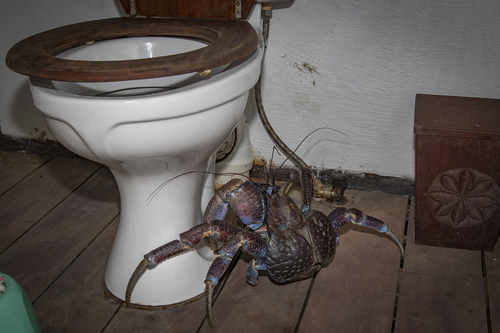
The coconut crab is a terrestrial species of giant hermit crab, and is also known as the robber crab or palm thief. It is the largest terrestrial arthropod known, with a weight up to 4.1Β kg (9Β lb). The distance from the tip of one leg to the tip of another can be as wide as 1Β m. It is found on islands across the Indian and Pacific Oceans, as far east as the Gambier Islands, Pitcairn Islands, and Caroline Island, and as far west as Zanzibar. While its range broadly shadows the distribution of the coconut palm, the coconut crab has been extirpated from most areas with a significant human population such as mainland Australia and Madagascar.
π‘οΈ Conservation Status
vulnerable
vu
π Taxonomy
The coconut crab has been known to western scientists since the voyages of Francis Drake around 1580 and William Dampier around 1688. Based on an account by Georg Eberhard Rumphius (1705), who had called the animal "'", Carl Linnaeus (1767) named the species Cancer latro,
π Respiration
Except as larvae, coconut crabs cannot swim, and they drown if left in water for more than an hour. They use a special organ called a branchiostegal lung to breathe. This organ can be interpreted as a developmental stage between gills and lungs, and is one of the most significant adaptations of the coconut crab to its habitat. The branchiostegal lung contains a tissue similar to that found in gills, but suited to the absorption of oxygen from air, rather than water. This organ is expanded laterally and is evaginated to increase the surface area; located in the cephalothorax, it is optimally placed to reduce both the blood/gas diffusion distance and the return distance of oxygenated blood to the pericardium.
Coconut crabs use their hindmost, smallest pair of legs to clean these breathing organs and to moisten them with water. The organs require water to properly function, and the coconut crab provides this by stroking its wet legs over the spongy tissues nearby. Coconut crabs may drink water from small puddles by transferring it from their chelipeds to their maxillipeds.
In addition to the branchiostegal lung, the coconut crab has an additional rudimentary set of gills. Although these gills are comparable in number to aquatic species from the families Paguridae and Diogenidae, they are reduced in size and have comparatively less surface area.
π Sense of smell
The coconut crab has a well-developed sense of smell, which it uses to locate its food. The process of smelling works very differently depending on whether the smelled molecules are hydrophilic molecules in water or hydrophobic molecules in air. Crabs that live in water have specialized organs called aesthetascs on their antennae to determine both the intensity and the direction of a scent. Coconut crabs live on the land, so the aesthetascs on their antennae are shorter and blunter than those of other crabs and are more similar to those of insects.
While insects and the coconut crab originate from different clades, the same need to track smells in the air led to convergent evolution of similar organs. Coconut crabs flick their antennae as insects do to enhance their reception. Their sense of smell can detect interesting odors over large distances. The smells of rotting meat, bananas, and coconuts, all potential food sources, especially catch their attention. The olfactory system in the coconut crab's brain is well-developed compared to other areas of the brain.
π Life cycle
Coconut crabs mate frequently and quickly on dry land in the period from May to September, especially between early June and late August.
The extrusion of eggs occurs on land in crevices or burrows near the shore. The egg-laying usually takes place on rocky shores at dusk, especially when this coincides with high tide. The empty egg cases remain on the female's body after the larvae have been released, and the female eats them within a few days.
The larvae float in the pelagic zone of the ocean with other plankton for 3β4 weeks,
π Distribution
Coconut crabs live in the Indian and the central Pacific Ocean, with a distribution that closely matches that of the coconut palm. The western limit of the range of B. latro is Zanzibar, off the coast of Tanzania, while the tropics of Cancer and Capricorn mark the northern and southern limits, respectively, with very few populations in the subtropics, such as the Ryukyu Islands.
Christmas Island in the Indian Ocean has the largest and densest population of coconut crabs in the world, although it is outnumbered there by more than 50 times by the Christmas Island red crab (Gecarcoidea natalis). Other Indian Ocean populations exist on the Seychelles, including Aldabra and Cosmoledo, but the coconut crab is extinct on the central islands. They occur on several of the Andaman and Nicobar Islands in the Bay of Bengal. They occur on most of the islands, and the northern atolls, of the Chagos Archipelago.
In the Pacific, the coconut crab's range became known gradually. Charles Darwin believed it was only found on "a single coral island north of the Society group". The coconut crab is far more widespread, though it is not abundant on every Pacific island it inhabits. Large populations exist on the Cook Islands, especially Pukapuka, Suwarrow, Mangaia, Takutea, Mauke, Atiu, and Palmerston Island. These are close to the eastern limit of its range, as are the Line Islands of Kiribati, where the coconut crab is especially frequent on Teraina (Washington Island), with its abundant coconut palm forest. The Gambier Islands mark the species' eastern limit.
π Ecology
===Diet===
]]
The diet of coconut crabs consists primarily of fleshy fruits (particularly Ochrosia ackeringae, Arenga listeri, Pandanus elatus, P. christmatensis); nuts (Aleurites moluccanus), drupes (Cocos nucifera) and seeds (Annona reticulata); They have been observed to prey upon crabs such as Gecarcoidea natalis and Discoplax hirtipes, and scavenge on the carcasses of other coconut crabs. They often descend from the trees by falling, and can survive a fall of at least unhurt.
Thomas Hale Streets discussed the behaviour in 1877, doubting that the animal would climb trees to get at the coconuts. In the 1980s, Holger Rumpf was able to confirm Streets' report, observing and studying how they open coconuts in the wild.
π Relationship with humans
Adult coconut crabs have no known predators apart from other coconut crabs and humans. Their large size and the quality of their meat means that they are extensively hunted and are very rare on islands with a human population. The coconut crab is eaten as a delicacy β and regarded as an aphrodisiac β on various islands, and intensive hunting has threatened the species' survival in some areas. On the Nicobarian Kamorta Island, eating the crab is believed to lead to bad luck and to cause severe, sometimes fatal, illnesses. In cases where locals fall ill after consuming the crab, their families create a wooden image of the creature. This effigy is then taken to the crab's capture site, where specific rituals are performed.
While the coconut crab itself is not innately poisonous, it may become so depending on its diet, and cases of coconut crab poisoning have occurred. However, as no evidence of Earhart's plane has been found on or near Nikumaroro, this theory is generally discredited by historians.
π Conservation
Coconut crab populations in several areas have declined or become locally extinct due to both habitat loss and human predation. In 1981, it was listed on the IUCN Red List as a vulnerable species, but a lack of biological data caused its assessment to be amended to data deficient in 1996.
In the Philippines, the coconut crab (locally known by various names such as tatus, umang kagang, kasaso, kuray, or manla), has been declared as locally threatened by the 2001 Fisheries Administrative Order No. 208 of the Bureau of Fisheries and Aquatic Resources. It is illegal to catch, sell, purchase, transport, or possess coconut crabs, with violators being punishable by a fine of β±120,000 and imprisonment for up to six years. Despite this, the open capture and consumption of coconut crabs for the tourist trade (particularly in the Batanes Islands) continues due to lax enforcement of the law and conflicts with other laws that supersede it, like the Indigenous Peoples' Rights Act of 1997. Populations across the islands have been declining rapidly due to overharvesting and habitat destruction.