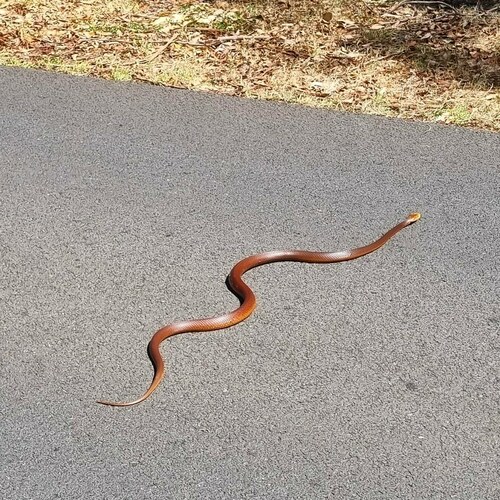
The coastal taipan, or common taipan, is a species of extremely venomous snake in the family Elapidae. Described by Wilhelm Peters in 1867, the species is native to the coastal regions of northern and eastern Australia and the island of New Guinea. The second-longest venomous snake in Australia, the coastal taipan averages around 2.0 m (6.6 ft) long, with the longest specimens reaching 2.9 m (9.5 ft) in length. It has light olive or reddish-brown upperparts, with paler underparts. The snake is considered to be a least-concern species according to the International Union for Conservation of Nature.
📌 Taxonomy
German naturalist Wilhelm Peters described the coastal taipan as Pseudechis scutellatus in 1867, from material collected in Rockhampton, Queensland. In 1922, scientific bird collector William McLennan killed two snakes near Coen in far north Queensland. Impressed by their size—up to 2.76 m, he sent the skins and skulls to the Australian Museum in Sydney. Australian naturalist Roy Kinghorn established the genus Oxyuranus in 1923, describing a specimen from Coen as O. maclennani after its collector. He noted the distinctness of the palatine bone necessitated the new genus as distinct from all other elapid snakes. In 1930, Kinghorn announced it as the second largest venomous snake in the world, with 3/4 inch fangs. In 1933, Australian zoologist Donald Thomson concluded that Pseudechis scutellatus and Oxyuranus maclennani were the same species; this meant that Peters' specific epithet had priority, as did Kinghorn's genus as the species was highly distinct. Hence, the coastal taipan became Oxyuranus scutellatus. Thomson had spent some years in Cape York peninsula with the indigenous people, who told tales of a giant snake they greatly feared. It is found throughout the southern portion of the island of New Guinea.
Raymond Hoser described Oxyuranus scutellatus barringeri from a specimen collected from the Mitchell Plateau, however Wüster declared this a nomen nudum as the author did not explain how it was distinct.
Kinghorn gave it the name "giant brown snake" in 1930, before Thomson introduced the term taipan in 1933. It is commonly called the coastal taipan, common taipan, or simply taipan. The New Guinea subspecies is known as the Papuan taipan. Local names in New Guinea include dirioro by the people of Parama village near the Fly River, and gobari near the Vailala River.
📌 Scalation
The number and arrangement of scales on a snake's body are key elements of identification to species level. The temporals are 2+3 (3+4). The dorsal scales are in 21–23 rows at mid-body. The ventrals number 220–250. The anal plate is single (undivided). The subcaudals number 45–80 and are divided. The scalation helps distinguish it from the king brown snake, which has a divided anal plate and 17 dorsal scales.
📌 Distribution and habitat
Considered to be a least-concern species according to the International Union for Conservation of Nature, The second subspecies (O. s. canni ) is found throughout the island of New Guinea, with higher concentrations of the snake being found in the nation of Papua New Guinea.
The coastal taipan can be found in a variety of different habitats, in warm, wetter, temperate to tropical coastal regions, monsoon forests, wet and dry sclerophyll forests and woodlands, and natural and artificial grassy areas, including grazing paddocks and disused rubbish tips.
📌 Behaviour
The coastal taipan is primarily diurnal, being mostly active in the early to midmorning period, although it may become nocturnal in hot weather conditions.
The consensus of snake handlers is that the coastal taipan tends to avoid confrontation, but becomes highly defensive if provoked.
📌 Reproduction and lifespan
Breeding season takes place between August and December. The coastal taipan is oviparous, laying a clutch of 7 to 20 eggs. The eggs take 60 to 80 days to hatch, with the newly hatched snakes ranging from in length. The young grow quickly, averaging a month, and reaching a length of in a year. Male coastal taipans reach sexual maturity when they reach 80 cm in length, which they reach around 16 months of age, while females are able to breed when they are around 100 cm long, around 28 months old.
📌 Venom
Generally feared more than any other Australian snake, It is classified as a snake of medical importance by the World Health Organization. value of this species is 0.106 mg/kg, according to the Australian Venom and Toxin database, or 0.12 mg/kg, according to Engelmann and Obst (1981). The estimated lethal dose for humans is 3 mg. Its venom contains primarily taicatoxin, a highly potent neurotoxin, along with taipoxin, which has an of 2 μg/kg. 124 μg of the latter can kill a healthy 62 kg adult.
📌 Treatment
Early administration (within 2–6 hours of bite) of antivenom and intubation for respiratory paralysis are keystones of management, but a chance of a hypersensivity reaction exists following antivenom administration. Neurotoxic symptoms may be irreversible once established due to the presynaptic nature of their pathology.
📌 Captivity
David Fleay began breeding coastal taipans in 1958, work by Charles Tanner (1911–1996) and him in keeping them in captivity facilitated the production of antivenom.