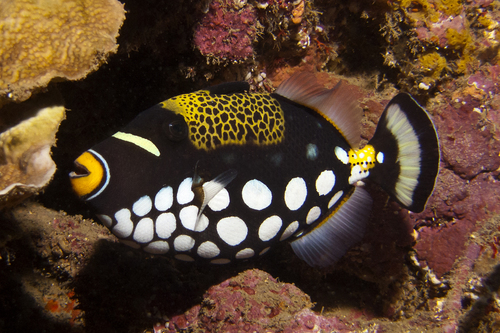
The clown triggerfish, also known as the bigspotted triggerfish, is a demersal marine fish.
๐ Taxonomy
Although it is in the genus Balistoides alongside the titan triggerfish (Balistoides viridescens), the genus is not monophyletic and requires revision. As a result, the clown and titan triggerfish are not each other's closest relatives. The clown triggerfish is possibly most closely related to species of the genus Melichthys and the orange-lined triggerfish (Balistapus undulatus).
๐ Distribution and habitat
The clown triggerfish is widely distributed throughout the tropical and subtropical waters of the Indian Ocean and in the western Pacific Ocean.
๐ Biology
]]
Although the clown triggerfish is widely distributed, it occurs in low numbers in the wild. However, this fish can be locally abundant in areas with high biodiversity. These fish create harems after reaching one year of age. Though they are able to live up to 20 years, they reach sexual maturity at about one year.
The female lays her eggs while the male fertilizes them in sandy patches. From here, the parents will defend the nest, for about eight days, until the eggs hatch. Which is when the female starts to care for them. Typically, clown triggerfish spawn in deep water, which is where the young stay until they grow close to 20 cm.
๐ Feeding
Balistoides conspicillum has a varied diet based on different benthic organisms like molluscs, echinoderms and crustaceans. They have also been recorded feeding on crinoids.
๐ Behaviour
This triggerfish has a diurnal activity, is solitary and defends a territory. It can be hard to find this fish in its habitat. It can be very aggressive with other fish and congeners.The clown triggerfish can be sociable the younger it is, however as it gets older, the less sociable and more aggressive it becomes.
The first long dorsal spine is erected to impress an opponent or deter a predator, preventing it from being pulled out of its shelter.
When the clown triggerfish is in danger it hides in holes. It is capable of locking the spine on their dorsal fin in place, while also locking their smaller dorsal and ventral fin in place. This makes it harder for the fish to be pulled out of their hiding hole.
๐ In aquariums
]]
]]
Because of its attractive coloration, this fish is one of the most highly prized aquarium fish.
The juvenile clown triggerfish are sought out after more than adults since juveniles are less aggressive towards other fish. They have been known to take out chunks of flesh while being hand-fed.
Decor in their tanks must be tough, as clown triggerfish will attack them.
There is high demand of the clown triggerfish in aquariums, and all captive specimens are caught in the wild. This can lead to local populations being impacted.
The clown triggerfish, or any triggerfish should not be one of the first fish added to an aquarium. They should be one of the last ones, if not the last fish added as they will most likely not see their tank mates as potential food sources. Any fish or crustaceans added after the triggerfish is added is seen as food and usually attacked quickly.
๐ Conservation status
The clown trigger fish is of least concern, however, this fish has been introduced into different ecosystems in different parts of the world. One place in particular is the Red Sea, in which the clown triggerfish was introduced, most likely intentionally, by a private aquarium keeper. This sea has a fragile ecosystem that has been under considerable stress from human impacts. One of the concerns is that the clown triggerfish that have been released into the wild may contain harmful bacteria that can impact wild fish